
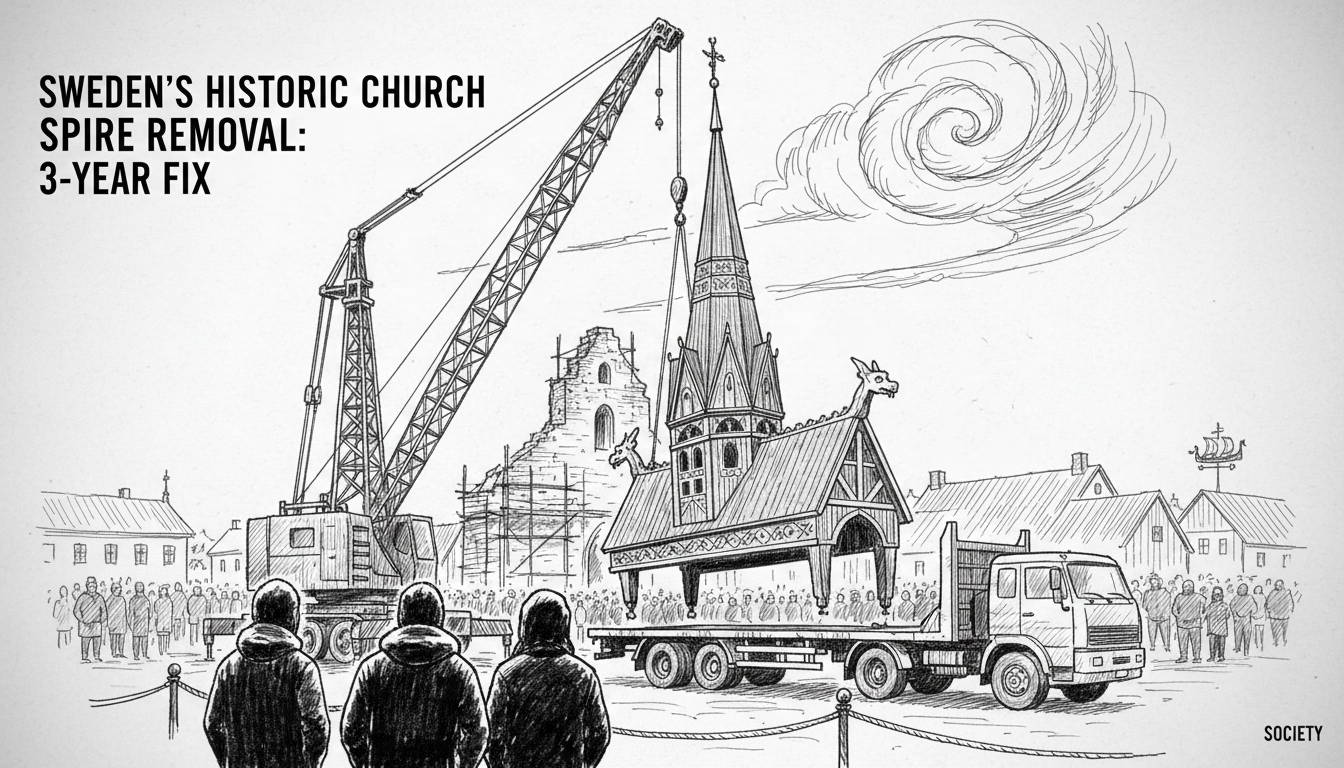
Sweden's Riddarholmen Church, one of Stockholm's oldest buildings, is losing its iconic spire for a three-year restoration project. The cast iron spire has dominated the island's skyline since 1846, but now it must come down. Workers from the National Property Board, Statens fastighetsverk (SFV), began the delicate operation yesterday. For the next 36 months, Stockholm's familiar silhouette will be missing a key feature. This is not just a construction job. It is a rescue mission for a piece of Swedish soul, built when knights and monks walked these shores.
A Monastery, a Tomb, a Landmark
Walking across the bridge to Riddarholmen feels like stepping into a quieter age. The church's grey stone walls have seen everything from medieval markets to royal funerals. Parts of Riddarholmskyrkan date back to the late 1200s. It began as a monastery for the Greyfriars order. After the Reformation, it transformed into the royal burial church. Kings like Gustavus Adolphus and Charles XII rest here. Regular religious services ended in the 19th century as its role solidified into a national monument and tourist site. Today, it is a museum of memory, open for visitors but silent during weekdays. Its spire, added in the mid-19th century, became a navigational point for boats on Lake Mälaren. Locals like bakery owner Lena K. in Gamla Stan say its absence will feel strange. 'I look for it when I cross the water,' she told me. 'It's our north star.'
The Hidden Dangers in the Iron
The restoration is driven by urgent, invisible threats. During recent inspections, experts discovered polychlorinated biphenyls (PCB) and asbestos within the spire's structure. SFV confirmed these findings in their official statements. Both materials were commonly used in construction last century for insulation and fireproofing. They are now known to be hazardous to human health. Their presence complicates every step of the project. 'This isn't a simple clean-up,' explained project manager Erik Lundström from SFV. 'We must carefully dismantle the spire to contain these materials. Worker safety and environmental protection are our top priorities.' The cast iron itself, while robust, has suffered from Stockholm's harsh climate. Salt winds from the Baltic and freeze-thaw cycles have caused corrosion. Without intervention, the structural integrity could fail. The problem is clear: age and outdated materials threaten to topple a historic treasure.
Dismantling a Skyline, Piece by Piece
The solution is a meticulous, three-year engineering ballet. The 42-meter-high spire will be dismantled entirely in sections. The brick tower beneath it and four smaller turret spires will also undergo restoration. Specialized crews will use cranes and scaffolding to lower each piece to the ground. On-site workshops will clean, repair, and treat the iron components. The hazardous materials will be sealed and removed according to strict Swedish environmental laws. Once the spire is off, the underlying stonework will be inspected and reinforced. The goal is to reassemble everything exactly as it was. 'We use historical drawings and photos from the 1840s,' Lundström said. 'This is about preservation, not modernization.' For Stockholm residents, the change will be visual. The spire's absence will open new views of City Hall and the Old Town. Photographers and artists are already planning to document the transformation. The project timeline means the spire should return to its perch by 2027, weather permitting.
Why This Church Matters to Experts
I spoke with Dr. Ingrid Sörensen, a historian specializing in Nordic architectural preservation. She emphasized the church's dual significance. 'Riddarholmskyrkan is a timeline in stone,' she said. 'Its architecture shows the shift from Gothic to Renaissance styles. The cast iron spire represents 19th-century industrial innovation. Preserving it maintains a physical connection to our engineering past.' She pointed out that royal burial churches are rare in Protestant Scandinavia. This makes Riddarholmen a unique cultural site. The restoration also highlights a national value. Swedes invest heavily in maintaining their heritage, even when it is costly and slow. SFV's budget for this project is not publicly disclosed, but such endeavors typically run into tens of millions of kronor. The work is funded by state resources, reflecting a collective commitment. 'It tells us what we choose to save,' Dr. Sörensen added. 'This church holds our kings, but also our identity.'
A Silent Island Waits
The restoration will affect the rhythm of Riddarholmen. The small island is mostly home to government buildings and courts. It is quieter than bustling Gamla Stan next door. Church visits will continue, but within a construction zone. Sound barriers and fencing will go up. Yet, this disruption is welcomed by many. 'It's better than losing it forever,' said local tour guide Mikael Berg. He leads history walks through the area. 'I can explain to tourists why the spire is gone. It becomes part of the story.' The project coincides with a growing interest in Swedish heritage. Museums across Stockholm report increased attendance. Events like the annual Historical Museum's medieval festival draw crowds eager to touch the past. This renovation fits that trend. It is a physical act of remembering. When the spire returns, it will be safer for another century. Future generations will see the same silhouette that has defined Stockholm since the industrial era. That continuity is precious in a fast-changing world.
The View from My Window
As a society reporter, I see stories in stones and spires. This project is more than construction news. It is about the choices a culture makes. Sweden could have sealed the hazardous materials and left the spire to decay. Instead, it chose a harder, longer path. That says something about Swedish values: patience, care, and respect for history. Walking back from Riddarholmen, I looked up. The spire still stood, but not for long. In three years, it will rise again, cleaned and strengthened. Until then, Stockholm will have a gap in its skyline. A gap that reminds us what we are working to keep. What will we preserve next?