
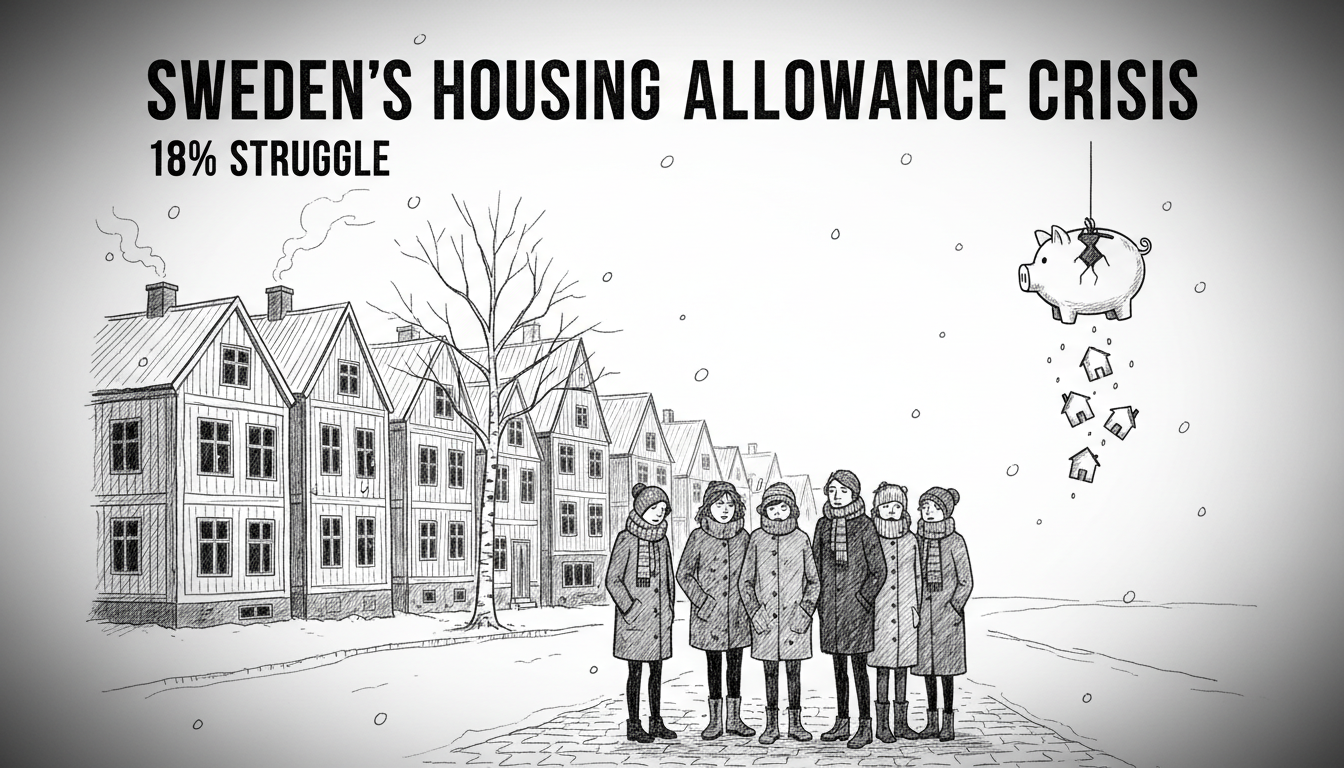
Sweden's housing allowance system is failing to keep pace with soaring rents, leaving nearly one in five households struggling. The Swedish Union of Tenants is now demanding urgent reform, arguing that the welfare state's promise of affordable housing is breaking down for its most vulnerable citizens. For renters, recent economic shifts have brought little relief, creating a stark divide between homeowners and tenants.
In a modest two-room apartment in Rinkeby, Stockholm, Fatima Hassan checks her bank account with a familiar sense of dread. Her bostadsbidrag, the crucial housing allowance, arrived days ago. Yet after paying her rent, there is almost nothing left for groceries this week. "The allowance covers maybe half of my rent now," she says, her voice tired. "Every month is a calculation. Do I pay the full rent and skip a meal, or do I pay less and risk a warning?" Her story is not unique. It echoes in neighborhoods from Rosengård in Malmö to Bergsjön in Gothenburg, where the gap between support and reality widens.
The Widening Gap Between Support and Reality
Bostadsbidrag is a cornerstone of the Swedish welfare model, administered by Försäkringskassan. It is designed as a safety net. However, the system has not adapted to the new economic landscape. While inflation has cooled and the Riksbank has lowered interest rates, providing relief to mortgage holders, the rental market tells a different story. Rents, particularly in the public and private rental sectors in cities, have continued to climb. For the approximately 18% of Swedish households that depend on this allowance, the calculation feels increasingly disconnected from their daily lives. The allowance is means-tested, factoring in income, housing costs, and children. But critics say the baseline amounts and ceilings have become outdated.
"The housing allowance has become the problem child of the Swedish welfare system," says a representative from Hyresgästföreningen. The union, representing millions of tenants, is pushing for an immediate increase. They argue that several tough years of high inflation have eroded the purchasing power of the benefit. With nearly 60% of apartments in multi-dwelling buildings being rental units, the issue affects a majority of urban Swedes. The pressure is not just on single individuals or students. It hits families hardest, where the cost of housing, combined with rising prices for food and electricity, creates an impossible squeeze.
A System Under Strain
Experts point to a structural tension within the system. "The housing allowance is caught between two goals," explains Lars Magnusson, a professor of economic history specializing in welfare systems. "One is to ensure no one is left without a roof. The other is to control public spending. In times of rapid cost increases, these goals clash." The debate often centers on adequacy versus incentive. Some policymakers worry that raising the allowance too much could reduce the motivation to seek higher income. Yet, for those receiving it, such theoretical debates feel abstract. Their reality is mathematical: income + allowance - rent = deficit.
This strain is visible in Sweden's municipal housing queues, which grow longer each year. It's felt in the rising number of applications for emergency social assistance from municipalities, often used to cover rent shortfalls. The situation risks creating a two-tiered society within cities. Those who own their homes benefit from lower interest rates and potential property value increases. Those who rent, particularly in the non-profit and private sectors, face a cost curve that outpaces their support.
The Human Cost in Stockholm's Suburbs
To understand the impact, you need to look beyond the statistics. In Tensta, another Stockholm suburb, community organizer Marcus Johansson sees the effects daily. "People are making choices we shouldn't see in Sweden," he states. "Choosing between a prescription medicine and the rent. Cutting back on heating so much that children are cold. The allowance is supposed to prevent this, but it's not working." He describes how local community centers have become informal support hubs, offering warm meals and advice on dealing with landlords and social services.
The cultural expectation of a secure, affordable home—a fundamental part of the Swedish social contract—is fraying. Traditions like fredagsmys (cozy Friday) or the importance of a personal, stable space for family life are compromised by financial stress. For new immigrants, the challenge is doubly hard. Navigating the complex application process for bostadsbidrag in a new language, while often starting with lower incomes, makes the housing allowance not just a benefit but a critical lifeline. Its inadequacy can stall integration and deepen social exclusion.
What Comes Next?
The call from Hyresgästföreningen places the issue squarely on the political agenda. The upcoming local and national budget discussions will be a key battleground. Potential solutions are complex. A simple across-the-board increase in the allowance is costly. Some experts suggest regional adjustments, reflecting the vast difference in rental costs between, say, Stockholm and Sundsvall. Others propose changing the calculation formula to better reflect current utility and living costs.
There is also the larger question of housing supply. The allowance addresses the symptom—high costs—but not the cause. Sweden has struggled for decades to build enough rental apartments, especially in growing cities. This shortage drives up prices and makes tenants more vulnerable. Any long-term solution must involve construction policy alongside welfare adjustments.
For now, people like Fatima Hassan wait. They patch together budgets, rely on family, and hope the system remembers them. The Swedish housing allowance was built on a promise of dignity and security for all. As the union's campaign highlights, that promise is now under severe pressure. The coming months will show whether Sweden can reform its safety net to catch those who are currently falling through. The outcome will define not just budgets, but the kind of society Sweden chooses to be. Will it uphold its renowned commitment to social welfare, or will a generation of renters be left behind?