
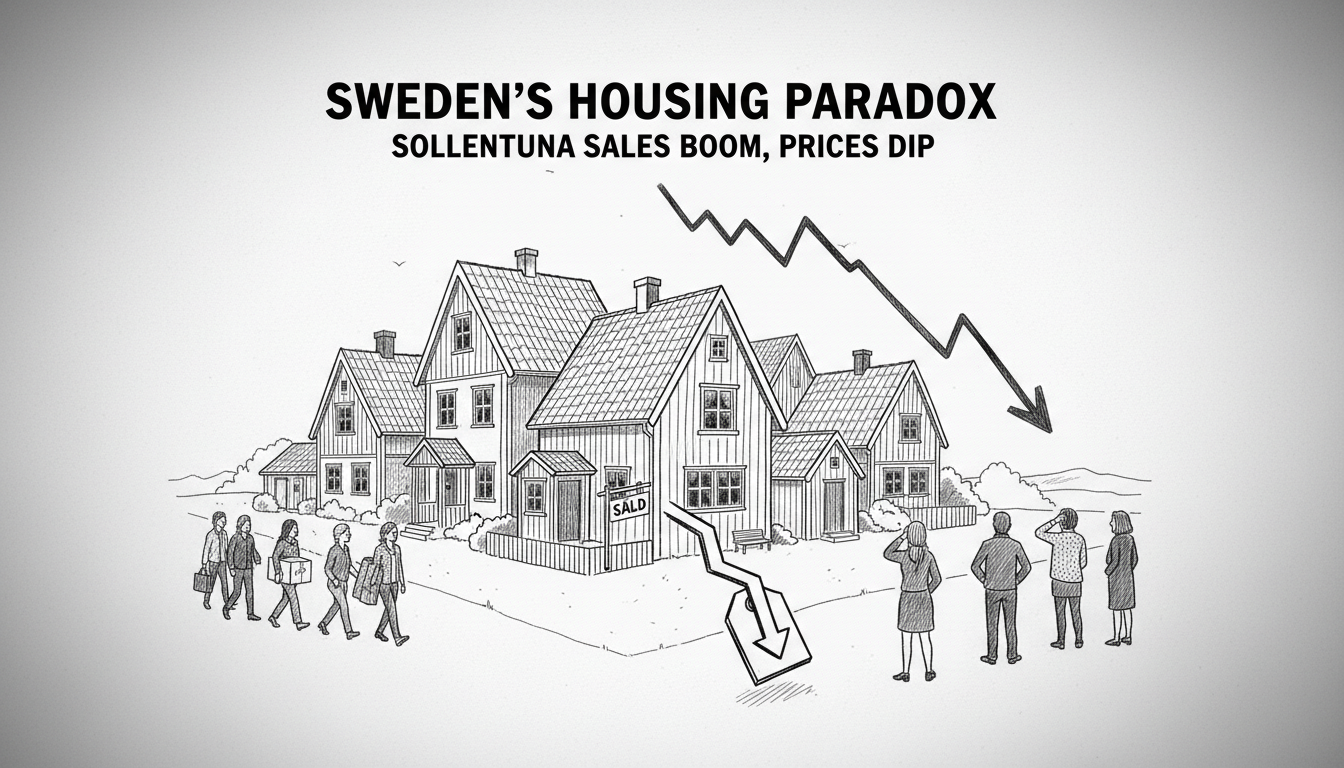
Sweden's real estate market is presenting a curious picture in Stockholm's northern suburbs. While national headlines often focus on soaring prices, the municipality of Sollentuna tells a different story for 2025. A significant number of homes changed hands, yet average prices for both villas and apartments dipped by 2 percent. This local anomaly offers a nuanced look at the forces shaping Swedish society trends and the Stockholm housing market.
I took the commuter train from Central Station to Rotebro, one of Sollentuna's main centers. The atmosphere was calm, a world away from the frenzied bidding wars often associated with the capital's property scene. At a café near the station, I met with real estate agent Elin Forsberg, who has worked the area for fifteen years. "It's been a busy year, but a sensible one," she said, stirring her coffee. "We sold many villas, 439 to be exact. That's high activity. But buyers were cautious, pragmatic. The days of automatic 10 percent annual increases are over, at least here for now."
A Market in Balance
The data from Svensk Mäklarstatistik is clear. Sollentuna saw 439 villa sales in 2025, a volume higher than almost any other year in the past decade. Yet the average villa price settled at 8.2 million Swedish kronor. For apartments, 937 units sold at an average price of 42,115 kronor per square meter. Both figures represent a 2 percent decrease. This creates a fascinating scenario: high demand meeting a new price reality. It suggests a market finding a sustainable equilibrium, rather than one in freefall or frenzy.
"People still want to live here," Forsberg explained. "We have good schools, forests like Edsbergsskogen, and a direct line to Stockholm. But their budgets are firmly dictated by mortgage rates. The calculus has changed." This sentiment was echoed by Lars Bengtsson, a housing market analyst. "Sollentuna is an interesting bellwether," he said in an interview. "It's a desirable, established suburb. When prices soften here despite strong sales, it signals a broader normalization. Affordability is the dominant driver, not speculation."
The Local Lifestyle Appeal
To understand Sollentuna's enduring appeal, you must look beyond the numbers. The municipality, a blend of residential areas like Häggvik, Helenelund, and Tureberg, offers a specific Swedish lifestyle. It provides suburban space and nature while maintaining excellent connectivity. For families, this balance is powerful. At the popular swimming spot by Norrviken lake, I spoke with Mikael and Johanna, who bought a villa in 2025. "We moved from a two-room apartment in Vasastan," Johanna said. "Here, our kids have a garden. We cycle to the lake. The price per square meter is completely different, even if the villa price felt like a big step."
Their experience highlights a key trend in Swedish society: a continued valuation of space and green areas, especially post-pandemic. This sustains demand in municipalities like Sollentuna, even when financial conditions tighten. The local culture, with its community associations and seasonal events like the Sollentuna Festival, adds intangible value that statistics cannot capture.
The Broader Stockholm Context
How does Sollentuna's 2 percent dip compare to the wider Stockholm region? While comprehensive 2025 data for all municipalities is still being compiled, analysts suggest the trend is mixed. Some inner-city districts may see stagnation or slight gains, while other suburbs mirror Sollentuna's adjustment. "The market is fragmenting," analyst Lars Bengtsson noted. "Uniform, rapid price growth across the board is gone. Now, it's about specific streets, property types, and local amenities. Sollentuna's high sales volume indicates it's still a hotspot, but buyers have regained some negotiating power."
This fragmentation reflects a healthier, more mature market. It moves away from a fear-of-missing-out driven bubble and towards transactions based on actual need and long-term financial planning. For the Swedish economy, a stable housing market is crucial, as it affects consumer confidence and spending.
The Interest Rate Shadow
No discussion of Swedish real estate is complete without addressing the Riksbank. The central bank's interest rate decisions cast a long shadow over every housing transaction. While rates have stabilized from their peak, they remain significantly higher than the near-zero levels of the past decade. This directly impacts mortgage costs, setting a firm ceiling on what most families can borrow, and therefore, pay for a home.
"The interest rate is the invisible hand in every viewing," said agent Elin Forsberg. "Buyers come pre-approved with a strict budget. They are not stretching like before. That discipline puts downward pressure on prices, even when many people are looking." This financial pragmatism is a defining feature of the current market phase. It suggests that future price movements in Sollentuna and similar areas will be closely tied to monetary policy, not just sentiment.
What This Means for Buyers and Sellers
For potential buyers, Sollentuna's 2025 data could be encouraging. The combination of solid choice and softened prices creates opportunity. The high sales volume means the market is liquid; properties are moving, but without the intense pressure that leads to drastic overbidding. For sellers, the narrative requires nuance. While they may not achieve the record prices of a few years prior, the strong sales volume means well-presented, reasonably priced homes will find buyers efficiently.
The apartment market, with its 2 percent per-square-meter price decrease, tells a similar story. It reflects a calibration in a segment popular with first-time buyers and investors. The premium for a square meter in a Sollentuna apartment block is being rationally assessed against commuting times, building quality, and monthly fees.
Looking Beyond the Numbers
Spending a day in Sollentuna reveals the human stories behind the statistics. At the Turebergs centrum shopping area, the buzz of everyday life continues, largely unaffected by minor percentage shifts in housing data. The true value of a place is built over years, through community, memories, and quality of life. The market data for 2025 suggests that in Sollentuna, this intrinsic value is being traded actively, but at a price that reflects a new economic reality.
As the Swedish housing market continues its slow recalibration, suburbs like Sollentuna serve as crucial indicators. They show that demand for a balanced, family-friendly lifestyle near Stockholm remains resilient. Yet, they also demonstrate that this demand now operates within stricter financial boundaries. The result is a market that is active, but not overheated; adjusting, but not alarming. In the long run, this may be the foundation for a more stable and accessible housing sector for all. The key question for 2026 is whether this new balance can hold, or if external economic forces will tip the scales once more.