
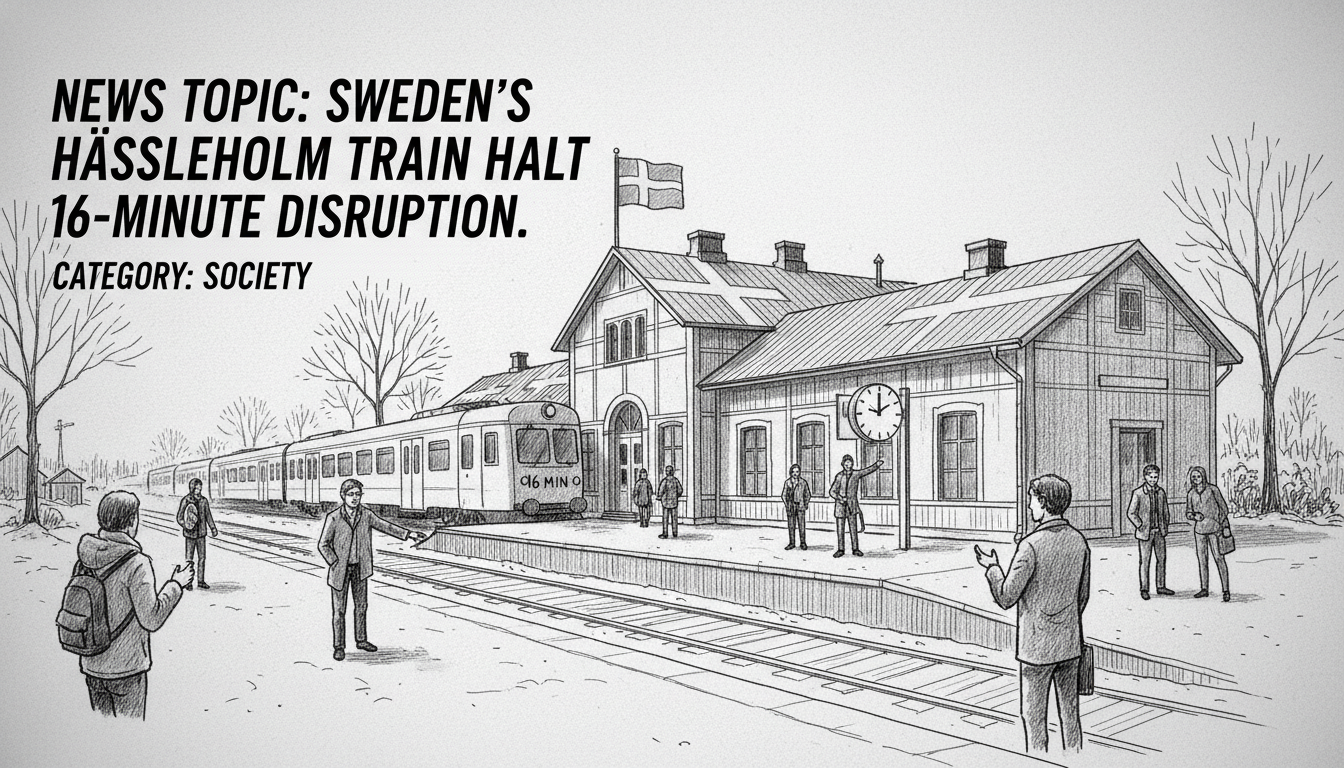
Sweden train delays rippled from Hässleholm on Monday after a 16-minute shutdown. The crucial rail hub came to a standstill at 1:17 PM when unauthorized individuals were detected on the track area. For the hundreds of passengers on trains bound for Malmö, Copenhagen, and Stockholm, their travel was abruptly frozen.
Skånetrafiken, the region's transport authority, confirmed trains began rolling again at 1:33 PM. They warned of potential knock-on delays and cancellations throughout the afternoon. This brief incident highlights the fragility of modern rail networks.
The Commuter's Standstill
Imagine sitting on the 12:45 service from Stockholm to Malmö. The Swedish countryside blurs past until, near Hässleholm, everything stops. There's no announcement at first. You check your phone. Your well-planned connection in Malmö to catch the Öresund train to Copenhagen is now in doubt. This was the reality for many. 'It's frustrating, of course,' said Erik Lund, a frequent business traveler reached by phone. 'But what can you do? Safety first, I suppose. I'll just be late for my meeting.'
His sentiment is common across Swedish society. There's a cultural acceptance of these safety-driven pauses, even as they disrupt the prized efficiency of Swedish public transport. Hässleholm station, often just a brief stop on a longer trip, became an unintended focal point. In the station's cafe, stranded passengers refilled coffee cups. They waited for updates on the large digital departure boards.
Why a Small Town Holds Big Power
Hässleholm's role is disproportionate to its size. It sits astride the Southern Main Line, the 'Södra stambanan'. This line is the backbone of Sweden's south-north rail traffic. Think of it as a central knot in the national network. A pull here tightens and strains lines across Skåne and beyond. Trains from Copenhagen crossing the iconic Øresund Bridge rely on this corridor. So do regional services connecting Lund's university students and Helsingborg's port workers.
'Even a short stoppage creates a scheduling domino effect,' explains a rail logistics consultant who requested anonymity due to client agreements. 'A train held for 16 minutes misses its allocated slot. This can force it to wait for other trains to pass. The delays then multiply down the line, sometimes for hours.' This is the hidden cost of the 1:17 PM stop. The immediate problem was solved quickly, but the recovery takes time.
Safety Protocol: The Non-Negotiable Rule
The reason for the halt is a standard and serious one in Sweden: 'obehöriga på spårområdet' – unauthorized persons on the track area. Swedish Transport Administration regulations are absolute on this. If a driver, sensor, or camera detects a person where they should not be, the immediate response is to stop all traffic. This protocol prioritizes human life above punctuality every single time.
It is a frequent cause of disruption in Sweden, especially in urban areas. The individuals involved in Hässleholm were reportedly escorted off the tracks by security or police without further incident. The motivation – whether trespass, distraction, or something else – is often not publicly disclosed. The outcome, however, is measured in delayed journeys and logistical headaches for Skånetrafiken's controllers.
The Ripple Effect Across Skåne
While national long-distance services faced delays, the impact was felt most keenly on local Skånetrafiken routes. Commuters trying to get home to towns like Kristianstad or Ängelholm faced uncertainty. The authority's app and website flashed yellow and red warnings. Their contingency plans swung into action. These include using replacement buses on parallel routes and reassigning train units to cover critical departures.
For the average Swede, this is a familiar inconvenience. It feeds into ongoing public debates about investment in rail infrastructure and maintenance. Are the networks robust enough? Can technology, like improved fencing or surveillance, reduce these intrusions? The incident provides a small case study. It shows how a single, localized safety event can test the system's resilience.
Looking Ahead: A Culture of Patience and Punctuality
Swedish society holds a unique tension between a deep respect for safety rules and an equally deep appreciation for timeliness. The 'tågstopp' in Hässleholm briefly forced that conflict into the open. Passengers sighed, recalibrated their plans, and moved on. There was no visible anger, just a quiet resolve. This reflects a broader societal trait: a trust in systems and rules, even when they momentarily inconvenience you.
The incident is now a data point. It will be logged by Skånetrafiken alongside countless others. It will inform planning and, perhaps, future investments in securing rail corridors. For the people on those stalled trains, it became a story for the dinner table. A minor saga of a Monday commute. Yet, it underscores a universal truth of modern life. Our interconnected journeys depend on the security and stability of every single point along the line. When one knot tightens in Hässleholm, the whole network feels the pull.
The next time you board a train in Sweden, you'll experience the renowned efficiency. But you'll also now understand the invisible safety net that can bring it all to a brief, necessary halt. It's the price of a system that values your safe arrival above all else.