
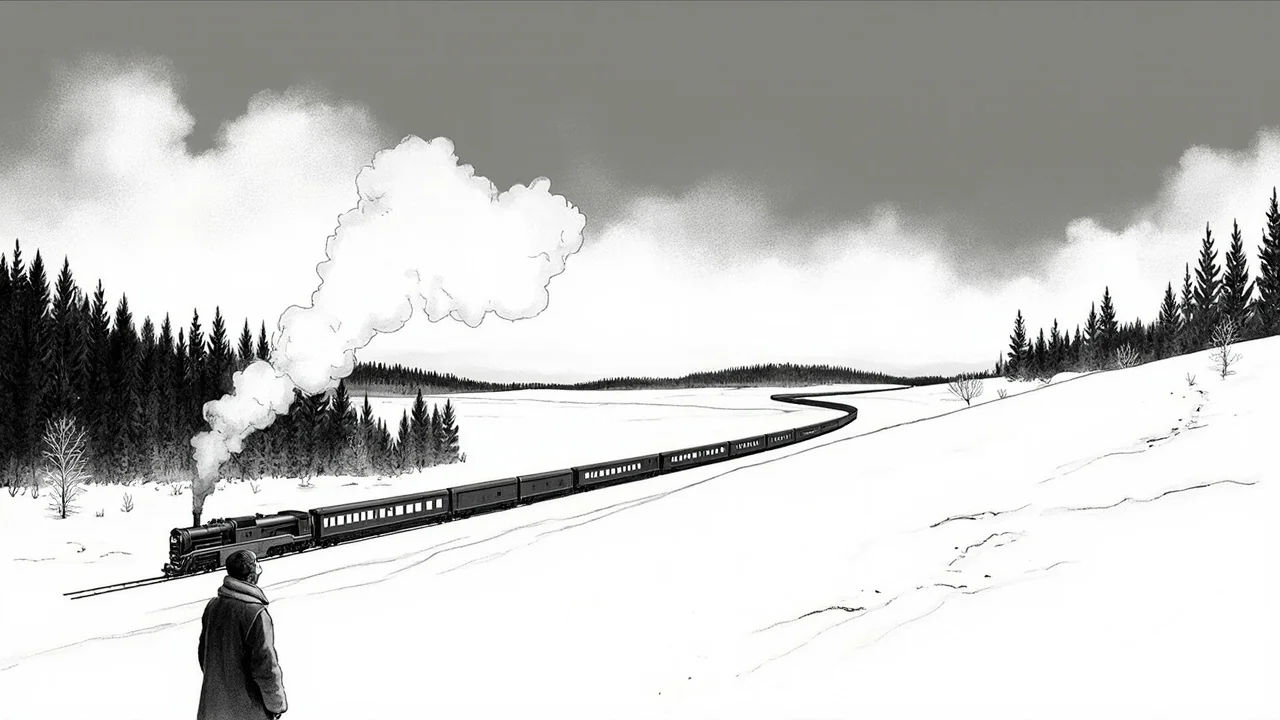
Sweden's state-owned railway operator SJ faces a significant logistical challenge with the historic Inlandsbanan line. The company's director for commercial traffic, Sofie Struwe, has stated that utilizing the inland railway as a diversion during disruptions on main lines is more difficult than it appears. This revelation comes amid ongoing discussions about Sweden's rail resilience and the future of its lesser-used tracks.
"No, we have such large volumes of traffic that it would have been impossible," Struwe said, addressing the idea of using Inlandsbanan more extensively. She pointed to a core issue: a lack of the specialized heating carriages required to run long passenger trains on non-electrified lines like the Inlandsbanan. While the inland railway has some of these carriages, SJ's needs are too great. "Snälltåget already has an established cooperation with Inlandsbanan, but it would have taken time for us," she added, referencing a private competitor.
The Inland Railway's Isolated Potential
Inlandsbanan, or the Inland Line, is a 1,300-kilometer track running through the sparsely populated heart of Sweden, from Kristinehamn in the south to Gällivare above the Arctic Circle. It is a single-track, non-electrified railway famed for its scenic beauty and slow travel. For many, it represents a nostalgic piece of Swedish industrial and cultural heritage, often associated with summer tourism and local transport in remote regions.
Struwe acknowledged this potential, highlighting a geographical advantage. "It is obvious that it would have been desirable if we had an extra line that we could use in situations like these," she stated. She specifically noted the railway's "protected location inland" as a theoretical benefit. In a country where the primary coastal rail arteries can be crippled by extreme weather, technical faults, or construction, a parallel inland route could offer a valuable alternative. Yet, the gap between theory and practice is wide.
The Technical Hurdles of a Heritage Line
The central problem is infrastructure. Mainline SJ trains are electric and designed for high-capacity, high-speed travel on modernized tracks. Inlandsbanan runs on diesel and requires those separate heating carriages to supply warm water and electricity to carriages when the locomotive is disconnected—a common necessity on a single-track line with passing loops. Acquiring and integrating a sufficient fleet of these carriages for SJ's massive operations is not a feasible quick fix.
This situation exposes a deeper tension in Swedish transport policy. There is constant public debate about maintaining a robust, climate-smart national rail network. When the main western or eastern lines fail, passenger frustration boils over. The idea of using Inlandsbanan as a backup naturally arises in the public discourse. Struwe's comments, however, pour cold water on this as a simple solution. It underscores a reality: Sweden's rail network is not a seamlessly interconnected web. It is a system of arteries and capillaries, with significant technical and operational barriers between them.
A Cultural Icon Versus Modern Demand
This story is not just about logistics; it's about the place of heritage infrastructure in a modern society. For communities along Inlandsbanan, the railway is a lifeline and a point of pride. Towns like Mora, Östersund, and Arvidsjaur have their identities intertwined with the track. The railway supports tourism, connecting visitors to the forests, lakes, and Sami culture of inland Sweden. There is a strong cultural desire to see it valued and utilized more.
Yet, the commercial logic of SJ, tasked with moving millions of passengers efficiently on trunk routes, runs counter to this. The time, cost, and operational complexity of rerouting a major intercity service onto a slow, single-track heritage line are prohibitive. The experience for passengers—a potentially multi-day scenic detour instead of a few hours on a high-speed train—would be utterly different. It raises a provocative question: Can a railway serve simultaneously as a cultural preservation project, a local transport service, and a national emergency backup? The Swedish case suggests it is incredibly challenging.
Looking Ahead: Integration or Specialization?
The comments from SJ's leadership signal a need for a clearer national conversation. Should significant investment be made to better integrate Inlandsbanan into the national network, perhaps through partial electrification or strategic upgrades? Or should its role be formally specialized as a tourist and local line, with separate, realistic expectations set for its use during national crises?
Private operator Snälltåget's existing cooperation with Inlandsbanan shows alternative models are possible for specific services. But scaling this to the level needed for mass diversions from SJ's network is another matter entirely. The situation also highlights the vulnerability of centralized systems. Sweden's reliance on a few key rail corridors is a strategic risk, as recent years of weather-related cancellations have shown.
The Human Cost of Rail Disruption
Behind the technical talk of heating carriages and traffic volumes are real people. A student trying to get from Stockholm to Umeå for an exam, a family heading to a wedding in Göteborg, a business traveler with critical meetings—all are left stranded when the main line fails. The public's yearning for a backup route like Inlandsbanan is a yearning for reliability and resilience. It is a demand that the system should have a Plan B.
SJ's frank assessment that Inlandsbanan is not a viable Plan B under current conditions is therefore socially significant. It directs attention back to policymakers and infrastructure owners. If the inland railway cannot play this role, what will? Does Sweden need to invest more in its primary corridors to make them less prone to failure, or does it need to develop a genuinely alternative route? The answer will shape travel, regional development, and national connectivity for decades.
The story of Inlandsbanan and SJ is a microcosm of a larger Swedish, and indeed Nordic, dilemma: balancing efficiency with redundancy, modern needs with historical legacy, and central hubs with peripheral regions. The tracks run through some of Sweden's most breathtaking landscapes, but the path forward for this piece of living history remains uncertain. Its protected inland location offers geographical promise, but without the technical and operational means to connect it to the modern network, that promise may remain just that—a scenic detour not taken in times of crisis.