
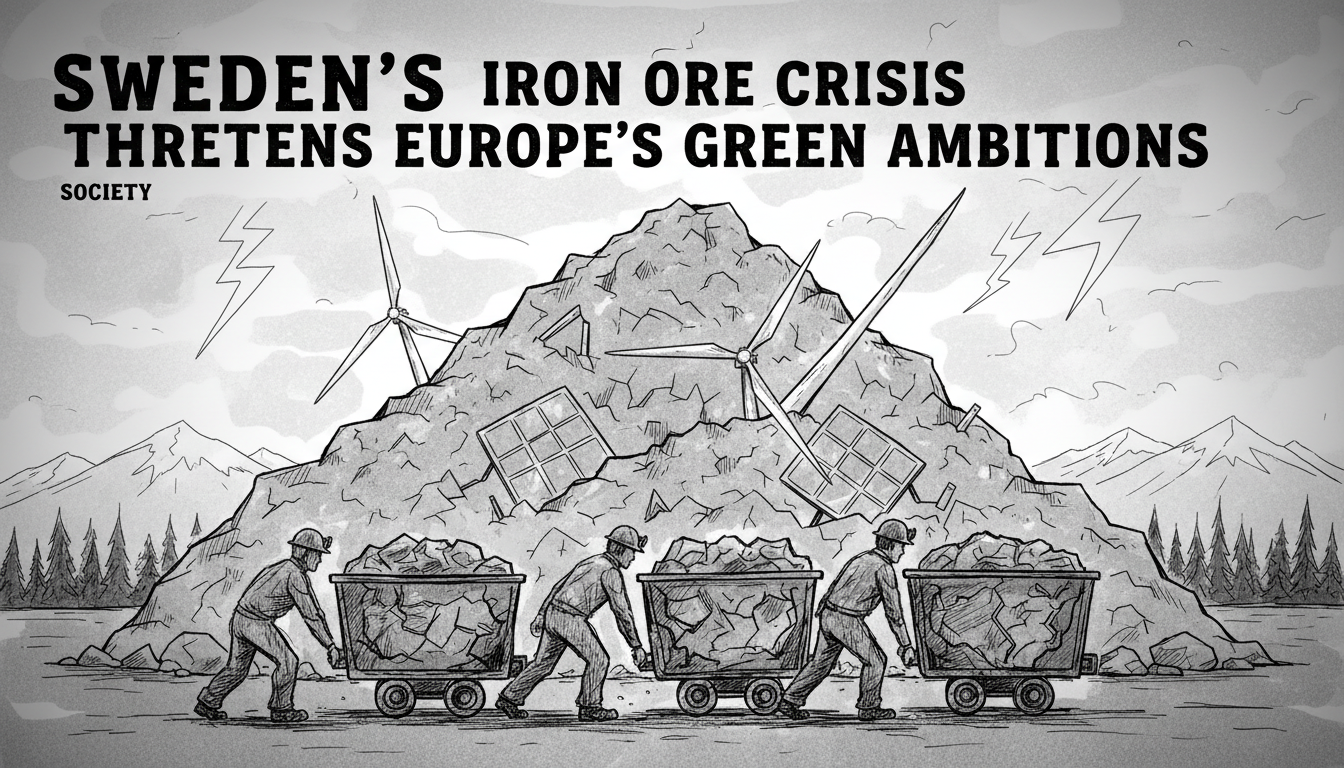
Sweden’s state-owned mining giant LKAB has issued a stark warning that could reverberate across the continent. The Kiruna mine, a cornerstone of the European Union’s industrial strategy, faces potential closure due to a deteriorating railway line. This critical piece of infrastructure, the 500-kilometer Malmbanan, is the sole lifeline for transporting millions of tonnes of iron ore from the Arctic Circle to global markets. "Without urgent, massive investment in the railway, the long-term operations in Kiruna are threatened," a senior LKAB official said in a statement. The situation presents a profound paradox for European policymakers championing a self-sufficient green future while allowing a key strategic asset to crumble.
A Strategic Linchpin in the Arctic
The Kiruna mine is not just another industrial site. It is the largest underground iron ore mine in the world, producing approximately 26 million tonnes annually. LKAB extracts over 80% of all iron ore within the European Union from this single location. This resource is fundamental for manufacturing the steel required for wind turbines, electric vehicles, and clean energy infrastructure. Europe’s ambitious green transition, aimed at reducing reliance on external suppliers, is physically dependent on the ore hauled from Kiruna’s depths. The mine’s output represents a significant pillar of Sweden’s export economy and regional employment in Norrbotten County.
The Precarious 500-Kilometer Lifeline
That iron ore travels a precarious route. The Malmbanan railway, meaning "the Ore Line," is a single-track artery running from Kiruna to the ice-free port of Narvik in Norway and to Luleå in Sweden. It is one of the heaviest freight lines in the world, operating under extreme Arctic conditions. Decades of heavy use and underinvestment have left it vulnerable. The track’s condition imposes severe speed and weight restrictions, creating a bottleneck that limits capacity and increases operational costs. For LKAB, which relies on just-in-time deliveries to its customers, any significant disruption or further degradation could halt production entirely. This is not a hypothetical risk but a direct threat to the mine’s economic viability.
Economic Ripples and Local Anguish
The potential fallout extends far beyond corporate balance sheets. The town of Kiruna, with a population of around 23,000, is literally built around the mine. The community has already undergone a massive, ongoing physical relocation because of subsidence from mining activities. The threat to the mine’s future introduces a new layer of profound uncertainty. Local businesses, municipal services, and thousands of families depend directly and indirectly on LKAB’s operations. "This isn't just about trains and tracks," said a community representative from Kiruna. "It's about the survival of our entire region. The state needs to see this as a national security issue, not just a transport budget line." The social contract that has sustained Sweden's far north for over a century is under strain.
A European Dilemma of Self-Sufficiency
This crisis highlights a critical vulnerability in the EU’s strategy for critical raw materials. Brussels has repeatedly stressed the need to secure domestic supply chains to power the green and digital transitions. The Kiruna mine is a textbook example of a strategic, internal asset. Yet, the infrastructure enabling its operation falls under national jurisdiction and requires national investment. Experts point to a glaring disconnect between high-level EU policy goals and the granular, costly reality of maintaining foundational infrastructure. "The EU wants green steel, but green steel starts with iron ore," noted a Brussels-based analyst specializing in industrial policy. "If the railway fails, it exposes the fragility of our supply chain logic. You can have all the strategic plans in the world, but they collapse without functional rails and ports."
The financial responsibility is a central point of contention. The Swedish state, through the Swedish Transport Administration, owns the Malmbanan. LKAB is its biggest customer, paying substantial fees for its use. The company argues these fees should fund necessary upgrades, but the state agency must balance railway investments across the entire country. The estimated cost for the comprehensive modernization required is in the billions of euros. This standoff reflects a broader Scandinavian challenge of financing monumental infrastructure in sparsely populated regions where the economic rationale is national or continental, not local.
The Path Forward: Investment or Inertia?
Solutions are complex and expensive. They involve building new passing loops to increase capacity, replacing aging rails and sleepers, and reinforcing bridges to handle heavier loads. A full duplication of the track, while ideal, is likely cost-prohibitive. The immediate demand from LKAB and regional politicians is for the Swedish government to prioritize the Malmbanan in its national infrastructure plan and commit to a clear, funded timeline for upgrades. There are also calls for the European Commission to classify the corridor as a Trans-European Transport Network (TEN-T) priority, which could unlock EU co-funding and political attention.
The coming months will be decisive. LKAB’s warning serves as a final alarm. Will Sweden and the EU recognize the strategic imperative and mobilize resources, or will short-term budget constraints jeopardize a long-term industrial vision? The outcome will test Europe’s commitment to its own green ambitions. It will reveal whether political declarations about strategic autonomy can withstand the harsh reality of maintaining a frozen railway in the Arctic. The iron ore vital for building a sustainable future remains trapped, waiting for a sign that the way forward is being secured.