
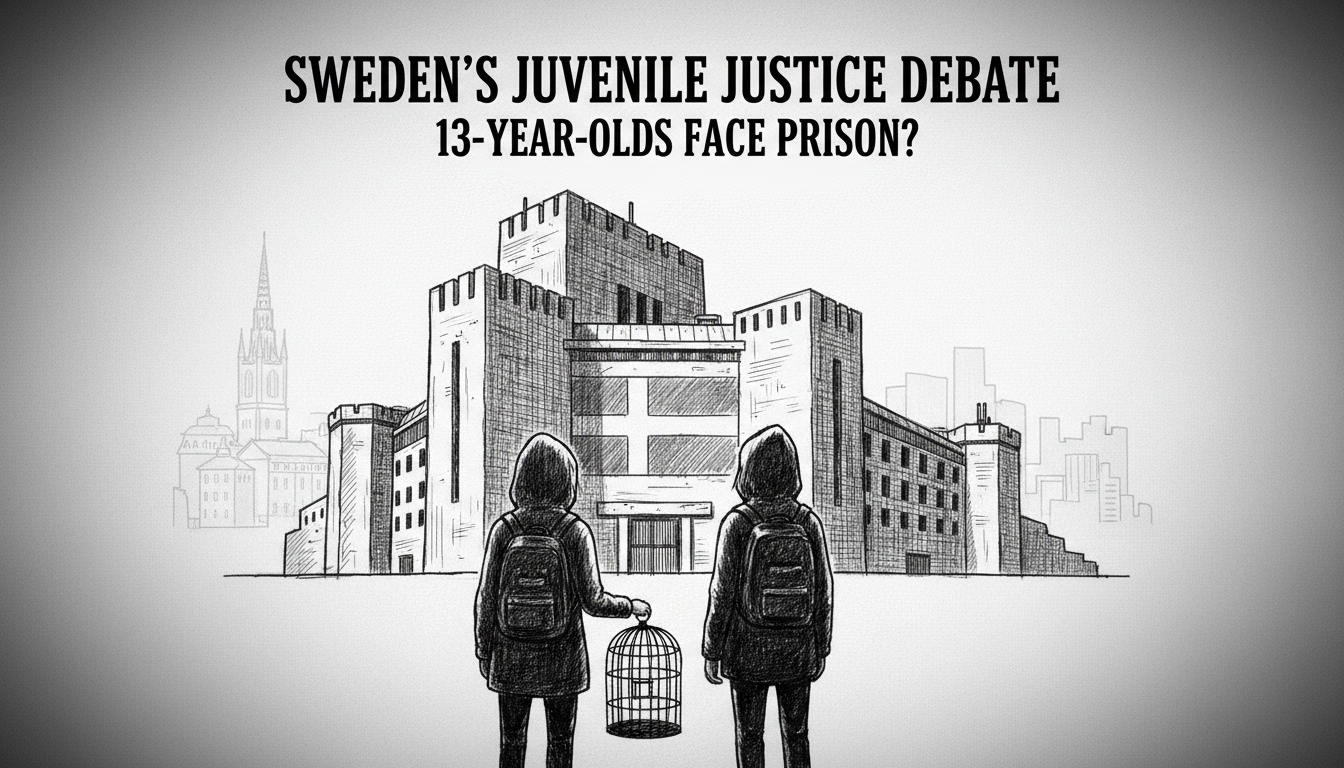
Sweden's government is pushing to lower the age of criminal responsibility to 13 years old, a proposal that has ignited fierce national debate. The policy, a cornerstone of the governing Tidö Agreement, aims to combat a sharp rise in youth gang violence. This move directly challenges Sweden's long-standing welfare-focused approach to juvenile offenders.
Justice Minister Gunnar Strömmer recently defended the plan at a press conference outside the Riksdag building. "Sweden was not a country where 13-, 14-, 15-year-olds shoot people dead," Strömmer stated. "But we are such a country now. We must adapt to that reality." His comments reflect a significant shift in the political narrative surrounding youth crime.
Prime Minister Ulf Kristersson echoed this stance, arguing for new legal tools. "Ordinary 13-year-olds must be protected from dangerous 13-year-olds," Kristersson told reporters. "We must be able to intervene with measures beyond social services and SiS homes, which we know have not worked." The government's position sets the stage for a major legislative battle.
A Stark Reality Inside Stockholm's Prisons
The debate is grounded in grim statistics and frontline experiences. The number of crime suspicions involving children under 15 has doubled over the past decade. Today, four out of ten perpetrators of completed violent crimes are under 18 years old. The most significant increases are among the youngest offenders.
Inside Stockholm's high-security Kronoberg detention center, chaplains witness this reality daily. Häktespastor Markus Landgren describes the young detainees as traumatized. "They live as if in a game where a war is constantly raging," Landgren explains. "Violence is always present for them." He notes the number of youths needing support far exceeds available resources.
Imam Ibrahim Ismail, Landgren's colleague, shares this perspective. The two religious leaders work together to provide solace. "We help each other," Ismail says. "It usually doesn't matter if the inmates speak to a priest or an imam. We are not there to make anyone change religion." Their primary message to the children is one of safety and connection.
Unlikely Support and Widespread Opposition
In a surprising twist, the government's controversial plan has found support from these frontline spiritual workers. Both Landgren and Ismail, who witness the consequences of youth violence firsthand, see a need for stronger intervention. Their backing provides the Tidö parties with a powerful, human-interest argument.
However, opposition from official referral bodies remains overwhelming. The Council on Legislation (Lagrådet) and numerous other expert agencies have submitted critical reviews. They highlight potential conflicts with the UN Convention on the Rights of the Child and question the proposal's effectiveness. Many experts argue it could hinder rehabilitation.
Criminologists and child psychologists warn that incarcerating young teenagers may deepen criminal identities. They advocate for enhanced social and psychological interventions instead. The Swedish National Council for Crime Prevention (Brå) has historically emphasized prevention and early support over punitive measures for minors.
The Legal and Social Crossroads
Sweden's current system treats offenders under 15 as children in need of care, not criminal punishment. The Social Services Act governs their handling, focusing on support and intervention. Placement in special residential homes (SiS-hem) is a common measure, though its effectiveness is now widely questioned by the government.
Lowering the age to 13 would mark a profound philosophical shift. It would move Sweden closer to models in some other European nations but away from its Nordic neighbors. The proposal requires navigating complex legal frameworks, including juvenile justice principles and international conventions.
The political calculus is clear for the Moderate Party, Christian Democrats, Liberals, and Sweden Democrats. They view this as a necessary response to public concern over gang recruitment of children. The tragic shooting of a 21-year-old in Malmö last December, allegedly by a 12-year-old, intensified the pressure for action.
Analyzing the Path Forward
The Riksdag will face a defining vote later this year. Passage is not guaranteed, despite the government's majority. Internal dissent could emerge, particularly regarding the proposal's alignment with Sweden's international human rights commitments. The legislative process will involve detailed committee scrutiny.
From my perspective, this debate represents more than a policy adjustment. It is a struggle over Sweden's self-image and its response to social fragmentation. The government frames the issue as a pragmatic adaptation to a violent new reality. Opponents see it as an abandonment of proven welfare-state principles.
Effective policy likely lies in a nuanced middle ground. It could involve targeted judicial powers for the most severe cases, coupled with a massive investment in prevention. Strengthening social services, youth programs, and family support must accompany any legal change. A purely punitive approach risks exacerbating the cycles of violence it seeks to end.
The coming months will reveal whether Swedish politics can craft a solution that both protects society and upholds its commitment to child welfare. The outcome will resonate through Stockholm's government districts and shape the nation's justice system for a generation.