
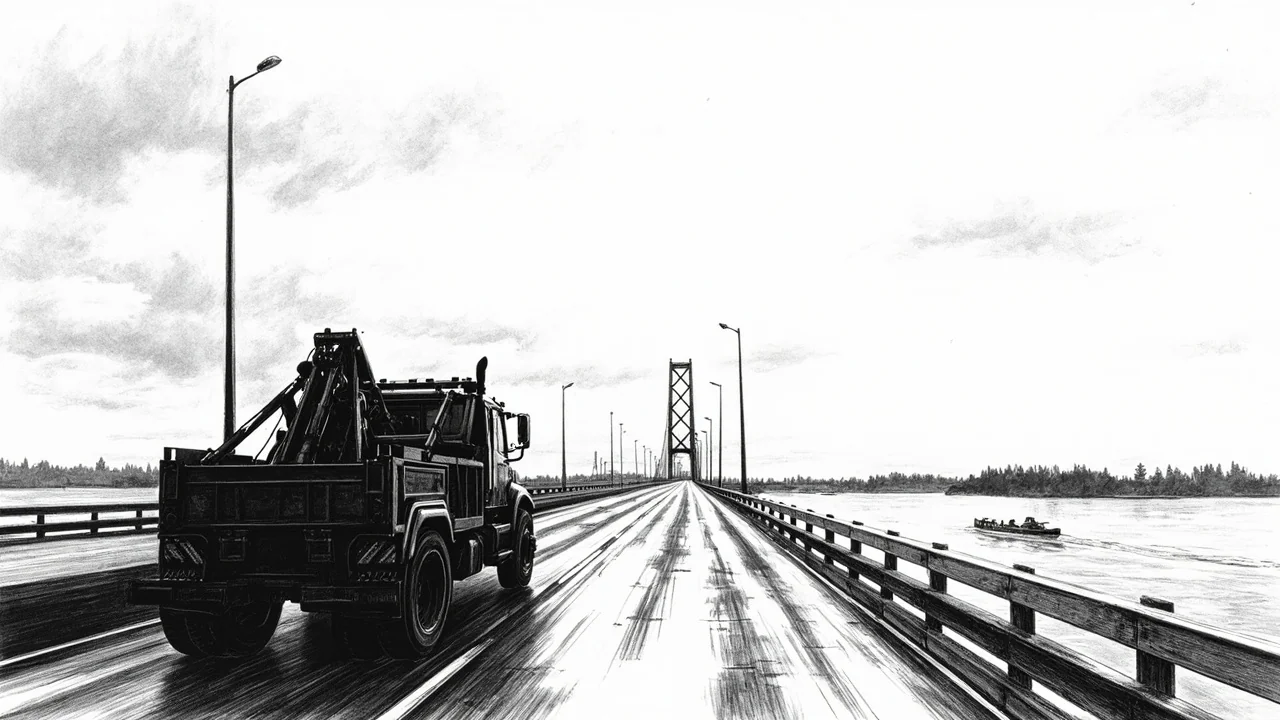
Sweden's iconic Öland Bridge is facing a new kind of gridlock. When an accident stops traffic on the 6-kilometer link between the mainland and the island of Öland, the only road connection is severed. Local politicians now say recovery is often delayed because insurance companies must first contact the "right" tow truck operator before a vehicle can be moved. This bureaucratic bottleneck on a vital national artery highlights a growing tension between private contracts and public safety across Swedish society.
In a formal letter to the South Police Region and the Southeast Rescue Service, municipal councilors Ilko Corkovic (S) in Borgholm and Michael Granstedt (S) in Mörbylånga demand change. They argue insurance processes must take a back seat. Police and rescue services should prioritize keeping traffic flowing by using the nearest available recovery vehicle.
"Not least because there is only one lifeline between the mainland and us," says Ilko Corkovic. His words carry the weight of an entire island community's frustration. For the 25,000 permanent residents of Öland, and the hundreds of thousands of summer tourists, the bridge is everything. It carries commuters, ambulances, groceries, and the island's economic lifeblood.
A Lifeline Paralyzed by Paperwork
The issue isn't about minor fender-benders. It's about major incidents that completely block one of Sweden's busiest summer routes. The current system, governed by public procurement contracts between police regions and specific towing companies, means that after a crash, officials must wait for that specific contractor to arrive. If they are coming from far away, or are busy with another job, traffic stands still. Meanwhile, other local tow trucks might be minutes away, unable to act due to contractual red tape.
Fredrik Westerholm, local police area chief in Kalmar, confirms the bind. He states police are bound by the Public Procurement Act. However, he notes that in crisis situations, they can deviate from the agreements and use any available recovery operator. The core of the politicians' argument is this: a total bridge blockage is a permanent crisis situation for an island. It should be treated as such from the first moment, not after a lengthy assessment.
The Swedish Contract Society Meets Geography
This standoff on the Öland Bridge is a microcosm of a larger Swedish trend. It's where the nation's deep trust in systems, rules, and orderly contracts collides with unforgiving geography and practical reality. Sweden excels at creating fair, transparent procurement systems. But on a narrow bridge in the Baltic Sea, efficiency can sometimes trump perfect procedural adherence.
"It's about common sense," a local café owner in Färjestaden, the town at the bridge's foot, told me. "In summer, a closed bridge means my deliveries don't come, my staff can't get to work, and tourists turn around. It's an economic heart attack. Waiting an extra hour for a truck from the 'correct' list doesn't make sense when someone nearby could clear the road in twenty minutes."
This sentiment echoes in other isolated Swedish communities. While not islands, towns in the far north or in dense forest areas face similar vulnerabilities with key road links. The Öland case brings a stark, physical clarity to a problem often buried in administrative documents.
Safety, Economy, and Summer Chaos
The consequences of delay are multi-layered. First, there is emergency response. An blocked bridge could delay an ambulance reaching the mainland hospital in Kalmar, or prevent critical medical personnel from reaching the island. Second, the economic impact is severe. Öland's economy is heavily dependent on tourism and agriculture. Perishable goods from the island's famous farms need reliable transport.
Finally, there's the sheer chaos and safety risk of stranded vehicles. In summer, queues can back up for kilometers in the sun, with families, elderly travelers, and pets trapped in their cars. This creates its own secondary risks of overheating vehicles and medical emergencies within the traffic jam.
The politicians' proposal is straightforward. They want a permanent policy shift for the Öland Bridge. In any incident that fully blocks traffic, the nearest available recovery resource should be deployed immediately. The insurance and contractual paperwork can be sorted out afterward. They advocate for a "safety first, paperwork second" protocol for this unique infrastructure.
A Test Case for National Policy?
The response from police authorities will be telling. It will test the flexibility of the Swedish administrative state. Can a locally-defined geographic crisis trigger a blanket exception to national procurement rules? The police have the theoretical ability to act in a crisis, but the councilors want that crisis definition applied proactively and automatically for the bridge.
This isn't just a regional traffic story. It's about how Sweden manages its vulnerable points in an era of increasing traffic and climate-related disruptions. Should other singularly critical infrastructure links—like the bridge to Tjörn or key mountain passes—have similar tailored response plans? The Öland councilors are arguing for a principle of geographic exceptionalism.
Expert perspective in public administration suggests this is a growing debate. "The Public Procurement Act is designed for fairness and cost-effectiveness in normal situations," says a Stockholm-based policy analyst who wished to remain anonymous. "Its weakness appears in acute, localized scenarios where time is the critical factor, not cost. The Öland Bridge is a perfect example. The law likely allows for this emergency action, but it requires clear local protocols and the courage to use them."
Looking Beyond the Baltic
As I write this from Stockholm, the problem feels both distant and intensely Swedish. It combines our love for rules with our profound connection to nature and isolated places. The image of a stalled car on a long bridge, with the Baltic Sea on both sides, is a powerful one. It represents a system in momentary failure.
The solution proposed by Corkovic and Granstedt is pragmatic. It prioritizes the collective good of a stranded community over rigid contractual adherence. In the Swedish social democratic tradition, where the welfare of the many is a core value, their argument has strong cultural resonance. It asks: what is the true cost of waiting? Not just in kronor, but in safety, well-being, and public trust?
The coming summer season will be the next test. All eyes will be on that 6-kilometer stretch of concrete and steel. Will the authorities adjust the protocol, or will another major stoppage cause hours of gridlock? The answer will reveal much about Sweden's ability to adapt its impressive systems when those systems meet the real world. For the people of Öland, it's a question that defines their daily connection to the rest of the country. Their lifeline deserves a smarter safety net.