
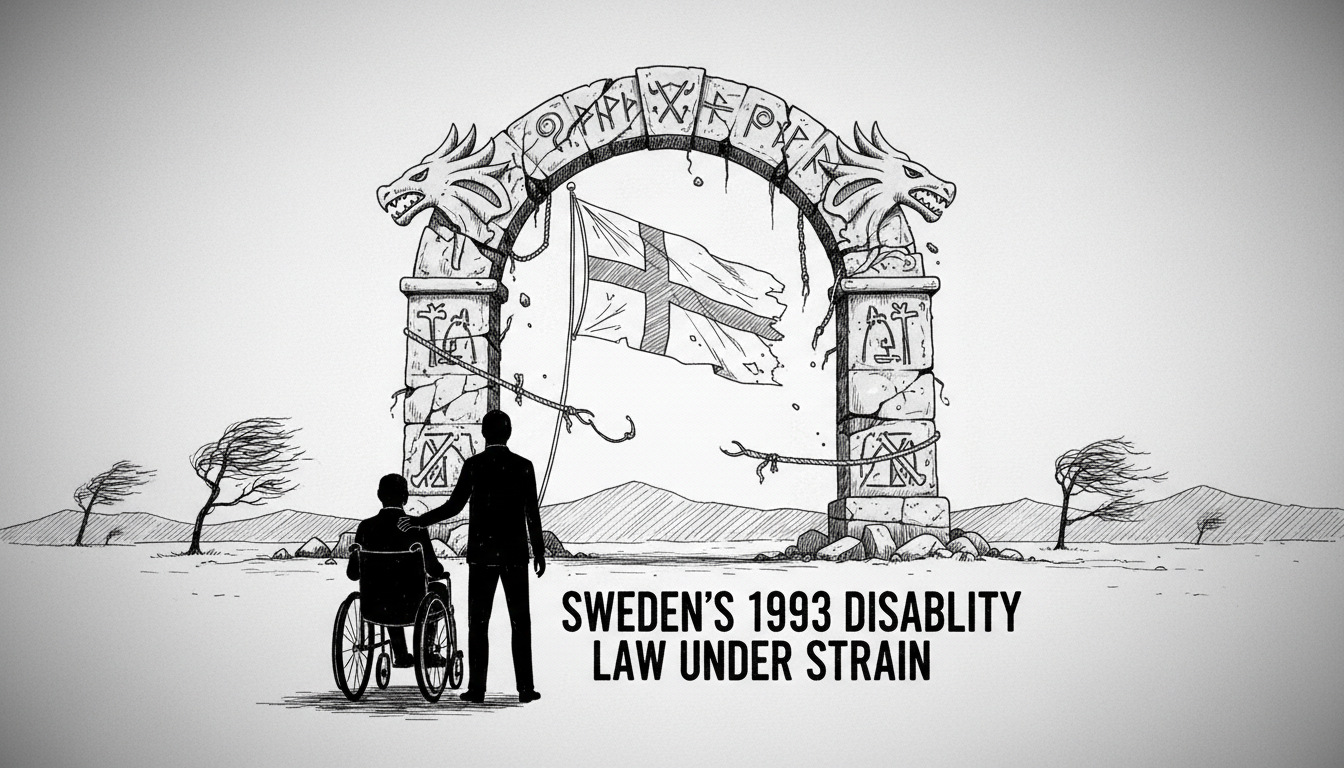
Sweden's landmark LSS disability law passed during the nation's worst recession, a testament to rare political unity. Today, the legislation faces a profound crisis of funding and political will. Bengt Westerberg, the Liberal leader who drove the reform, directs his disappointment at all current parties for their inaction.
The contrast is stark between 1993 and today. The Swedish Parliament, the Riksdag, unanimously enacted the Law on Support and Service for Persons with Certain Functional Impairments. This occurred while the nation grappled with a banking collapse and soaring unemployment. Politicians across the aisle prioritized human dignity over fiscal austerity. The Riksdag building became a symbol of consensus for a transformative social policy.
A Historic Consensus Against the Odds
Bengt Westerberg served as Deputy Prime Minister in a four-party centre-right coalition under Prime Minister Carl Bildt. His portfolio included social policy during the devastating early-1990s crisis. The government's primary focus was staunching the economic hemorrhage. Yet Westerberg championed LSS as a non-negotiable commitment. He argued for the rights of individuals with significant disabilities to live full lives.
The law guaranteed three core rights: personal assistance, housing with special services, and daily activity support. It moved Sweden from a needs-based welfare model to a rights-based framework. Municipalities became legally obligated to provide these services. The reform's passage during such fiscal turmoil remains a unique chapter in Swedish political history.
The Mounting Pressure of Implementation
Three decades later, the system is buckling under financial and administrative strain. Approximately 65,000 individuals received personal assistance under LSS in 2022. Expenditures have grown exponentially, creating tension between rights and municipal budgets. The Association of Local Authorities and Regions (SALAR) consistently warns of unsustainable costs. Municipalities, responsible for implementation, report severe strain on their finances.
This strain leads to tightened eligibility assessments and service reductions. Families report constant battles to secure entitled support. The National Board of Health and Welfare has documented widespread discrepancies in how different municipalities interpret the law. This creates a postcode lottery for essential services, undermining the law's founding principle of equality.
Political Paralysis in Rosenbad
Observers note a complete shift in the political climate. No major party currently champions strengthening LSS. Debates in the Riksdag now focus almost exclusively on cost containment. The governing coalition, led by the Moderates and the Christian Democrats, has prioritized tax cuts and budget discipline. Social Affairs Minister Jakob Forssmed has emphasized the need for efficiency within existing frameworks.
Opposition parties, while critical of cuts, offer no comprehensive plans for increased investment. The political discourse frames LSS costs as a problem to manage, not a right to uphold. This represents a fundamental departure from the 1993 consensus. The political headquarters at Rosenbad now produces directives focused on limitation rather than expansion of support.
Westerberg's Critique and the Human Cost
Bengt Westerberg, now retired from politics, voices profound dismay. His disappointment targets all political blocs for abandoning the law's spirit. He argues that the original vision of full participation and independence is being eroded by a thousand small cuts. The human impact is significant, affecting hundreds of thousands of Swedans with disabilities and their families.
Advocacy groups like the Swedish Disability Rights Federation document increasing cases where people lose crucial assistance. This can mean the difference between living independently and being institutionalized. The law's promise of a life like anyone else's is fading for many. This regression threatens a core pillar of the Swedish welfare state's international reputation.
A System at a Crossroads
Experts identify several structural challenges. The open-ended nature of the rights creates uncapped financial liabilities for municipalities. Demographic trends and an aging population increase demand. Furthermore, a complex mix of private and public providers has introduced market logic into a sphere designed for care. This has led to issues with quality control and profit extraction from public funds.
The Swedish Agency for Participation notes that LSS was visionary but built for a different era. Reforms are needed to ensure sustainability without sacrificing core principles. This requires political courage currently absent from the debate. The question is whether Sweden will recommit to its landmark law or allow it to wither through neglect.
The Path Forward Requires Leadership
The solution requires a multi-faceted approach. First, the Riksdag must initiate a comprehensive review to modernize LSS for current demographics and costs. Second, the national government must reassume greater financial responsibility. Currently, the burden falls disproportionately on municipalities with limited revenue-raising powers. Third, stronger national standards are needed to ensure uniform interpretation and application across all 290 municipalities.
Ultimately, the future of LSS depends on political will. It requires leaders willing to prioritize long-term social stability over short-term budget goals. The 1993 parliament demonstrated that unity on fundamental rights is possible even in dire times. Today's political class faces a similar test of its values and vision for Swedish society. The legacy of a groundbreaking reform hangs in the balance, awaiting a new generation of champions.