
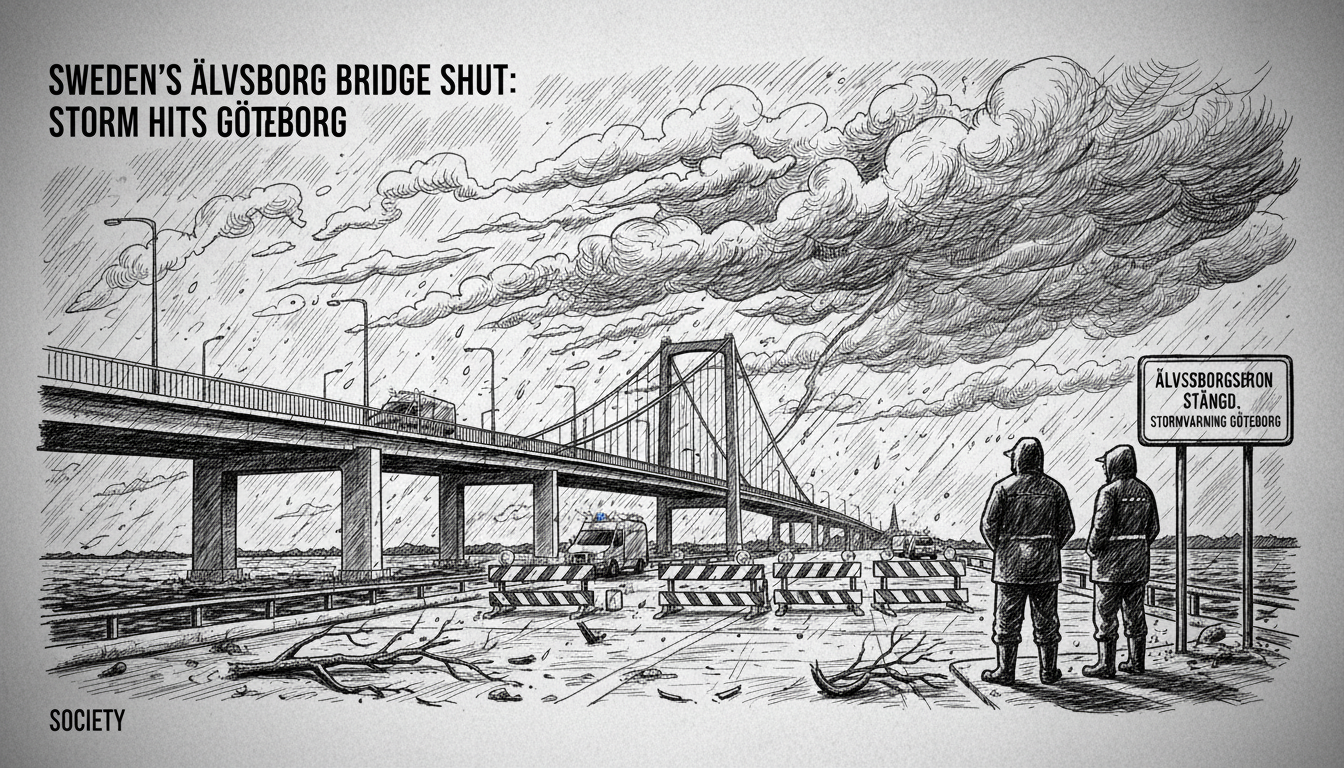
Sweden's second city, Göteborg, is bracing for a powerful coastal storm. The Swedish Meteorological and Hydrological Institute (SMHI) has issued a yellow warning for strong winds and potential storm gusts. The warning, active from 1:00 PM, has already forced the closure of the critical Älvsborg Bridge, severing a major traffic artery and signaling a disruptive afternoon for residents.
"It's starting to pick up around lunchtime today. It could become troublesome during the afternoon," said SMHI meteorologist Kristin Hallberg. Her forecast proved accurate quickly. By 1:42 PM, the iconic suspension bridge was closed entirely. "The bridge is closed due to strong winds. Currently, it is scheduled to be closed until 3:00 PM. But that could change," said Peter Jonsson, a press contact for the Swedish Transport Administration.
The Monday morning commute offered a damp, blustery preview. Rain soaked pedestrians and winds made cycling a battle. For locals, it was a familiar, if unwelcome, sign of the city's exposed position on the windy west coast.
A City Built on Wind and Water
Göteborg's relationship with the weather is fundamental. Founded at the mouth of the Göta River, its identity is tied to the sea. The North Sea and the Skagerrak Strait funnel winds directly into the city center. This makes it uniquely vulnerable compared to sheltered Stockholm. "We're used to it, but you always have to respect it," said Erik Lund, a ferry captain with decades of experience on the river. "When SMHI says yellow, you pay attention. It's not just about rain; it's about the force of the wind coming off the water."
The Älvsborg Bridge is a symbol of this constant negotiation with nature. Opened in 1966, the suspension bridge is a vital lifeline, connecting the northern Hisingen island district with the central mainland. Its closure causes immediate, cascading problems. Public transport is rerouted, delivery schedules are thrown into chaos, and commutes can double in length. For emergency services, it requires careful contingency planning.
The Science of a Yellow Warning
A yellow warning from SMHI is a serious alert. It signifies weather that can pose a danger to the public, cause damage to property, and disrupt societal functions. It's the middle level in Sweden's three-tier system (yellow, orange, red). For wind, a yellow warning typically means sustained strong winds with gusts that could reach storm force, potentially up to 21-24 meters per second (about 47-54 mph).
"The decision to close a bridge like Älvsborgsbron isn't taken lightly," explained transport engineer Mia Karlsson. "It's a balance between safety and mobility. High-sided vehicles, like trucks and vans, become extremely vulnerable on open bridges in crosswinds. There's a real risk of them being blown over, which is catastrophic. The closure is a preventative measure to avoid that scenario entirely."
Authorities monitor wind speed and direction in real time. Specific thresholds, based on the bridge's engineering and historical data, trigger speed reductions and then full closures. The temporary shutdown until 3:00 PM is an initial estimate, entirely dependent on the storm's behavior.
Life in a Coastal Metropolis
The storm's impact ripples beyond traffic reports. For Göteborg's residents, a day like this changes routines. Outdoor markets in squares like Kungstorget pack up early. The famous Haga district, with its quaint cobblestone streets and sidewalk cafes, sees chairs hastily stacked indoors. Ferry services to the southern archipelago often face cancellations, stranding both residents and tourists.
"I was supposed to take the kids to Slottsskogen after school, but we'll be having a 'mysig' afternoon indoors instead," said Anna Forsberg, a mother of two in the Majorna neighborhood, using the Swedish word for cozy. "We'll bake bullar (cinnamon buns) and watch the weather from the window. It's part of life here."
This cultural adaptation is key. Swedish society is generally well-prepared for weather disruptions. People check SMHI's app regularly. Employers often show flexibility. There's an unspoken understanding that fighting the elements is futile.
Infrastructure Under Pressure
Events like today's bridge closure spotlight the pressure on Sweden's infrastructure, particularly as climate models suggest more frequent and intense weather events. Göteborg has invested heavily in climate adaptation, including massive stormwater tunnels to prevent flooding. But bridges remain fixed points of vulnerability.
"Every closure is a data point," said Karlsson. "We learn about wind patterns, traffic flow under duress, and communication effectiveness. The goal is always to minimize disruption while guaranteeing safety. Today's event will be analyzed to see if the thresholds and response timing were optimal."
For businesses, especially logistics and port operations, the cost is tangible. Göteborg's port is Scandinavia's largest, and while ships are designed for rough seas, inland transport links seizing up causes delays and financial penalties.
Looking Ahead: An Unpredictable Evening
As the afternoon progresses, the city watches and waits. The promised "troublesome" period is now. Will the winds peak and subside, allowing the bridge to reopen by 3:00 PM? Or will the storm linger, causing an extended closure that affects the evening commute?
SMHI's warning is the guiding light. Residents are advised to secure loose outdoor items, like garden furniture and trampolines—a common sight in Swedish suburbs that can become dangerous projectiles. Cycling is strongly discouraged. Even walking in exposed areas near the waterfront can be hazardous.
The storm is a reminder of the power of nature in a highly modern, engineered society. Göteborg, a city of sleek trams, innovative startups, and global trade, is still at the mercy of the wind coming across the North Sea. It's a humility baked into the coastal Swedish lifestyle. The bridge will reopen, the clean-up will begin, and life will return to normal. But for now, the city pauses, respects the yellow warning, and stays put. Will the storm's bark be worse than its bite, or is Göteborg in for a long, blustery night?