
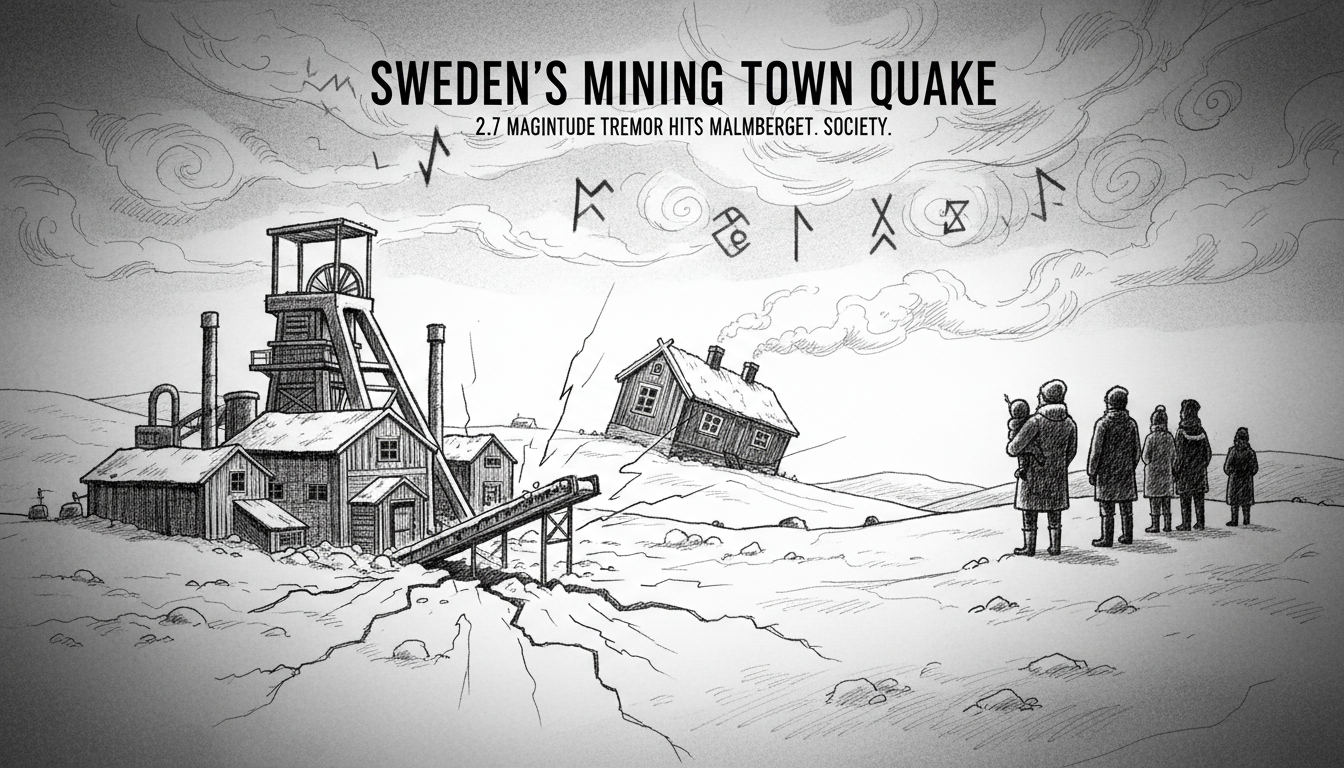
Sweden's northern mining town of Malmberget shook with a 2.7 magnitude earthquake on Tuesday, a tremor strong enough to rattle dishes and send vibrations through homes. The quake, centered in the vast underground iron ore mine operated by state-owned LKAB, was felt across the neighboring community of Gällivare, sparking concern and vivid memories of the area's unstable ground.
"It was a hell of a bang, uncomfortable," said Gustav, a local resident, capturing the sudden shock. On social media, others described their experiences. "The house shook, lights flickered, porcelain and glasses rattled in the cupboard... unpleasant," wrote one person from the Hed area. Eeva Linder felt it strongly on Blockvägen in the Vuosku area, while Vivianne noted the ground shook properly during her walk along Tältgatan in Malmberget around 2 PM.
The seismic event, one of the larger recorded in the Gällivare/Malmberget region according to LKAB, originated in a specific section of the mine called the Gunilla hanging wall. In response, the mining giant immediately halted loading operations in that zone. "An investigation has been initiated into why settlements have occurred in the same area," LKAB stated. The company assured the public that underground operations elsewhere were unaffected.
The Unsteady Ground of Sweden's Iron Belt
For outsiders, a 2.7 quake might seem minor. In Malmberget, it is a potent reminder of living atop a hollowed-out world. The town, whose name literally translates to "Ore Mountain," exists symbiotically with the LKAB mine. This relationship has a cost: subsidence. As ore is extracted from deep underground, the layers above can settle, crack, and collapse. This process, known as induced seismicity, turns human industry into a geological force.
The landscape here tells a story of gradual disappearance. Over decades, entire neighborhoods have been demolished and relocated as the ground gives way to mining-induced craters. Residents live with a map that changes, where familiar streets can be slated for removal. The tremor this week is not an isolated natural event but a sharp, sudden symptom of this slow, man-made transformation.
A Community's Shaken Nerves
The quake's impact varied street by street. In the central Heden area of Gällivare, it was felt strongly. On Dahlsgatan, another resident reported feeling the shake. Yet just a few kilometers away in Koskullskulle, Andreas noticed nothing. This patchwork experience is typical for mining tremors, where depth and local geology amplify or dampen the vibrations reaching the surface.
For long-time residents, such events are woven into life's fabric, though never routine. They prompt checks on home foundations, glances at ceiling cracks, and conversations about the mine's next planned expansion. There is a deep-seated trust in LKAB, a major employer and community pillar, but also an acknowledged reality that their homes are perched on uncertain ground. The swift halt of operations and launch of an investigation are standard safety protocols, designed to manage the inherent risks.
Expert Insight: Mining as a Seismic Trigger
Geologists and mining engineers explain that what happened in Malmberget is a clear example of human-induced seismicity. "When you remove massive volumes of rock, you change the stress fields in the earth's crust," explains Dr. Lena Karlsson, a geotechnical engineer familiar with Nordic mining. "The rock seeks new equilibrium, and that release of energy is what we feel as an earthquake."
She notes that LKAB's mines are among the most monitored in the world. Seismographs dot the region, providing real-time data. A 2.7 magnitude event is within the expected range for such large-scale sub-level caving mining but warrants investigation, especially when clustered in a specific area like the Gunilla zone. The goal is not to prevent all tremors—an impossibility—but to understand patterns, predict larger events, and ensure safety protocols evolve.
"The key question for the investigation will be whether this was a predictable settlement or an anomaly," Karlsson says. "Understanding the 'why' behind the vibrations in that specific hanging wall is crucial for planning future extraction and ensuring long-term stability."
Life in the Shadow of the Mine
Beyond the geology, this event highlights a unique Swedish cultural and economic reality. Towns like Malmberget and nearby Kiruna are the engine rooms of the Swedish economy, producing the high-quality iron ore that supplies Europe's steel industry. This comes with a profound cultural sacrifice: the constant adaptation of the community itself.
Churches, town halls, and historic homes have been moved on flatbed trucks. Social networks are periodically disrupted. The tremor is a physical manifestation of a community in flux, where the ground itself is not a permanent foundation. Yet, there is also immense pride. This is a region that powers Sweden's export economy, and its people have a strong, resilient identity forged in the Arctic climate and the deep mines.
Looking Ahead: Investigation and Inevitability
LKAB's investigation will now pore over seismic data, rock stress models, and extraction records from the Gunilla area. The company will need to determine if adjustments to their mining method are required. For residents, life has returned to normal—but with a renewed awareness.
The Swedish Civil Contingencies Agency (MSB) monitors such events but typically does not intervene for tremors of this magnitude, which are considered an industrial workplace safety issue first. The responsibility lies with LKAB and the Swedish Work Environment Authority.
The quake raises a silent, perennial question for communities in Sweden's mineral-rich north: How do you balance immense economic contribution against environmental and social cost? The shifting ground of Malmberget provides a literal, unsteady answer. The town will continue to exist, but on terms dictated by the ore beneath it. This week's tremor was a brief, loud reminder of that bargain. As the investigation continues underground, life above ground adapts, as it always has, to the rumbles from below.