
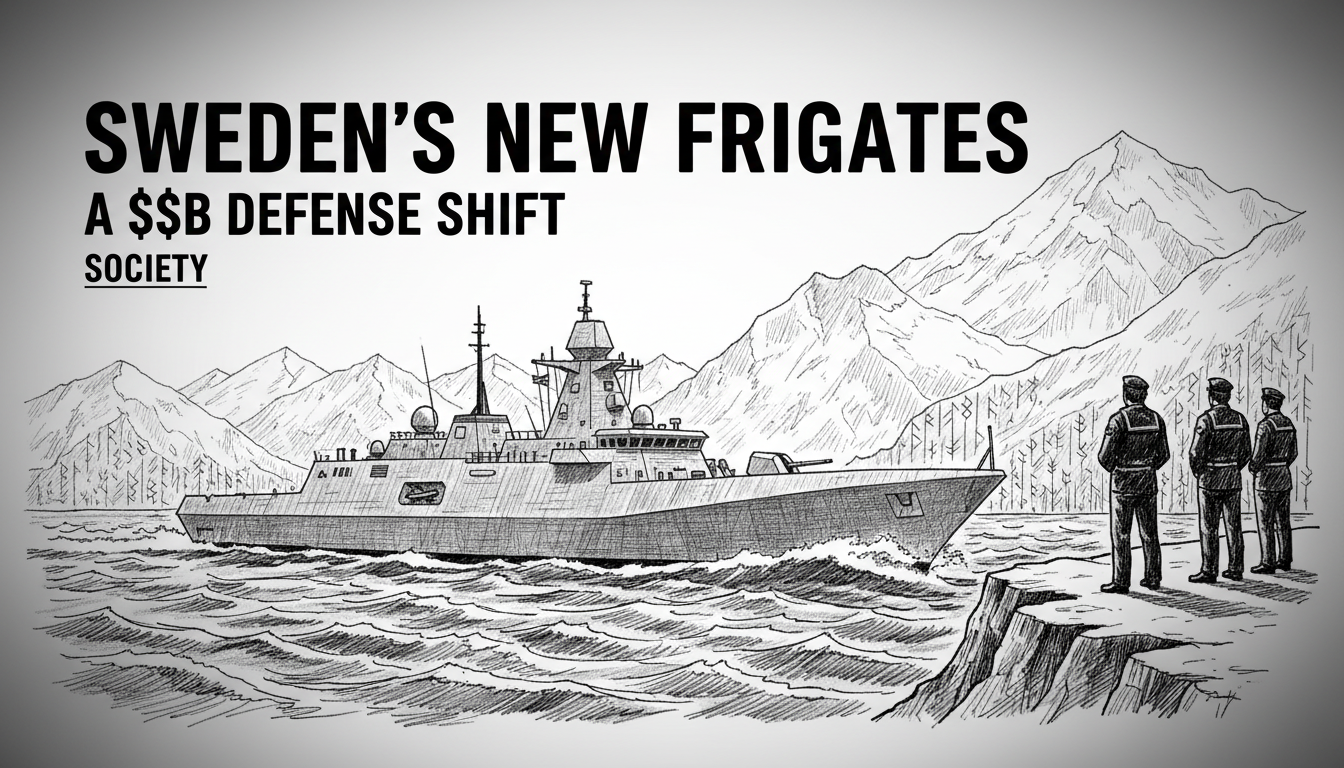
Sweden is building its first major warships in half a century. This marks a decisive end to a fifty-year era of prioritizing small, nimble coastal defense vessels. The Swedish Defence Materiel Administration (FMV) aims to sign a contract for four new frigates in early 2025, representing a multi-billion dollar investment and a fundamental change in naval strategy.
“We are moving away from a previously light fleet, which essentially had the sole main purpose of stopping a so-called invasion force expected to come against Swedish waters,” says Linus Fast, a researcher at the Swedish Defence Research Agency (FOI). The new frigates, measuring around 120 meters, will be a dramatic leap from the current 72-meter Visby-class corvettes, Sweden’s largest combat ships.
From Archipelago Guard to Open-Water Power
For generations, the Swedish Navy's identity was sculpted by the jagged coastline of the Stockholm archipelago. Its strategy focused on 'littoral denial'—using fast attack crafts, mines, and submarines to deter any invasion in shallow, complex waters. The last destroyers, larger vessels capable of blue-water operations, were retired in the 1980s. The end of the Cold War saw further downsizing, a peace dividend that now seems a distant memory.
The security landscape of the Baltic Sea has darkened. Increased Russian naval activity, mysterious submarine intrusions past Swedish shores, and the critical need to protect undersea infrastructure like gas and data cables have forced a rethink. “The threat picture has expanded,” a naval analyst in Karlskrona, home to the naval base, told me. “We’re no longer just defending our inlets. We are responsible for helping secure an entire sea, alongside our allies.”
The New Flagships: Capabilities and Cost
The planned frigates are not just bigger; they are multi-role platforms designed for a new era. They will be equipped for anti-submarine warfare, a top priority in the quiet, crowded Baltic. They will also provide air defense, acting as a protective shield for other vessels, and ensure sea control far from Swedish shores. This versatility allows them to join NATO task forces, a direct consequence of Sweden’s NATO membership.
The price tag is substantial, running into many billions of Swedish kronor. While an exact final cost awaits the contract, it is the largest naval procurement in modern Swedish history. This spending is part of a broader surge; Sweden has committed to raising its defense budget to meet the NATO target of 2% of GDP, a significant climb from recent decades.
“It’s an investment in sovereignty and solidarity,” explains a source within the defence ministry. “These ships send a signal: Sweden is a committed security provider, not just a consumer of security within the alliance.” The frigates will be built for endurance, able to operate for long periods in the harsh North Atlantic or the Mediterranean, far beyond their traditional home waters.
Joining the NATO Fleet: A Strategic Realignment
The procurement is perhaps the most tangible symbol of Sweden’s post-neutrality foreign policy. For 200 years, avoiding military alliances was a cornerstone of Swedish identity. That changed irrevocably with the application to join NATO following Russia’s full-scale invasion of Ukraine. These frigates are the hardware of that new political reality.
“Previously, our operations were conceived in a national context,” says Linus Fast. “Now, interoperability with NATO is baked into the design from the start.” This means common communication systems, logistics chains, and tactical procedures. A Swedish frigate could one day find itself protecting a carrier group in the Atlantic or leading a mine-clearing operation in the Baltic alongside Danish, German, and Polish allies.
Public Debate: Guns, Butter, and National Priorities
Such a vast expenditure does not go unchallenged. In a nation proud of its generous welfare state, some ask if billions for warships could be better spent on schools, healthcare, or the green transition. The debate echoes in newspapers and cozy fik (coffee shops) in Stockholm's Södermalm district.
“It’s a difficult balance,” admits Karin, a teacher I spoke with. “We all feel less safe with the war in Ukraine, but we also see queues for healthcare. I understand the need, but I hope the costs are controlled.” The government argues that national security is the ultimate foundation for societal wellbeing. They frame it not as a choice between guns and butter, but as an essential investment to safeguard the conditions that allow the Swedish model to exist at all.
The Road Ahead: Challenges and Sea Trials
The path from contract to commissioning is long. Building these complex vessels will take most of the next decade. It will test Swedish and likely international shipbuilding industries, requiring a fusion of advanced stealth technology, weapon systems, and sensors. Recruiting and training the hundreds of sailors needed to crew these floating fortresses is another hurdle, in a competitive labour market.
Yet, the direction is set. The sight of a large, modern Swedish frigate moored at Skeppsbron in central Stockholm, flying the NATO flag alongside the Swedish cross, will become a reality. It represents more than just military hardware; it is the embodiment of a historic pivot. Sweden is no longer a neutral island in a stormy sea, but a fully integrated piece of the allied defense of Northern Europe.
Will this massive investment truly redefine Sweden’s role on the world's maritime stage? The answer will unfold not in budget documents, but in the decades these ships spend patrolling the world's oceans, a constant, physical reminder of a smaller nation's weighty decision to shoulder a larger share of global security.