
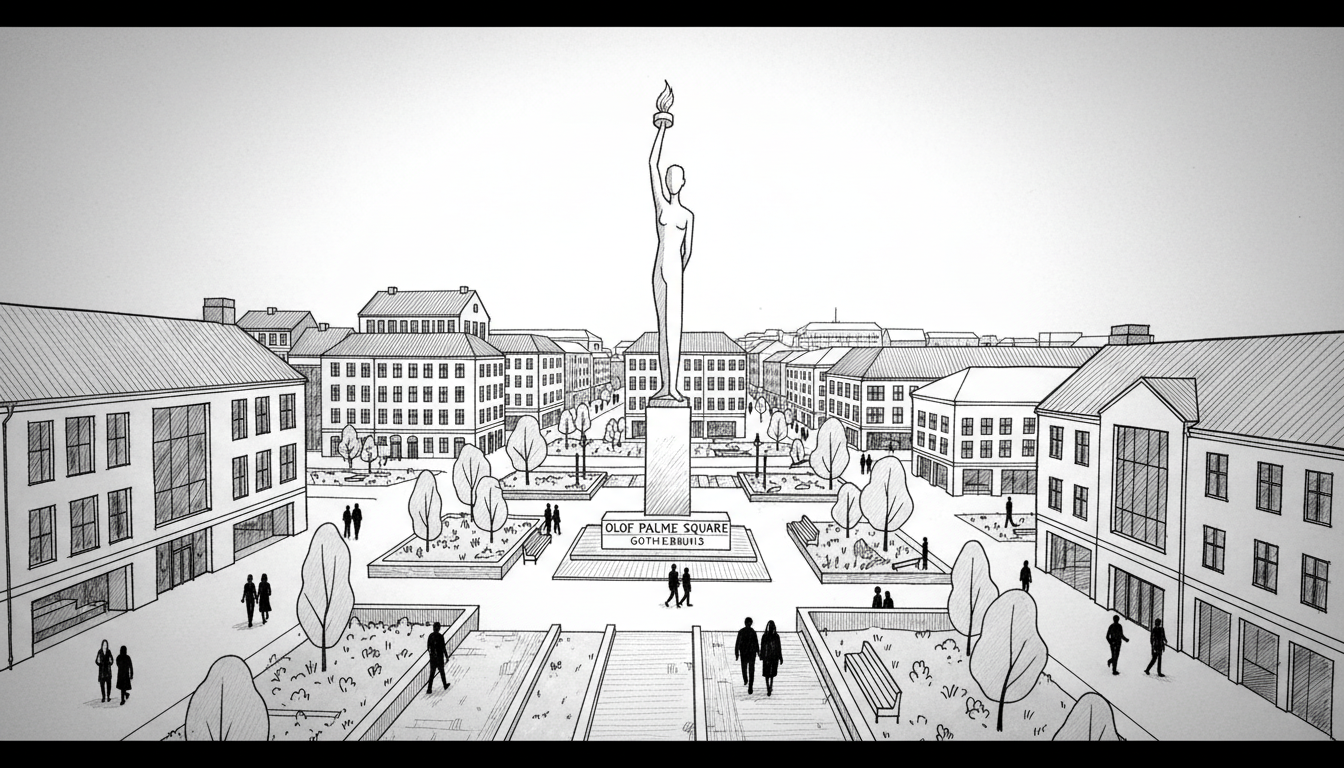
Sweden's second city has transformed a tired, worn-down shortcut into a vibrant public square. Gothenburg's newly inaugurated Olof Palmes plats at Järntorget now features sofas, small stages, and magnolia trees. The project aims to create a living room for the city, a place where office workers eat their lunch and friends gather after work.
"The hope is that people choose to come here during their lunch break to eat their packed lunch," said project leader Marit Sternang at Saturday's opening. Her words capture the simple, yet profound, goal of the renovation. It’s not about grand monuments, but about creating daily usefulness. This shift from a place you passed through to a place you choose to stay in reflects a broader trend in Swedish urban planning.
From Traffic Hub to Community Heart
Järntorget, or 'Iron Square', has a long history as a central hub. For centuries, it was a key point for transportation and commerce in Gothenburg. In recent decades, however, it had become what many locals described as a worn-out surface—a place to cross quickly, not to linger. The worn paving and lack of seating made it functional but not inviting. The renovation, led by the local district council, sought to change that dynamic entirely.
The new design introduces elements of comfort and nature. Plush, durable sofas in deep blues and greys are arranged in conversational clusters. Two low stages suggest future possibilities for small performances or public speeches. The most striking addition is a series of magnolia trees, their broad leaves and spring blossoms intended to soften the urban landscape. "We wanted to create a sense of oasis," explained a city planner involved in the project. "A pocket of green and calm in the middle of the city's movement."
Honoring a Legacy Through Daily Life
The square's namesake, Olof Palme, remains one of Sweden's most significant and controversial political figures. Serving as Prime Minister for over a decade across two periods, his assassination on a Stockholm street in 1986 sent shockwaves through the famously peaceful nation. The crime, still officially unsolved, marked a loss of innocence for Swedish society. Naming public spaces after him is a common form of memorial, seen from Stockholm's Olof Palmes gata to parks across the country.
Yet, this memorial feels different. It is active, not passive. "A square named for Palme shouldn't be a silent, empty place," said historian Lars Trägårdh, who has written about Swedish social democracy. "Palme was about engagement, debate, and public life. A busy square full of people talking, eating, and maybe even arguing a little—that feels more fitting than a statue. It keeps the memory alive in the rhythm of everyday life." This approach to memorialization—focusing on utility and community—is distinctly Swedish. It prioritizes the living over static monumentality.
The Swedish Philosophy of Public Space
Urban planners emphasize that projects like this are central to Scandinavian urban health. "Public squares are the living rooms of our cities," said Karin Bradley, a professor of Urban and Regional Planning at KTH Royal Institute of Technology. "Their quality directly impacts social interaction, mental well-being, and a sense of belonging. In Sweden, there's a strong belief that these spaces should be designed for everyone—free to use, comfortable, and welcoming."
This philosophy stems from the concept of Allemansrätten, or the right of public access, which extends a mindset of shared, equitable use of land into urban design. The addition of sofas, not just benches, is a deliberate choice. Benches can be transactional and temporary. Sofas invite people to settle in, to stay a while, to share the space more intimately. The inclusion of stages, even small ones, invites culture and spontaneity. It says the space is for gathering and expression, not just transit.
Local Reactions and Future Hopes
On a crisp afternoon following the opening, the square was already seeing use. A group of colleagues from a nearby office sat on one sofa cluster, eating sandwiches from paper bags. Two students shared a single sofa, textbooks open on their laps. "Before, you would never sit here," said Erik, a consultant whose office overlooks the square. "It was just concrete and bikes. Now it feels like a place. I think we'll use it for coffee breaks when the weather is good."
Not all feedback is uniformly positive. Some longtime residents wonder if the sleek, modern design loses some of the square's historic, gritty character. Others question the maintenance of the sofas and plants through Gothenburg's wet winters. The city council has allocated funds for upkeep, viewing it as a necessary investment in public infrastructure. The success of the square will ultimately be measured by its use through all seasons.
Project leader Marit Sternang has broader hopes. "We imagine summer concerts on the small stages," she said. "We imagine the magnolia trees in bloom becoming a landmark. Mostly, we imagine this space filling with the ordinary, wonderful noise of people enjoying their city together." This vision connects directly to Olof Palme's own advocacy for a strong, vibrant public sphere—a society where community happens in shared spaces.
A Model for Swedish Urban Renewal
The transformation of Olof Palmes plats is part of a wider movement in Swedish cities. From the redevelopment of Stockholm's Slakthusområdet (the former meatpacking district) to Malmö's ongoing work around the Western Harbour, there is a focus on creating multi-use, human-centric urban environments. These projects often replace mono-functional areas—like transportation hubs—with spaces designed for leisure, socializing, and culture.
This trend responds to several societal shifts. The rise of remote work has made local neighborhood amenities more valuable. A growing urban population increases the demand for quality outdoor space. There's also a recognition that attractive, safe public squares can boost local businesses and tourism, creating a virtuous cycle for city centers. The investment in Järntorget is seen as an investment in the vitality of central Gothenburg itself.
As the afternoon sun angled across the new square, the potential was palpable. The sofas were occupied. People chatted. The magnolia trees, still young, cast small shadows. The stöket—the mess or hustle—that once defined the area as a transit point has given way to a different kind of energy. It’s the energy of a place that is no longer just a shortcut, but a destination in itself. The true inauguration of Olof Palmes plats won't be marked by a single Saturday ceremony, but by thousands of future lunch breaks, conversations, and quiet moments in the sun. In making a square for daily life, Gothenburg may have created its most fitting memorial yet.