
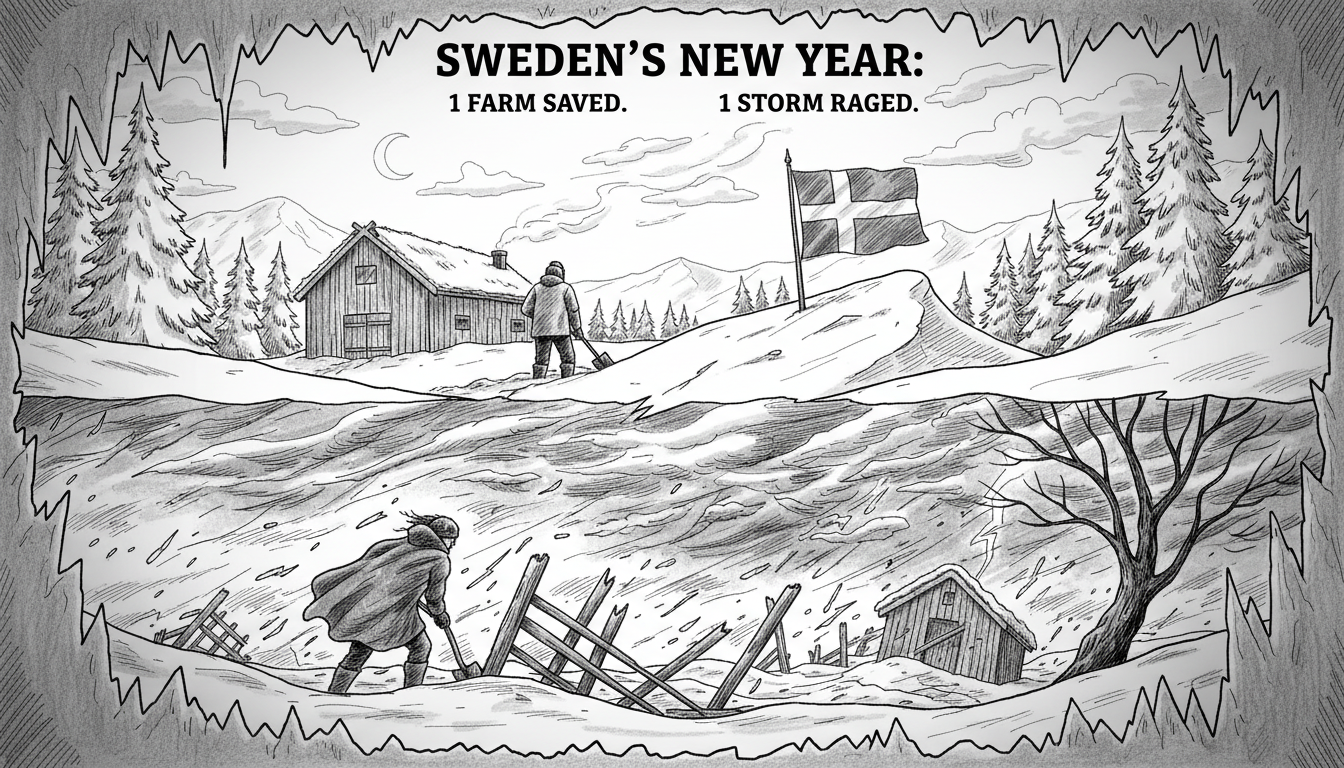
Swedish society trends on New Year's Day revealed a nation of contrasts. A historic Stockholm farm celebrated a new beginning while emergency services dealt with fireworks injuries and a major highway closure. The storm named Anna swept across the capital, painting a picture of resilience and routine chaos as Sweden turned the page to a new year.
In the southern Stockholm suburb of Älvsjö, an unexpected victory for Swedish culture news unfolded. The city's last active traditional farm, Älvsjö Gård, entered the new year on solid footing after community efforts saved it from closure. "Here, children and adults can learn more about our cultural heritage and about cultivation," said farm manager Lena Pettersson, her boots muddy from the morning feed round. The 17th-century farm, with its red wooden buildings, represents a living thread to Sweden's agrarian past within the modern metropolis.
A Rare Urban Oasis Preserved
Stockholm's urban farms are vanishingly rare. Älvsjö Gård is one of perhaps three that still operate with livestock and crops within city limits. Its survival speaks to a growing Swedish lifestyle trend valuing local food sources and hands-on education. "We are not a museum," Pettersson emphasized. "We are a working farm that shows where food actually comes from." Last year, over 5,000 schoolchildren visited its fields and barns. The farm's rescue involved a partnership between the district council, a local heritage association, and volunteer "farm friends." This model of community stewardship is becoming essential for preserving such spaces.
New Year's Eve: More Calls, One Serious Injury
As midnight approached, Swedish New Year's Eve fireworks traditions played out with familiar consequences. Police reported more call-outs this year compared to last New Year's Eve. The incidents ranged from noise complaints to dangerous misuse of pyrotechnics. In a sobering case, a man in his thirties was seriously injured by a firework in the Järfälla district, northwest of Stockholm. He was rushed to Karolinska University Hospital. "It serves as a stark annual reminder," said police spokesperson Erik Lund, in a statement. "These are explosives, not toys."
Debate over firework regulations is a perennial feature of Sweden immigration news and broader societal discussion. New Swedes often experience their first traditional celebration, while long-standing residents weigh tradition against safety and environmental impact. In recent years, several municipalities have restricted public firework sales or designated official display areas only.
Essingeleden Closure and Storm Anna's Arrival
New Year's Day travel was severely disrupted when a truck overturned on the Essingeleden highway just after dawn. This critical artery, carrying over 150,000 vehicles daily, was completely shut in both directions near Fredhäll. The closure caused ripple-effect congestion across western Stockholm for hours. Recovery crews worked in difficult conditions as the first snow flurries of the year began to fall.
Those conditions worsened with the arrival of Storm Anna. The Swedish Meteorological Institute issued a yellow warning for the Stockholm region, forecasting strong winds and heavy rain. Named storms are a relatively new phenomenon in Sweden, adopted to raise public awareness. By afternoon, gusts were whipping across Kungsträdgården and rocking boats in the Strömmen channel. The storm underscored the challenges of Nordic winters, even as climate change alters their character.
The Deeper Currents Beneath the Headlines
These first-day events are more than isolated incidents. They reflect enduring Swedish society trends. The fight for Älvsjö Gård highlights a urban population reconnecting with its roots. The farm acts as a green anchor in a fast-developing area, a concept gaining traction from Malmö to Umeå. "It's about food sovereignty and cultural memory," explained agricultural historian Dr. Maja Lindström. "In an uncertain world, knowing you have a local food producer and a place that teaches self-sufficiency is incredibly valuable."
The New Year's Eve statistics, meanwhile, point to an ongoing negotiation between personal freedom and collective safety. Sweden has a liberal approach to consumer fireworks compared to neighbors like Norway. Each year's injuries reignite the debate. Similarly, the swift response to the Essingeleden accident and the storm warning system show a society highly organized for managing disruption, a trait forged by long, demanding winters.
Looking Ahead: Tradition Meets Transformation
As Storm Anna buffeted the city, the scenes from the day formed a mosaic of modern Sweden. In Älvsjö, a farmer checked on her sheep. In a hospital, doctors treated firework burns. On a closed highway, workers righted a truck. This is the unglamorous machinery of a society functioning—preserving, protecting, and clearing up.
The survival of a single farm might seem a small victory. But in the context of globalized food chains and urban sprawl, it is a conscious choice. It represents a strand of Swedish culture news that is about looking forward by understanding the past. The challenges of the night—the injuries, the accidents—are the yearly toll of celebration and mobility. Together, they ask a fundamental question as the new year begins: What traditions do we keep, and how do we adapt them to keep us safe? The answers will continue to shape Swedish lifestyle and community resilience in the year ahead.