
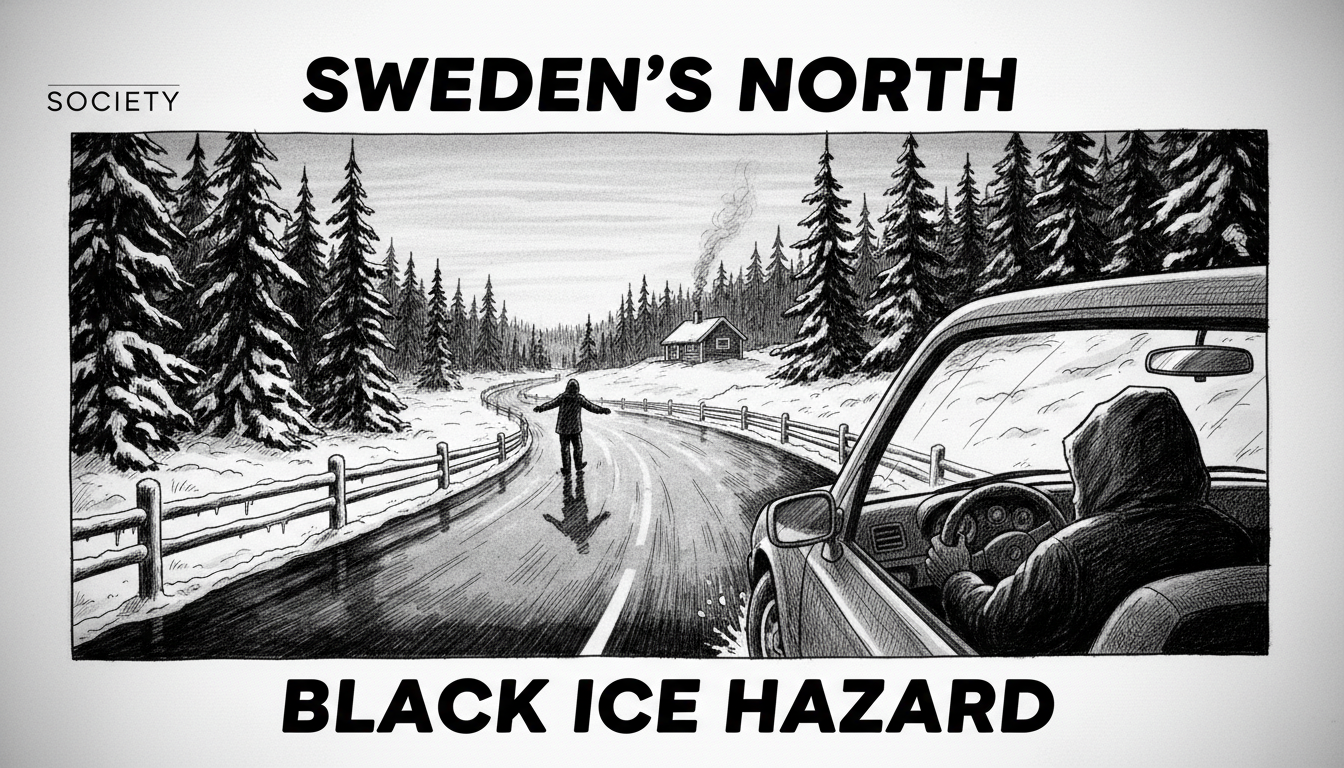
Sweden's meteorological authority has issued a stark warning for sudden black ice across the country's northernmost counties. The SMHI alert covers Norrbotten and Västerbotten, where rain is expected to freeze on cold surfaces, creating treacherous driving conditions. A yellow warning is in effect for areas including Piteå, Luleå, Kalix, Haparanda, Övertorneå, Jokkmokk, Älvsbyn, and Boden from 10:00 to 17:00 on Monday. A separate warning for Arjeplog, Arvidsjaur, and Sorsele runs from 05:00 to 13:00. Authorities urge drivers to exercise extreme caution, reduce speed, and allow extra travel time, with potential delays or cancellations in public transport.
The Invisible Threat on Northern Roads
Ishalka, or black ice, is a winter driver's worst nightmare. It forms a thin, nearly invisible layer of clear ice on road surfaces. This phenomenon is particularly common in northern Sweden during transitional periods when temperatures hover around freezing. Rain or drizzle falls onto surfaces that are still below zero, freezing instantly. "It's the most deceptive hazard we face," says Lars Mårtensson, a veteran driving instructor from Luleå. "One moment the road looks wet, the next you have zero grip. It demands total respect." The warning specifically highlights this risk of rain freezing on cold surfaces, a classic recipe for black ice formation.
Understanding Sweden's Weather Warning System
The SMHI uses a color-coded system to communicate risk levels to the public. A yellow warning, like the one issued today, signifies a moderate risk where weather conditions may cause societal consequences and pose some danger to the public. It is a call for heightened awareness and preparedness. Green indicates no particular warnings, orange signifies a high risk with potential for significant impact, and red is reserved for extreme and dangerous events. These warnings are crucial in a country like Sweden, where vast distances and sparse populations in the north mean drivers can be far from help if conditions deteriorate rapidly.
Life in the Warning Zone
For residents of Norrbotten and Västerbotten, such warnings are a familiar part of the long winter. Norrbotten alone covers about a quarter of Sweden's total land area, making it the nation's largest county. Västerbotten is the second largest. Together, they represent a region of immense forests, mountains, and a population accustomed to nature's extremes. "You learn to read the sky and the thermometer together," explains Elin Krantz, a nurse in Piteå who commutes 40 kilometers daily. "When SMHI says there's risk of ishalka, you don't question it. You put on your proper winter tires, you leave earlier, and you drive like your grandmother is in the passenger seat with a full cup of coffee." Her advice reflects the official guidance from transport authorities: adapt your speed to the conditions and allow significantly more time for your journey.
Expert Advice for Navigating Icy Conditions
Traffic safety experts consistently stress a few key rules when black ice warnings are in effect. First, winter tires are not just recommended; they are a legal requirement in Sweden from December 1st to March 31st. However, even the best tires cannot defy physics on sheer ice. Increasing following distance is critical—experts recommend at least tripling the normal space between you and the car ahead. Smooth, gentle inputs for steering, braking, and acceleration are essential to maintain control. "Avoid any sudden movements," advises Mårtensson. "If you do feel the car start to slide, look and steer in the direction you want to go, and avoid slamming on the brakes." Public transport services also brace for impact during these warnings, with delays and cancellations a real possibility as buses and trains adjust to the unsafe conditions.
The Broader Context of Winter in the North
This specific warning fits into the broader pattern of life above the Arctic Circle. The climate here dictates daily rhythms. While the south of Sweden might see slush and grey skies, the north contends with deep cold and rapid weather shifts. Communities are generally well-prepared, with robust infrastructure for snow clearance and public information campaigns. However, the unpredictability of black ice makes it a persistent challenge. It can form on bridges, shaded forest roads, and open highways where wind chill cools the pavement faster. Local municipalities and the Swedish Transport Administration often increase road salting and sanding operations in response to SMHI alerts, but covering every kilometer in these vast counties is an immense task.
A Cultural Acceptance of Nature's Power
There is a distinct cultural attitude in northern Sweden towards weather hazards. There is less complaint and more pragmatic acceptance. Weather dictates plans, and warnings are heeded. This is not seen as an inconvenience but as a necessary part of coexisting with a powerful natural environment. The concept of 'lagom'—meaning just the right amount—applies even to risk assessment: not overly fearful, but sensibly cautious. People check the SMHI app as routinely as checking the time. Schools might delay starts, employers often show flexibility, and the social expectation is to prioritize safety over punctuality when the yellow warning flags are raised.
Looking Beyond the Immediate Warning
While this warning expires by Monday evening, it signals the beginning of a high-risk period. As winter deepens, the sun hangs low, providing little warmth to melt ice. Fluctuations around the freezing point will continue, creating perfect conditions for recurrent black ice events. For visitors or new residents, understanding and respecting these warnings is a key part of integrating into Swedish society, especially in the north. It's a reminder that in this landscape of stunning northern lights and deep silent forests, nature still sets the terms. The SMHI's alert is more than a weather bulletin; it's a brief but vital communiqué on how to navigate the day safely. Will this winter see more frequent warnings as climate patterns shift? That's a question for climatologists, but for the people of Norrbotten and Västerbotten this Monday, the focus is on the road immediately ahead, watching for that telltale, deceptive sheen of black ice.