
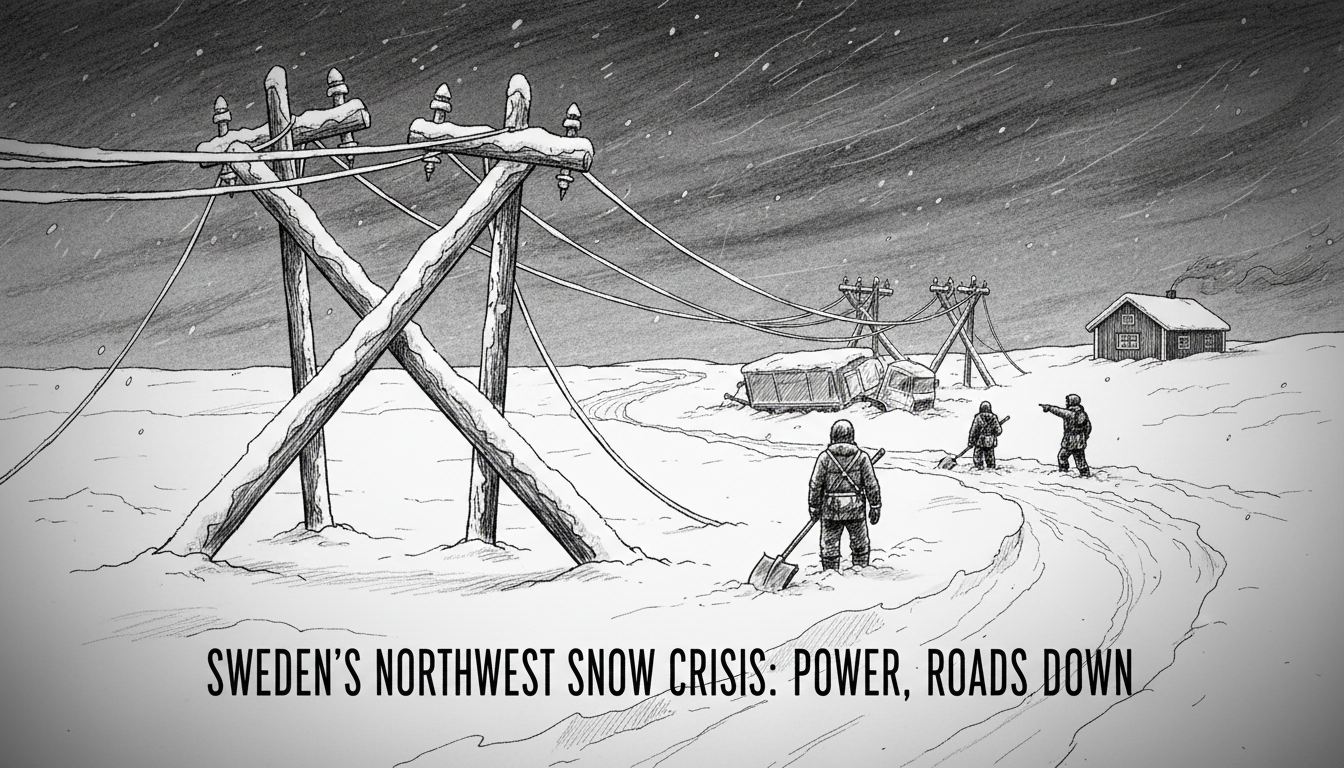
Sweden's northwest coast is paralyzed under meters of fresh snow, transforming picturesque winter landscapes into scenes of significant disruption. Roads are impassable, power lines have fallen, and communities in regions like Jämtland and Västerbotten are battening down. This is not just a heavy snowfall; it is an extreme weather event testing the limits of one of the world's most winter-ready nations.
From my window in Stockholm, the snow is a gentle novelty. Up north, it’s a different story. The Swedish Meteorological and Hydrological Institute (SMHI) has issued its most severe red warnings for the area. They predict over 50 centimeters of snow in 24 hours, with strong winds creating massive drifts. “It’s coming down so thick and fast that ploughs can’t keep up,” said Lars Mårtensson, a county transport official, in a briefing. “Our primary goal is now to keep main arteries open for emergency services.”
The Human Face of a Snow Blockade
The true impact is felt in isolated villages and coastal towns. Imagine the silence after a power cut, magnified by the muffling effect of deep snow. Supermarket shelves begin to empty as delivery trucks are stuck. Schools and daycare centers are closed, forcing parents to scramble. For the elderly or those living alone, the situation carries genuine risk. In the mountain resort of Åre, famed for its skiing, even the ski lifts have ground to a halt, a rare event that underscores the severity of the conditions.
Swedish society is built around the concept of ‘förebygga’ – to prevent or prepare. Homes are well-insulated, most cars have winter tires, and municipal snow-clearing armies are legendary. Yet, this storm pushes beyond standard preparedness. The geography itself is a challenge. The northwest coast, with its fjords and mountains, is sparsely populated. Clearing a road here is a monumental task compared to doing so in a dense city. It’s a reminder that nature ultimately sets the terms, even in Sweden.
Beyond the Ploughs: Cultural Resilience in Winter
How Swedes respond to this is cultural. There is no panic, but a pragmatic mobilization. The local ‘vårdcentral’ (health center) checks its list of vulnerable residents. Neighbours with snowmobiles offer to fetch supplies. The social media hashtag #snökaos (snow chaos) fills with both practical updates and wry, shared humour. This collective calm stems from a deep-seated familiarity with winter’s demands, a key part of the Swedish psyche. The Danish concept of ‘hygge’ has its Swedish counterpart in ‘mys’ – creating coziness. During a storm like this, ‘mys’ becomes a survival strategy: lighting candles, making soup, and waiting it out.
Economically, the disruptions are immediate. Forestry operations stop. Tourism, a lifeblood for towns like Strömstad and Uddevalla on the coast, takes a hit as travel becomes impossible. The national rail operator has cancelled all services north of Sundsvall, stranding passengers. Each hour of standstill costs municipalities and businesses millions of Swedish kronor. Sweden invests billions annually in winter road maintenance, but the budget for a single extreme event is never infinite.
Expert Insights: Why Here, Why Now?
Meteorologists point to a perfect storm of conditions. A persistent low-pressure system over the Norwegian Sea is acting like a conveyor belt, pulling moist Atlantic air directly onto the cold coastal mountains. This classic orographic lift is wringing out that moisture as relentless snow. “The alignment of the jet stream and sea surface temperatures has created a stalled pattern,” explained a climate researcher from Uppsala University, who preferred not to be named as they were not the official SMHI forecaster. “These are the events climate models suggest may become more intense, if not necessarily more frequent.”
Emergency management experts stress communication. SMHI’s color-coded system is crucial. A yellow warning means be aware. Orange means be prepared. Red, as in use now, means take action. The public heeds these warnings, which prevents many crises. The Swedish Civil Contingencies Agency (MSB) coordinates regional resources, ensuring snow-clearing equipment from the south can be dispatched north if needed. This system is now in full swing.
A Look at the Season's Toll
To understand the scale, consider seasonal averages. The mountainous parts of northwest Sweden routinely see over 2 meters of snowfall each winter. This event delivers a significant chunk of that in mere days. The weight of wet, heavy snow is the real danger. It snaps power lines and tree limbs, creating secondary hazards. It stresses rooftops, especially on older barns and sheds common in the countryside. The clean-up will take weeks, long after the skies clear.
For travelers, this is a stark warning. The dream of a winter wonderland holiday can quickly become a logistical nightmare. The Swedish Transport Administration advises against all non-essential travel in the red warning zones. For those who must travel, packing an emergency kit with warm clothes, food, and a shovel is not a suggestion—it’s a necessity. The famous E4 and E12 highways are littered with stranded vehicles, a testament to those who underestimated the storm.
The Long Melt: What Comes Next?
As the snowfall eventually eases, the region’s focus will shift to digging out and assessing damage. The rapid melt, when it comes in spring, brings its own risks of flooding. For now, communities will rely on a deep-rooted Scandinavian instinct for cooperation. There’s a word, ‘dugnad,’ used in Norway and understood in Sweden, meaning voluntary communal work. That spirit is visible as people band together to clear a neighbour’s driveway or check on an elderly resident.
This extreme snowfall on Sweden’s northwest coast is more than a weather report. It is a story of modern infrastructure meeting ancient elements, and of a society whose culture is uniquely adapted to winter yet still respects its power. It asks a silent question: as our climate changes, how will our preparedness? The Swedes, with their systematic approach and communal resilience, are writing one answer in the deep, quiet snow.