
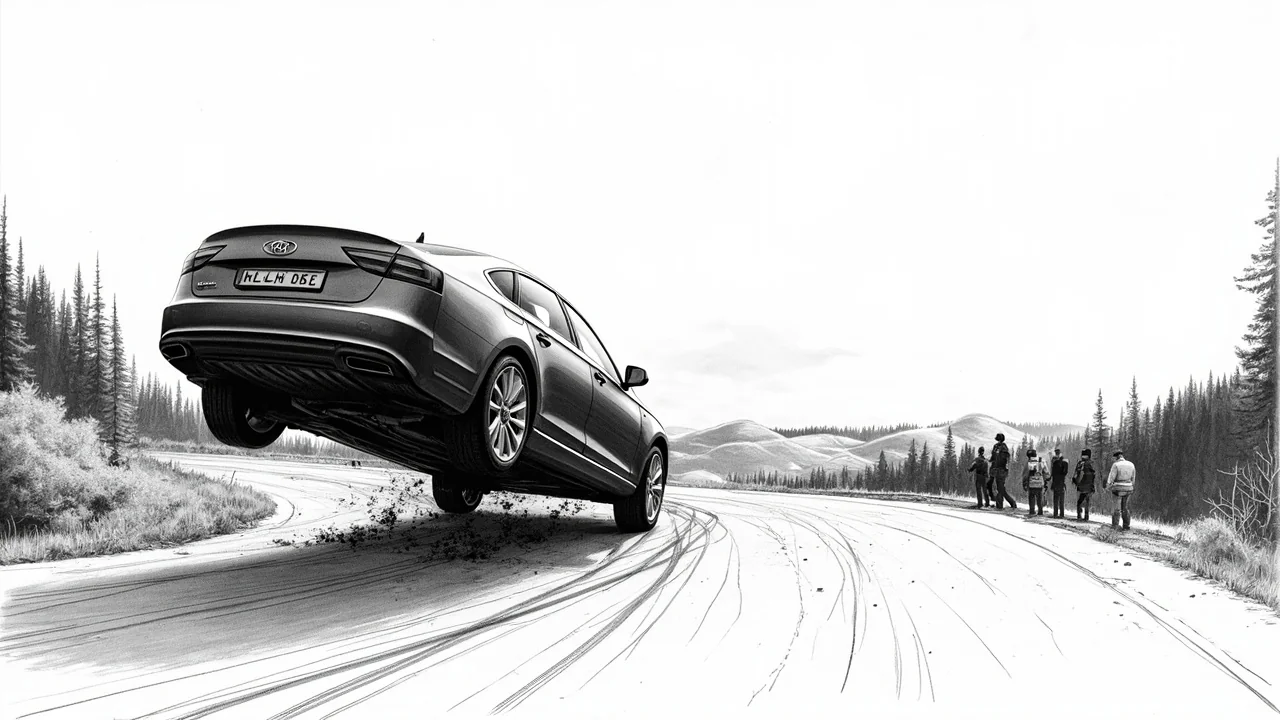
Sweden’s most infamous road curve has claimed its 50th documented vehicle, this time trapping the very tow truck sent to perform a rescue. The incident occurred last Thursday afternoon on a slippery forest road near Mora, in Dalarna county. For local resident Göran Grönhammar, it was another chapter in a 40-year saga of watching drivers battle the hazardous bend just outside his home.
"A mail truck had gotten stuck on a smaller road nearby and needed to be recovered," Göran Grönhammar explained. "When the tow truck had pulled the mail van onto its bed and tried to drive up the hill, it got stuck because it was so icy." The twist of fate meant the rescuer needed rescuing. Grönhammar notes the one positive aspect: a recovery vehicle can recover itself. "I helped loop a strap around a tree so it could attach a cable and pull itself free," he said.
The Accidental Archivist of Route 70
Göran Grönhammar’s unique photo collection began four decades ago. What started as simple documentation evolved into a persistent campaign for improved safety. The curve, on a stretch of Route 70, is deceptively sharp and often treacherously slick. For years, cars and trucks would slide off, some threatening to crash into Göran’s nearby shed. His relentless documentation became evidence in a long battle with the national transport authority, Trafikverket. That fight eventually led to the installation of the very guardrail that saved the tow truck from tumbling into a ravine last week. "The tow truck had gotten stuck against the railing in the curve," Grönhammar said. "That saved it from going down into the ravine."
This story is about more than a single mishap. It highlights the quiet struggles of rural infrastructure maintenance across Sweden. As climate change brings more frequent freeze-thaw cycles, secondary roads face increasing challenges. Grönhammar’s personal mission underscores how citizen advocacy can drive change, even if slowly.
A Turning Point, Literally
In a stroke of poetic usefulness, the tow truck was able to use a turnaround space Grönhammar had recently cleared. He prepared it for an upcoming 80th birthday celebration. "It’s the only place on a long stretch where it’s possible to turn a vehicle around," he remarked. The fact that a personal party preparation aided a municipal recovery operation feels deeply Swedish. It speaks to a practical, community-oriented mindset where individuals often fill gaps in public services.
The incident is a textbook example of Swedish förenkla—simplification or making do. Instead of calling a second tow truck for the first, they used local knowledge and available resources. Grönhammar, the tree, and his shovel provided the solution. This self-reliance is a cherished value, especially in the Swedish countryside where distances are great and services can be distant.
Expert Analysis: A Symptom of a Larger Challenge
We spoke with traffic safety analyst Lena Karlström, who has studied winter road conditions across Nordic regions. "This specific case is anecdotal, but it points to a systemic issue," Karlström said. "Maintenance resources are prioritized on major highways and urban corridors. Lower-traffic rural roads, which can be just as dangerous due to terrain and conditions, often get less frequent attention. When a recovery vehicle gets stuck, it’s a clear sign of exceptionally hazardous conditions that likely affect all drivers on that route."
Karlström notes that local reporting is invaluable. "Persistent citizens like Mr. Grönhammar provide a longitudinal view that official surveys might miss. His 50 photos over 40 years are a powerful dataset showing a persistent problem that was only partially solved by a guardrail." The analyst suggests more dynamic solutions might be needed, such as improved signage for changing conditions or automated friction sensors that alert maintenance crews.
The Human Factor in Rural Infrastructure
This story also touches on themes of depopulation and community resilience. In many rural Swedish towns, an aging population remains deeply connected to their environment. They become its stewards and witnesses. Göran Grönhammar is not just a man with a camera; he is a de facto safety monitor. His sustained engagement turned a personal nuisance into a public safety issue that was finally addressed.
Professor Anders Lund, a sociologist focusing on rural Swedish communities, sees a broader pattern. "There’s a strong tradition of individual responsibility in Swedish culture, linked to allemansrätten—the right of public access," Lund explains. "But this also extends to a sense of collective care for one's immediate surroundings. When formal systems are slow, individuals step in. This gentleman documenting accidents for 40 years is practicing a form of civic duty. He is holding the system accountable with patience and concrete evidence."
Beyond the Guardrail: What’s Next?
The new guardrail prevented a disaster, but it didn't prevent the 50th incident. The road remains slippery. The curve remains sharp. The question now is what comes after documentation and basic safety measures. Will this latest event, with its ironic twist, prompt a review of the road's design or winter maintenance schedule? Or will Göran Grönhammar need to prepare for photo number 51?
For Grönhammar, the work continues. His shovel will clear the turnaround space again. His window will remain a lookout post. And his collection, a humble archive of 50 moments of misfortune, stands as a testament to the power of paying attention. In an era of fast news and fleeting trends, this Swedish man’s four-decade project reminds us that some problems—and some solutions—require a very long view. It makes one wonder how many other dangerous curves across Sweden have their own silent archivists, waiting for someone to notice their collection.
As Sweden continues to balance its vast geographical challenges with limited resources, stories like this one from the forests of Dalarna serve as a crucial reminder. Infrastructure is not just about concrete and steel; it's about the people who live with it every day. Their lived experience, their patience, and sometimes their photographs, are essential tools for building a safer society.