
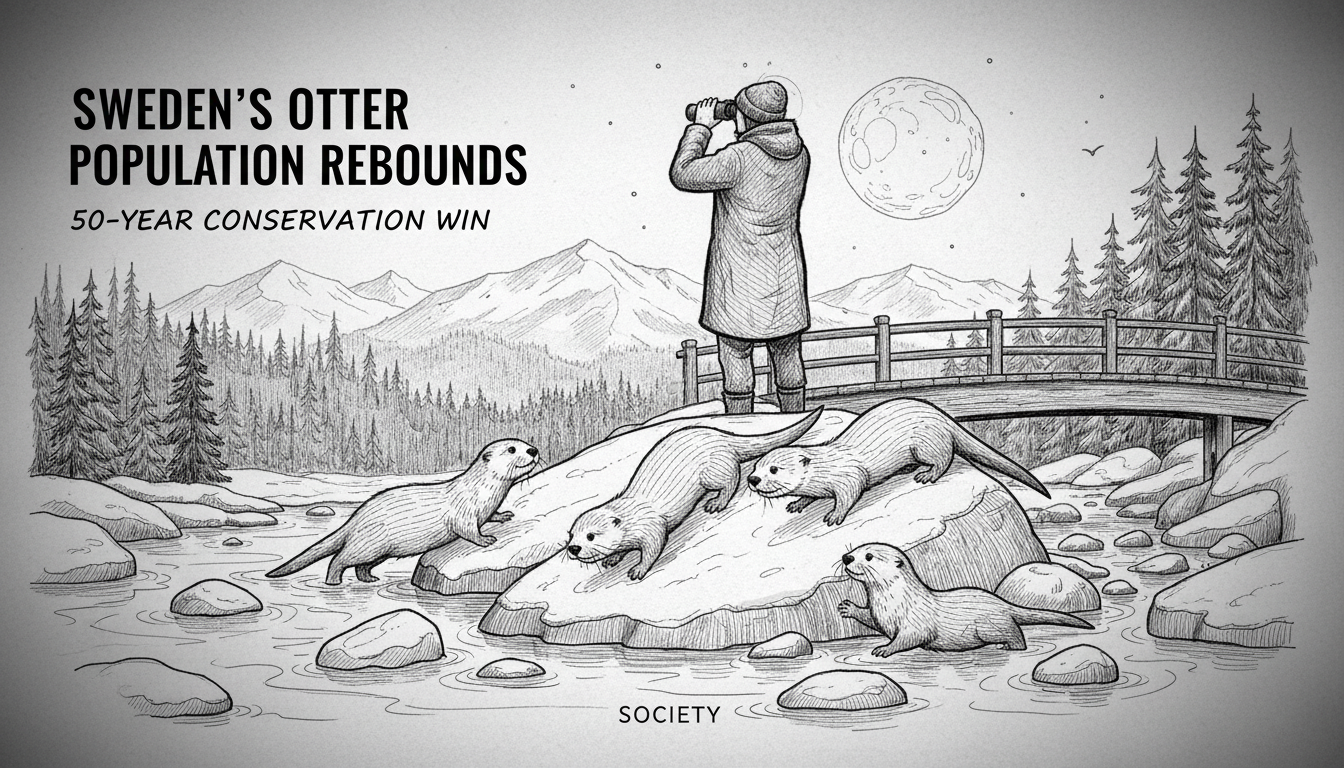
Sweden's otter population has staged a remarkable comeback, officially moving from the 'Near Threatened' category to 'Viable' on the nation's authoritative Red List of threatened species. This success story, announced by the Swedish University of Agricultural Sciences (SLU), is a direct result of conservation measures that began over half a century ago. The recovery of the otter, alongside the white-tailed eagle and the agile frog, offers a rare piece of positive environmental news in a report that still signals serious trouble for other native species like the critically endangered European eel.
"Measures initiated in the sixties and seventies have finally led to the otter being classified as viable," said Henrik Thurfjell from SLU's Swedish Species Information Centre in a statement. His words underscore a long-term national commitment to wildlife protection. For Swedes, whose connection to nature is a core part of the national identity, this news resonates deeply. It’s a validation of the environmental consciousness that grew from the post-war era, a sentiment often reflected in everything from children's literature to the public's right of access to the countryside.
A Conservation Legacy Bears Fruit
The otter's journey back from the brink is a textbook case of effective environmental policy. In the mid-20th century, otter numbers in Sweden plummeted. The culprits were a familiar and devastating trio: widespread hunting for their pelts, severe habitat destruction as wetlands were drained for agriculture, and the insidious spread of environmental pollutants like PCBs and DDT. These toxins accumulated in the food chain, weakening the otters and crippling their reproductive systems. By the 1960s, the species' future looked bleak.
Public awareness and political will eventually aligned. Sweden implemented a national ban on otter hunting. Concurrently, the country began a decades-long effort to clean its waterways and regulate harmful chemicals, partly inspired by the work of pioneering scientists like Rachel Carson. The creation of protected wetland areas provided safe havens. "This isn't an overnight success," explains wildlife biologist Elin Ström, who has monitored otter populations in the Stockholm archipelago. "It's the result of consistent, science-based policy. You protect the habitat, you remove the direct threats, and if you're patient, nature often finds a way to heal."
Shadows in the Clear Water
Despite the celebratory headlines, scientists are issuing cautious congratulations. A significant cloud hangs over the otter's recovery: persistent environmental toxins. High levels of PFAS chemicals and other modern pollutants continue to be measured in otters across Sweden. Researchers do not yet fully understand the long-term impact of these 'forever chemicals' on otter reproduction and health.
"We are seeing the population grow and spread, which is excellent," notes Thurfjell. "But we have this unanswered question about the toxins. What does it mean for their immune systems? For their kits' survival rates? We've solved one set of problems, but a new, more complex one has taken its place." This concern reflects a broader challenge in Swedish environmentalism—the shift from combating visible, point-source pollution to managing invisible, pervasive chemical threats.
The Red List's Mixed Messages
The Swedish Red List, compiled by SLU Artdatabanken with input from hundreds of experts, serves as the nation's ecological health check. The otter's promotion is a bright spot in a document filled with warnings. The report functions like a stock ticker for biodiversity, updated every five years using International Union for Conservation of Nature (IUCN) criteria. It assesses the risk of extinction for thousands of species within Sweden's borders.
While some species recover, others slide closer to the edge. The European eel remains 'Critically Endangered,' its mysterious life cycle and complex migratory routes proving difficult to protect from overfishing, habitat barriers, and climate change. In a worrying development, several fish species fundamental to both ecosystems and Swedish culture—like herring, salmon, and trout—are new entries on the list, all assessed as 'Near Threatened.' Their decline points to pressures in both the Baltic Sea and inland waterways, from changing sea temperatures to hydropower dams.
A Cultural Comeback for a Charismatic Creature
The otter's return is being felt and celebrated beyond scientific circles. In Swedish folklore and children's stories, the otter (utter) is often portrayed as a playful, intelligent, and somewhat elusive character, a symbol of healthy, wild waterways. Its increased presence is noted by fishermen, kayakers, and countryside homeowners.
"I remember my grandfather talking about how rare they were when he was young," says Mikael Berg, a nature guide based in Värmland. "Now, on early morning tours along the Klarälven river, we spot them regularly. Clients, especially from abroad, are thrilled. It’s a sign that the river is alive." This visibility is powerful. It creates a tangible link for the public between conservation action and positive results, fostering continued support for environmental protections.
The Road Ahead for Swedish Wildlife
The lesson from the otter is twofold: long-term conservation works, but it requires eternal vigilance. The strategies of the 1970s—banning hunting, curbing obvious pollutants—are not sufficient for the challenges of the 2020s. Today's threats are often global and systemic: climate change, microplastic pollution, fragmented landscapes, and novel chemical compounds.
Protecting a species like the salmon or the eel demands international cooperation across the Baltic region, something Sweden actively pursues through EU policy and regional partnerships. The new listings for common fish species are a stark wake-up call that even historically abundant wildlife is not safe.
"The otter story proves we can make a difference," concludes Elin Ström. "It should give us hope and momentum. But we can't just be caretakers of a few charismatic species. We have to think about the entire ecosystem—the water quality, the forest corridors, the insect populations. The next fifty years of conservation will be about managing complexity and interconnection." For a nation that defines itself so strongly through its relationship with nature, the Red List is more than a scientific report; it's a mirror. The reflection now shows a cautious success story, but one framed by urgent, ongoing work.