
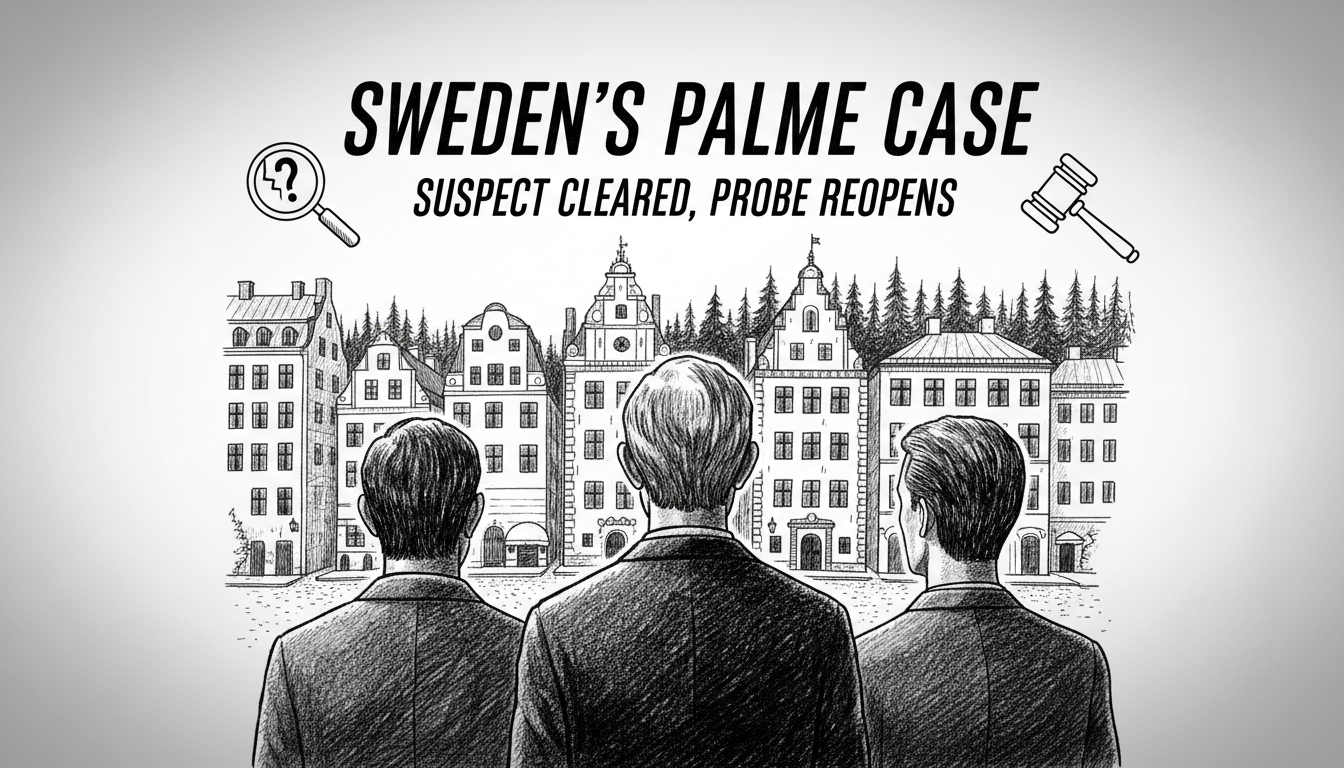
Sweden's most traumatic unsolved murder case has taken a dramatic turn. Stig Engström, the man officially named as the prime suspect in the assassination of Prime Minister Olof Palme, is no longer under suspicion. The decision by senior prosecutor Lennart Guné effectively dismantles the conclusion of the 34-year investigation, announced just four years ago, and reopens a painful national wound with a simple message: the search for truth continues.
For many Swedes, the news felt like a strange kind of relief. The 2020 closure, which pinned the murder on the deceased Engström, never sat right with the public. It felt rushed, inconclusive, and left a bitter aftertaste. "We carried that decision like a stone," says Erik Lundqvist, a retired teacher from Vasastan. "It didn't solve anything. It just told us to stop asking questions. Now, perhaps, we can ask them again."
The Case That Refuses to Close
The Palme assassination on a cold February night in 1986 shattered Sweden's image of itself as a peaceful, open society. The Prime Minister was shot dead on Sveavägen, a central Stockholm street, after leaving the Grand Cinema with his wife. The killer vanished into the night. The initial investigation was widely criticized as bungled, and the case quickly spiraled into a maze of conspiracy theories involving Kurdish separatists, South African agents, and shadowy domestic groups.
Stig Engström, an employee at the Skandia insurance company near the scene, became known as "Skandiamannen." He inserted himself into the investigation, giving contradictory statements to police. For decades, he remained a person of interest among many. In June 2020, after leading a specialized investigation team, chief prosecutor Krister Petersson made a stunning announcement. He named Engström as the murderer and closed the case, stating that since Engström died in 2000, no charges could be brought.
A Prosecutor's Quiet Reversal
The 2020 conclusion was met with immediate skepticism from legal experts and the media. Following a major investigative review by a national newspaper, senior prosecutor Lennart Guné was tasked with re-examining the evidence against Engström. His findings, delivered in a low-key manner, amount to a systematic critique of his predecessor's work.
Guné stated the evidence was simply too weak. There was no murder weapon linking Engström to the crime. No clear motive was ever established. Most crucially, the timeline of Engström's movements that night, based on witness accounts, did not convincingly align with the window of opportunity for the murder. The circumstantial evidence—that he wore a cap similar to one a witness might have seen, or carried a bag that could have held a weapon—collapsed under rigorous scrutiny. "Witnesses have described hats, knitted caps, or no headgear at all on the perpetrator," Guné noted, highlighting the unreliability of this key detail.
"This is a textbook example of why circumstantial evidence needs to form a coherent, unbreakable chain," explains Karin Södergren, a professor of criminal law at Stockholm University. "What was presented in 2020 were isolated links—a location, a bag, a vague description. Guné has shown those links don't connect strongly enough to bear the weight of such a monumental accusation. The burden of proof, even in a closed investigation, must be substantial."
The Cultural Wound of an Unsolved Mystery
The Palme case is more than a criminal investigation in Sweden; it's a cultural and psychological fixture. It represents a loss of innocence, a moment when political violence reached the very top of the egalitarian Swedish society Palme himself championed. Every few years, a new book, documentary, or theory emerges, keeping the conversation alive. The case is debated in living rooms, academic circles, and online forums with a passion rarely seen for other historical events.
"It's our national ghost story," says author and cultural commentator Maja Lindström. "It haunts us because it's unfinished. We have a deep-seated need for narrative closure, for understanding why. The 2020 ending felt like a forced, unsatisfying finale. This reopening, while painful, honors the complexity of the story and the memory of Palme. It says the truth matters more than administrative convenience."
This sentiment is echoed in neighborhoods across Stockholm. In Södermalm, where Palme lived and his Social Democratic roots run deep, the news has sparked renewed reflection. "We grew up with this shadow," says Lena Forsberg, a café owner. "My parents talked about where they were when they heard the news. I remember the flowers piling up on Sveavägen. A quick solution was an insult to that memory."
What Comes Next for the Palme Investigation?
Legally, the case remains closed. Guné's review did not reopen the criminal investigation; it simply retracted the accusation against Engström. Practically, however, it clears the deck. The path forward is now open for new leads to be taken seriously without the overarching theory of Engström's guilt dominating the frame.
This could lead to several outcomes. New forensic techniques, applied to old evidence, might yield clues. Fresh tips, previously discounted because they didn't fit the "Skandiamannen" narrative, could be re-evaluated. The focus may shift back to other long-standing lines of inquiry. The government could, in theory, appoint a new investigation team, though there is no indication of that yet.
"The greatest significance of this decision is its restoration of procedural integrity," says Professor Södergren. "It demonstrates that the justice system is capable of self-correction. It tells the public that a premature conclusion, even one delivered with finality, can be challenged and overturned based on facts. For the credibility of the state, that is vital."
For the Palme family and for a nation that lived through that night, the emotional calculus is different. The uncertainty returns, but so does the possibility of a more credible answer. The case is once again defined by its open questions rather than a disputed answer.
As the Swedish autumn darkness settles over Sveavägen, the site of the murder now marked by a simple memorial, the national conversation continues. The story of Olof Palme's death is being rewritten once more, not with a definitive ending, but with a renewed commitment to the search. The ghost, for now, remains. But the hunt for the truth behind it has been legitimized again. Can a country find peace with a mystery that may never be solved? Sweden is, once again, grappling with that question.