
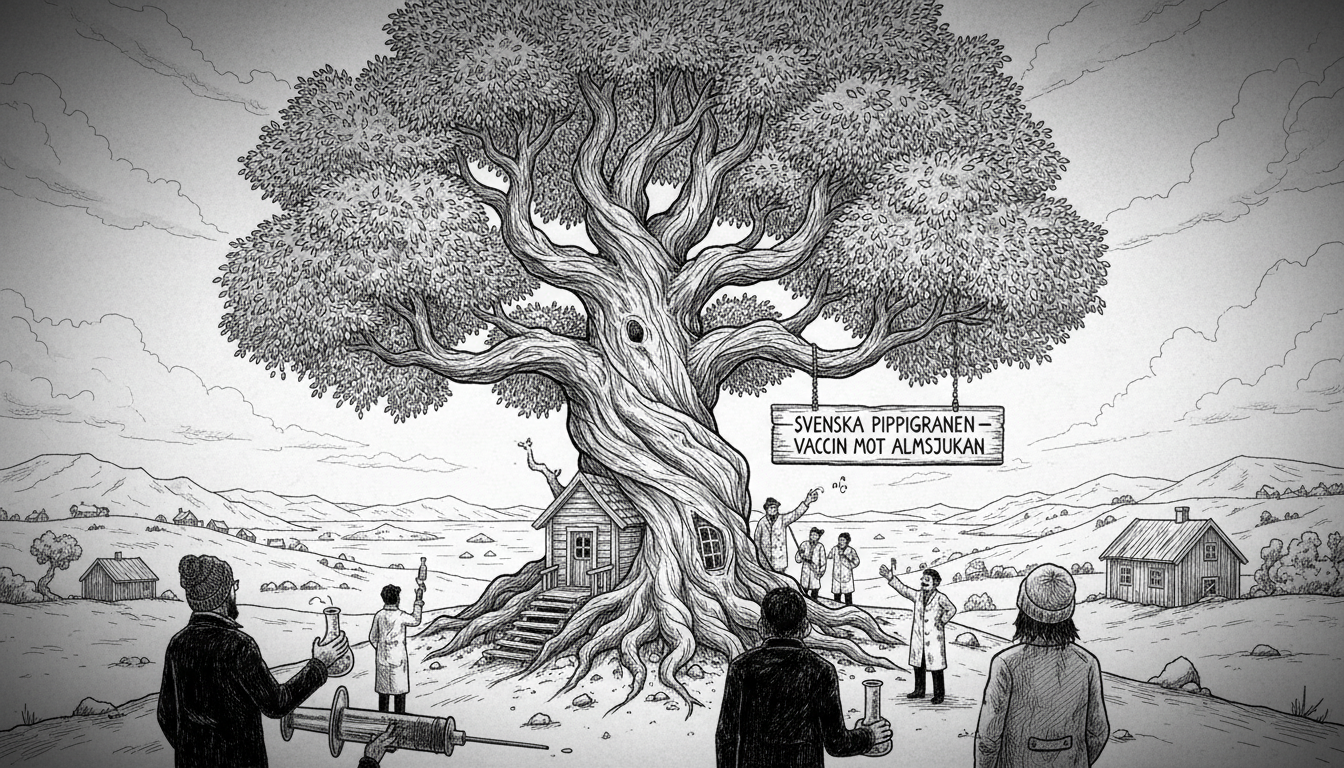
Sweden's most famous elm tree, the 'soda tree' from Astrid Lindgren's Pippi Longstocking stories, is now receiving annual vaccinations. The historic tree at Astrid Lindgren's Näs in Vimmerby is under threat from the relentless spread of Dutch elm disease, known in Swedish as 'almsjukan'. This fungal disease has already devastated millions of elms across Europe, and its arrival at this cultural landmark signals a new front in a long ecological war.
Christopher Mörk, the head gardener at Astrid Lindgren's Näs, watches over the tree with a mix of reverence and concern. "It's a piece of living history," he says, standing in the garden where Lindgren grew up. "When you see it, you're not just looking at a tree. You're looking at the inspiration for a magical part of Swedish childhood. Protecting it is about protecting a piece of our collective imagination." The tree, which Lindgren described in her stories as the source of Pippi's fizzy lemonade, is more than just flora. It is a cultural touchstone, a living link to Sweden's most beloved author.
A Silent Killer Creeps Closer
Dutch elm disease is a silent, relentless killer. Caused by the fungus Ophiostoma ulmi, it is spread by tiny elm bark beetles. The beetles carry fungal spores from sick trees to healthy ones. Once the spores enter a tree's water-conducting vessels, they multiply rapidly. The tree's own defense mechanisms tragically backfire, clogging its veins in an attempt to stop the invader. This process slowly starves the tree, leading to wilting leaves, dead branches, and eventual death. The disease has swept across continents for over a century, wiping out an estimated 75% of elms in some regions. In Sweden, vast avenues of majestic elms that once defined the landscape have been reduced to memories and stump-filled parks.
The arrival of the disease at Lindgren's childhood home was not a surprise, but it was a blow. "We've seen it coming for years," Mörk explains. "You monitor the surrounding area, you see the beetles, and you know it's only a matter of time. The question is never 'if,' but 'when.' And now it's here." The Näs estate, a preserved cultural environment that attracts visitors from around the world, is now a battleground in miniature. The fight for the soda tree is both practical and symbolic.
The Annual Ritual of Protection
Every spring, Mörk and his team undertake a careful, scientific ritual. They administer a vaccine to the old elm. This isn't a shot in a syringe, but a targeted injection of a fungicide directly into the tree's trunk. The treatment aims to create a protective barrier within the tree's system, hoping to stop the fungus before it can take hold. "It's a preventative measure," Mörk is quick to clarify. "It's not a cure. And it offers no guarantees. We are essentially trying to boost the tree's immune system against a pathogen that is very, very good at its job."
The process is costly and requires constant vigilance. It must be repeated annually, and its success is never assured. Experts in arboriculture and plant pathology stress that vaccination is just one tool. Sanitation—the rigorous removal and destruction of infected wood—is equally critical to break the beetle's breeding cycle. "You can't just vaccinate one tree and hope for the best," says a plant pathologist from the Swedish University of Agricultural Sciences, who asked not to be named as they are not directly involved with the Näs project. "It requires an integrated management approach. The tree at Näs is lucky; it has a dedicated team. For the millions of wild elms in the Swedish countryside, there is no such safety net."
More Than Just Wood and Leaves
Why go to such lengths for a single tree? The answer lies in the heart of Swedish cultural identity. Astrid Lindgren is more than an author; she is a national icon. Her stories of Pippi Longstocking—the strongest girl in the world who lived in Villa Villekulla—challenged authority and celebrated childhood freedom. They are woven into the fabric of Swedish society. The soda tree is a physical manifestation of that whimsical, rebellious spirit. Losing it would feel like losing a part of the story itself.
Visitors to Näs often make a pilgrimage to the tree. For many Swedes, seeing it connects them to their own childhoods and to a shared cultural heritage. "I read Pippi to my children, and my parents read it to me," says Lena, a visitor from Stockholm. "To stand here and see this tree, the one she actually saw and wrote about... it makes the stories feel real. It's a living monument." This emotional connection transforms the tree from a biological organism into a vessel of collective memory. Its potential loss is not just an ecological event, but a cultural one.
A Broader Battle for Sweden's Green Heritage
The plight of the soda tree highlights a wider, quieter crisis in the Swedish landscape. Dutch elm disease has permanently altered the country's arboreal profile. The stately elm, once a cornerstone of parks, manor grounds, and city avenues, has become a rarity. Municipalities across Sweden have faced difficult and expensive choices in managing the disease. In places like Lund and Uppsala, where elm-lined streets were famous, the fight has been particularly poignant.
Research continues into developing disease-resistant elm varieties, offering a glimmer of hope for the future. Some hybrid strains show promise, and there are efforts to replant with these more resilient trees. But for the old, historic elms—the ones with decades or centuries of growth—the only hope is diligent, ongoing protection. The tree at Näs is a high-profile example of a conservation effort that is happening, with less fanfare, for other significant trees nationwide.
An Uncertain Future for a Beloved Symbol
As Christopher Mörk looks ahead, he is realistic but not hopeless. "We will do everything we can, for as long as we can," he states. The annual vaccination is a commitment, a promise to defend this piece of heritage. But he acknowledges the powerful forces of nature at work. The beetles are relentless. The fungus is efficient. Climate change, with warmer temperatures potentially extending the beetles' active season, may even be tilting the scales further against the elms.
The story of the soda tree is a microcosm of a larger challenge: how do we protect the living, breathing elements of our cultural history in a changing world? It is a story about the intersection of ecology and memory, about the value we place on the tangible objects that anchor our intangible stories. For now, the tree stands in Vimmerby. Its leaves rustle in the same wind that once inspired a young Astrid Lindgren. A team of dedicated gardeners watches over it, armed with science and a deep sense of duty. The vaccine is a shield, but the battle is annual. The question hanging in the air is one that resonates far beyond the garden at Näs: in the face of a silent, creeping threat, how long can a memory made of wood and leaves endure?