
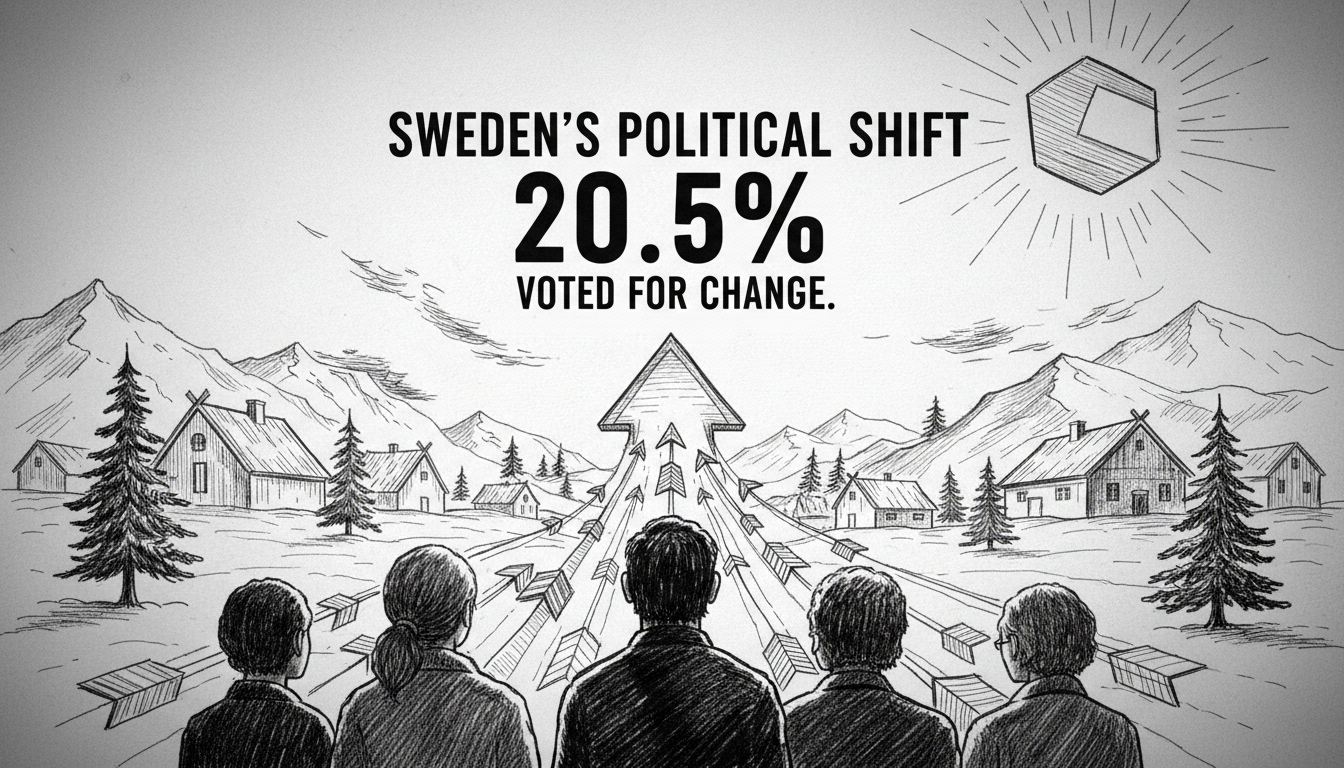
Sweden's political landscape is undergoing its most profound transformation in a generation. The change is felt not just in the Riksdag, but in the quiet conversations held over fika in cafes from Stockholm's Södermalm to Gothenburg's Haga district. The Sweden Democrats, a party with roots in the far-right fringe, secured 20.54% of the vote in the 2022 general election. They are now the second-largest force in parliament. This seismic shift forces a nation built on social democracy to confront new questions about identity, welfare, and its future.
My colleague, Mikael Bergström, has lived in the Stockholm suburb of Rinkeby for twenty years. He remembers a different era. "We had our challenges, but there was a different feeling," he tells me, stirring his coffee. "Now, the national debate about 'problem areas' is constant. It filters down. You feel looked at, categorized. The Sweden I moved to felt more confident, more open." His experience echoes a national tension. Sweden's famed model, built on equality and solidarity, is being stress-tested by rapid demographic change and a hardening political discourse.
The New Political Reality
The rise of the Sweden Democrats from political pariah to powerhouse is the defining story of contemporary Sweden. For decades, the party was shunned by the mainstream. Today, its policies on immigration and law and order heavily influence the governing coalition. The traditional blocs of left and right have shattered. Forming a stable government now requires complex negotiations across new ideological lines. Political analyst Karin Lundgren describes it as a permanent realignment. "The cordon sanitaire is gone," she says. "The Sweden Democrats are no longer on the outside looking in. They are central to policymaking, particularly on integration and crime. This has fundamentally altered how politics is done."
This shift did not happen overnight. It followed a period of high immigration, particularly during the 2015 European migrant crisis. Integration challenges in some neighborhoods, coupled with a rise in gang violence, became focal points for political debate. The Sweden Democrats channeled this anxiety into electoral success. Their message resonated beyond their traditional base, attracting voters who felt the established parties were not listening.
Economic Headwinds and Welfare Worries
The political transformation unfolds against a delicate economic backdrop. Sweden's economy, a powerhouse of innovation and export, contracted by 0.2% in 2023. While the employment rate remains strong at around 82%, concerns about the sustainability of the welfare state persist. The model relies on high employment and a broad tax base. With an aging population and new pressures on public services, the debate over resources has intensified.
At a community center in Malmö, social worker Lena Pettersson sees the pressure firsthand. "The queues for language classes are longer. School resources are stretched," she explains. "When people talk about the welfare state, they are talking about my desk, my classroom. We need calm, long-term planning, not just political headlines." This is the core of the Swedish dilemma: how to maintain generous social benefits while adapting to new demographic and economic realities. The political debate often frames this as a choice between openness and security, a dichotomy many Swedes find frustrating.
A Society Searching for Balance
The conversation in Sweden today is about balance. Can the nation preserve its internationalist, humanitarian ethos while addressing legitimate concerns about social cohesion and order? Cultural events, like the upcoming Midsummer celebrations, become subtle touchpoints. Will they remain a universal symbol of Swedish tradition, or become markers of exclusion or inclusion in a changing society?
Experts point to the Nordic capacity for pragmatism. "Swedes are practical people," says historian David Andersson. "The welfare state itself was a practical solution to old problems. The current turmoil is about finding new solutions. The risk is that the political discourse becomes so polarized that practical compromise becomes impossible." The stability of the governing coalition is fragile, tested by monthly controversies over budget items and policy directions.
What Comes Next?
The path forward is uncertain. The next major electoral test looms with the European Parliament elections. All parties are watching the polls closely. The Sweden Democrats aim to consolidate their gains. The Social Democrats, the traditional leaders of Swedish politics, are struggling to redefine their message for a new era. Smaller centrist parties are caught in a squeeze.
For the average Swede, the changes manifest in daily life. It is in the tone of the news debate, the policies affecting their children's schools, and the sense of national identity. The Sweden of lagom—the principle of just the right amount—is grappling with extremes. The nation that defined the middle way is now navigating its edges.
The ultimate question is whether Sweden can engineer another adaptation of its famous model. Can it integrate new political realities and demographic diversity into a renewed sense of common purpose? The answer will be written not just in parliament, but in town squares, workplaces, and homes across the country. The world, which has long looked to Sweden as a social laboratory, is watching to see what the experiment produces next.