
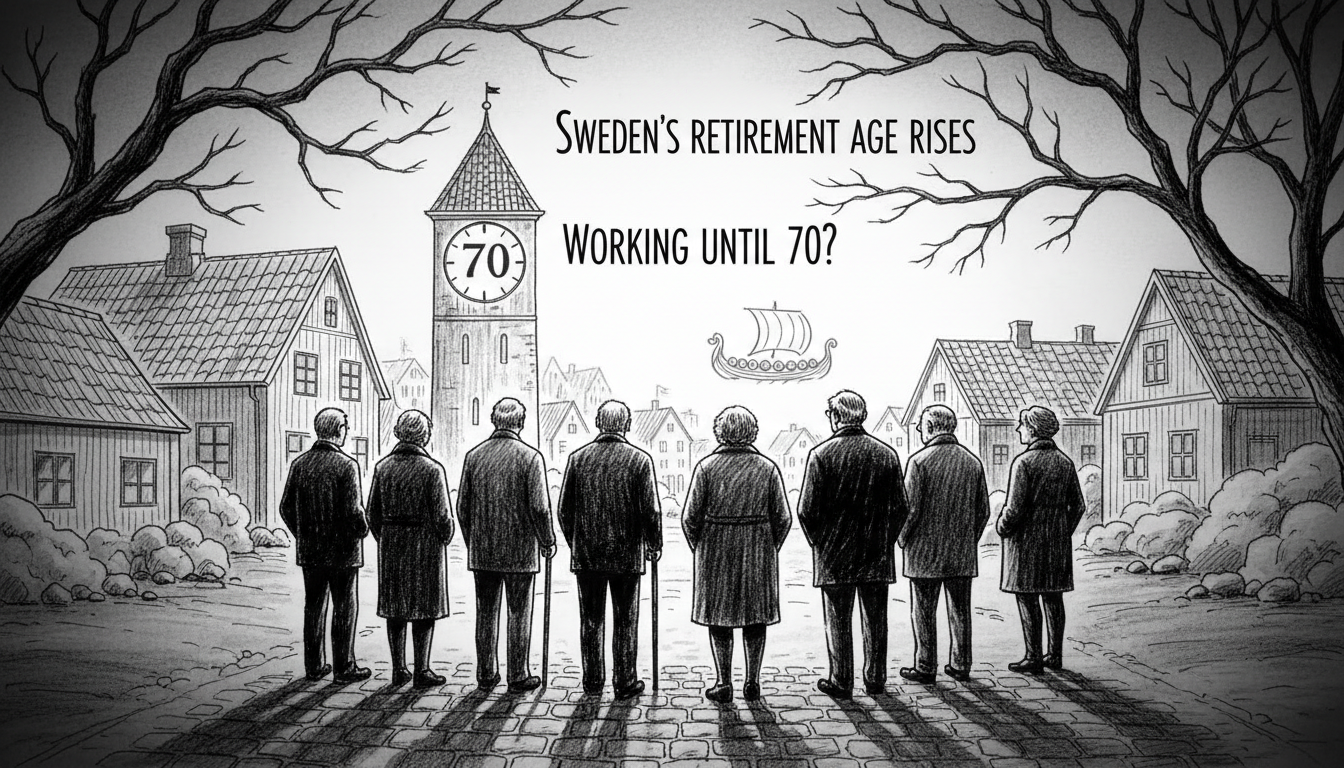
Sweden's retirement age is climbing again, pushing the standard target for a full pension to 67 for those born in 1963 and later. For younger Swedes, the forecast is even starker. Official projections now suggest anyone born after 1981 may not reach their official 'riktålder'—the target retirement age—until they turn 70. The news is a cold dose of actuarial reality, forcing a national conversation about work, life, and what a sustainable future really means.
I met Elin, a 24-year-old preschool teacher, at a café in Stockholm's Södermalm district. She stirred her latte slowly. 'I love my job, I really do,' she said. 'But the idea of doing it for another 46 years? It feels endless. You start to wonder, when is the time for me? When do I get to just be?' Her sentiment echoes across fikabröd and office kitchens. The promise of a long, secure retirement—a cornerstone of the famed Swedish welfare model—is being stretched thin by longer lifespans.
The Mechanics of a Moving Target
Sweden's pension system is often held up as a model of sustainability. A major reform in the 1990s fundamentally changed the rules. Gone was the fixed retirement age of 65. In its place came a system explicitly tied to life expectancy. The key concept is the 'riktålder' or target age. This isn't a forced stop-work date. Instead, it's the age the system calculates you need to reach to draw a full pension without reductions, based on the nation's average lifespan. If you retire earlier, your monthly pension is permanently lower. If you work longer, it increases.
'It's a automatic balance mechanism,' explains financial economist Lars Hultkrantz, a professor who has studied the pension reforms. 'As we live longer, the system adjusts to maintain financial stability. The alternative—not adjusting—would mean drastically lower pension payments for future generations.' The adjustment happens annually, but the public notices it most when a new birth cohort crosses a threshold. For those born in 1963, that threshold is now 67. For their children, it will be higher.
A Generation Gap in Retirement Prospects
The change creates a palpable generational divide. Those now in their 60s are largely grandfathered into the older system or face smaller adjustments. The real weight falls on millennials and Gen Z. 'We're the first generation to truly feel this shift in our bones,' says Markus, a 31-year-old IT consultant in Gothenburg. 'My parents retired at 65. My grandfather retired at 65. For me, 65 is just another workday. The goalposts have moved, and I have to plan my entire life—savings, housing, family—around a horizon I can't even see clearly.'
This planning is complicated by the structure of the Swedish pension. Your future income rests on three pillars: the 'inkomstpension' (income pension, based on lifetime earnings), the 'premiepension' (premium pension, a defined-contribution investment account), and the 'garantipension' (a safety-net top-up for those with low or no income history). The stability of the whole system depends on a high ratio of workers to pensioners. With an aging population, that ratio is under pressure.
The Human Cost of Economic Logic
While the economic logic is clear, the human impact is messy. Not all jobs are created equal. A university professor or a policy analyst might comfortably work into their late 60s. But what about a nurse, a construction worker, or a preschool teacher like Elin? 'My back already hurts some days after lifting children,' she notes with a wry smile. 'The physical and emotional demand is huge. The idea of doing this at 69 feels impossible. Does the system expect me to change careers at 55?'
This is the central tension. The system assumes longer working lives are universally feasible and desirable. Reality is more nuanced. Health, job satisfaction, and the physical nature of work vary dramatically. Some experts argue for more targeted support, like earlier retirement options for strenuous professions, funded by later retirement for less physically demanding jobs. Others stress the importance of lifelong learning and career mobility to help people transition.
Redefining 'Retirement' in a Long-Life Society
The conversation in Sweden is gradually shifting from just 'retirement age' to 'working life.' There's a growing focus on workplace health, flexible hours, and 'omställning'—the ability to reskill and change careers mid-life. The concept of a single, cliff-edge retirement is becoming outdated. Instead, many envision a gradual 'phasing out,' mixing part-time work with partial pension draws. The system technically allows for this flexibility, but cultural and employer norms often lag behind.
'We need to stop seeing this as a purely negative story,' argues Sofia Ritzén, a researcher at the Swedish Institute for Social Research. 'Yes, the age is rising. But the potential for a longer, more varied life arc is also there. The challenge is building a society that supports that arc—with healthy workplaces, continuous education, and a social safety net that doesn't just begin at 70.'
Looking Ahead with Cautious Pragmatism
Walking through the vibrant streets of Stockholm's Hornstull market, you see the full spectrum of Swedish life. Elderly couples browse design goods, young parents push prams, and people of all ages work in bustling cafes. The pension question hangs over all of them, a shared concern that binds generations even as it divides their experiences.
The Swedish model has always been built on pragmatism and collective responsibility. This latest adjustment is a stark example. It prioritizes the system's survival for the many over the traditional retirement timeline for the individual. The coming decades will test whether that system can also adapt to be genuinely humane—recognizing that while we may live longer, our capacity for certain kinds of work does not automatically follow suit.
For Elin and her peers, the message is clear: trust in the state pension alone is a risky strategy. Personal savings, private pension insurance ('tjänstepension'), and investing their 'premiepension' wisely have become non-negotiable parts of adult life. The social contract is being rewritten, one birth year at a time. The final question remains: can Sweden craft a new version of security for its citizens, or will a longer life simply mean more years of uncertainty?