
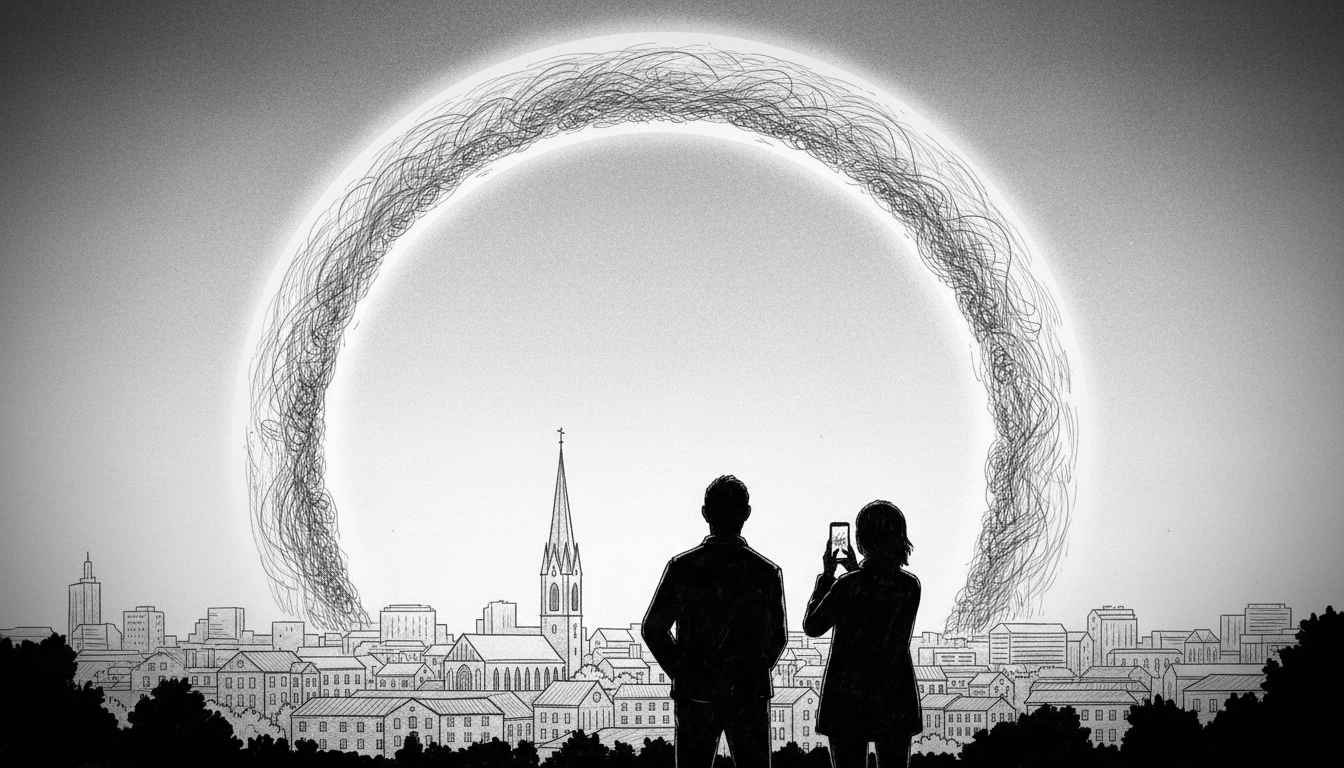
Sweden's second city, Gothenburg, paused on a Tuesday morning as a perfect golden ring materialized around the sun. The luminous circle, a 22-degree halo, captivated residents who stopped on sidewalks and in parks to point their phones skyward. This weather phenomenon, while scientifically common, felt like a moment of shared magic for the coastal city.
"I was walking to a meeting in Haga and just had to stop," said local photographer Erik Lundström. "Everyone on the street was looking up. For a few minutes, we were all just strangers sharing something beautiful. It’s the kind of moment that defines a day." The halo remained visible for nearly an hour, its intensity shifting with the high, thin clouds.
The Science Behind the Magic
Linnéa Rehn Wittskog, a meteorologist at the Swedish Meteorological and Hydrological Institute (SMHI), explains the phenomenon with clear, accessible science. "The halo appears because of ice crystals in the air," she says. "When sunlight passes through these hexagonal crystals, it bends or refracts at a specific angle—22 degrees—creating the circle we see." She notes that while halos are not rare, their prominence depends on specific atmospheric conditions.
Contrary to popular belief, they don't only appear in bitter cold. "It can happen even when it's not cold at ground level," Wittskog clarifies. "We need high clouds, like cirrus or cirrostratus, which contain ice crystals. Today's halo was lower and more vivid because the air at that level had the right combination of moisture and temperature." This visibility made Tuesday's event particularly striking for Gothenburg's residents.
A Recurring Guest in Nordic Skies
Atmospheric optics are a familiar part of the Nordic experience. From the midnight sun to the northern lights, Swedes have a long cultural relationship with celestial displays. Halos, sun dogs, and light pillars belong to this family of phenomena. They are especially frequent in late autumn, winter, and early spring when cold, moist air masses are common.
"We probably get conditions suitable for halos dozens of times a year," Wittskog estimates. "But people often miss them. You need to look up at the right moment, and the sun's brightness can sometimes obscure the ring." The event in Gothenburg succeeded because it occurred during a busy morning commute under a partially veiled sun, making the ring distinct against a softer sky.
This shared experience highlights a subtle aspect of Swedish culture: an appreciation for nature's interruptions. The concept of 'fika'—a deliberate coffee break—extends to these spontaneous pauses for a sunset or a sudden snowfall. The halo provided a collective, city-wide 'fika' moment, documented not by news crews but by hundreds of personal smartphones.
More Than Just a Weather Event
The reaction on social media and in conversations across the city revealed something deeper. In an age of curated digital content, a natural, ephemeral spectacle still commands universal attention. Parents pointed it out to children on the school run. Office workers gathered at windows. It was a unifying, non-digital event in the heart of a modern city.
Johan and Frida Berg, teachers at a school in Majorna, used the event as an impromptu science lesson. "The kids were fascinated," Frida said. "It was a perfect teachable moment about light, weather, and perception. It’s one thing to read about it in a book, another to stand in the schoolyard and see it happen above you." This illustrates how such phenomena are woven into the fabric of daily Swedish life, blending education with everyday wonder.
Cultural historian Dr. Elsa Moberg, author of "Nordic Light: Culture and Climate," suggests these events resonate because of Sweden's specific relationship with light. "We are a people profoundly affected by the changing light," she notes. "We celebrate the summer solstice and endure the dark winters. So when the sky presents an unexpected gift of light—a halo, northern lights, a particularly vivid sunset—it touches something fundamental. It’s a break in the ordinary, a reminder of the natural world's artistry."
Why This Halo Felt Different
Tuesday's halo was notable for its timing and location. Appearing over a major urban center during a workday, it reached a massive audience. Had it occurred over a remote forest in Norrland, it might have gone largely unnoticed. Its placement over Gothenburg's iconic landmarks—the Göta älv river, the Lipstick building, the bustling streets of Linnéstaden—created a striking contrast between human architecture and natural spectacle.
Furthermore, the quality of the light in late autumn in Sweden has a particular, low-angled clarity. The sun doesn't climb high, casting long shadows and a golden hue. This ambient light likely enhanced the halo's golden color, making it more photogenic and emotionally resonant than a faint, white ring might have been in high summer.
Looking Up in a Digital Age
The event prompts a simple question: how often do we look up? In our daily routines, focused on screens and sidewalks, the sky becomes mere background. A phenomenon like the Gothenburg halo forces a shift in perspective, literally and figuratively. It is a democratic spectacle, free and accessible to anyone who steps outside.
This aligns with the Swedish principle of 'Allemansrätten,' or the right of public access. It grants everyone the freedom to roam and enjoy nature. While typically applied to forests and coastlines, the sentiment extends to the sky. No one owns the halo; it is a temporary public art installation for the entire city.
As climate patterns shift, the frequency and nature of such optical phenomena may change. Warmer air holds more moisture, which could alter cloud composition. Scientists like Wittskog monitor these changes, but for the public, each halo remains a unique event. It is a reminder of the complex, beautiful, and often overlooked physics constantly at play in the atmosphere above us.
A Moment of Shared Wonder
Ultimately, the story of the golden ring over Gothenburg is not just a weather report. It is a snapshot of a city momentarily united in awe. It cut across the usual divisions of age, profession, and neighborhood. In the districts of Örgryte and Frölunda, in the central station and the docks of Frihamnen, people shared the same view.
These collective experiences are the threads of community. They become shared memories—"remember that Tuesday morning with the ring around the sun?" In a world often segmented by digital algorithms and busy schedules, a natural light show offers a profound, if fleeting, connection. The halo has dissipated, the ice crystals have moved on, but the sense of shared wonder lingers in Sweden's vibrant west coast city. It serves as a gentle prompt to occasionally break our routine, look beyond our immediate surroundings, and appreciate the unexpected beauty that can appear, quite literally, out of thin air.