
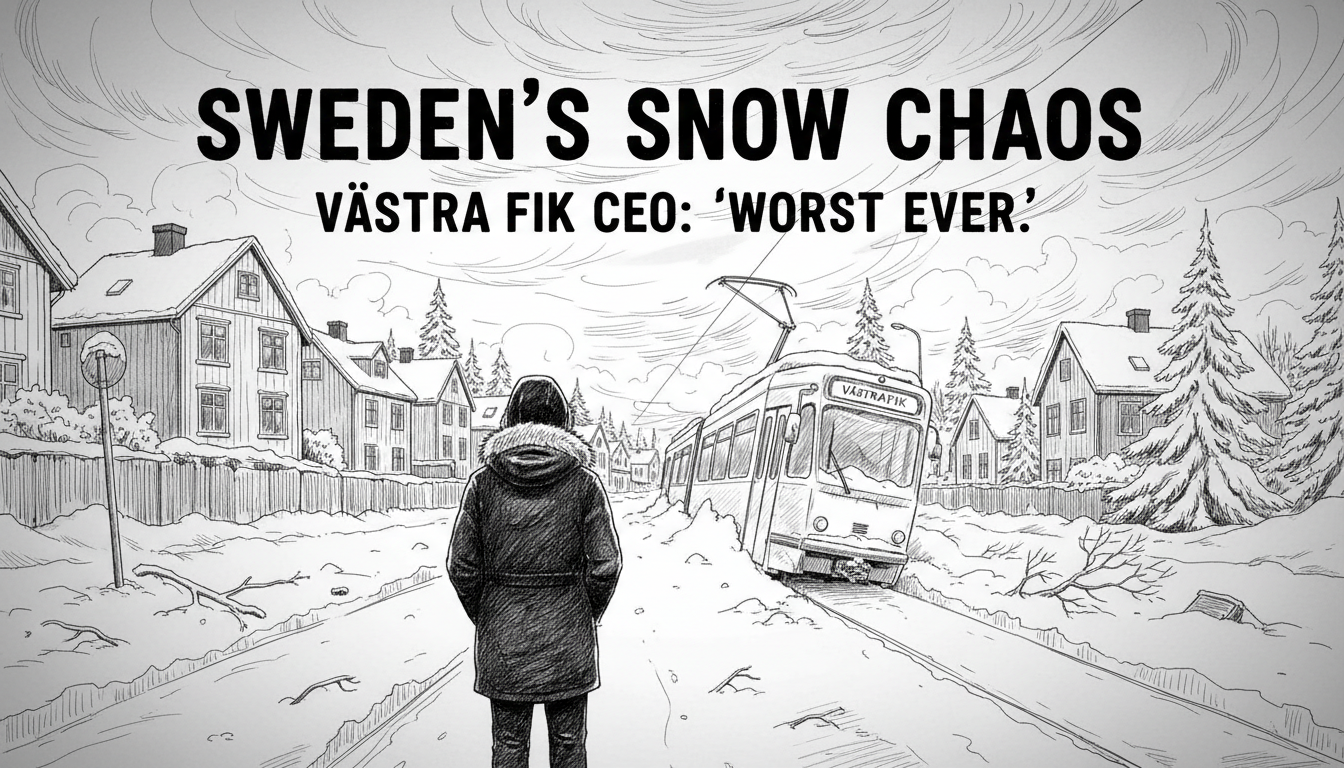
Sweden's public transport system faced a severe test this week. A heavy snowstorm paralyzed the West of the country, halting buses, trams, and trains across the region. Västtrafik CEO Lars Backström described the disruption as among the worst he has seen in his career. The chaos left thousands of commuters stranded and sparked a major debate about Sweden's winter preparedness.
Lars Backström, the head of the region's public transport authority, did not mince words. He stated that the situation was unique and exceptionally severe. While he refrained from a full review of the company's response, his stark assessment highlighted the scale of the crisis. For many Swedes, a society built on reliability and punctuality, the breakdown was more than an inconvenience. It was a cultural shock.
A Region Brought to a Standstill
The snow arrived with a vengeance, blanketing Gothenburg and surrounding municipalities. Roads became impassable, and rail lines froze. Commuters faced hours-long delays or complete cancellations. Social media filled with images of packed platforms and empty timetables. People shared stories of abandoning their journeys and seeking shelter with friends or in cafes. The disruption cut deep into the daily rhythm of Swedish life, where trust in a functioning infrastructure is a given.
In neighborhoods like Majorna and Haga, normally bustling with trams, an unusual silence fell. The storm tested the famous Swedish concept of 'förutsägbarhet' – predictability. This incident shows that even the most robust systems have their limits. It raises questions about how a nation so accustomed to harsh winters can be so vulnerable to a single storm. The event felt particularly jarring in a country that prides itself on mastering its environment.
The CEO's Assessment and Public Reaction
Lars Backström's public statement was careful but telling. By calling it one of the worst snow disruptions in his years of experience, he acknowledged the extraordinary nature of the event. He stopped short of a detailed critique of Västtrafik's actions, likely pending a full internal review. This balance is typical of Swedish crisis management: acknowledge the problem, commit to analysis, but avoid premature conclusions. The public reaction, however, was less measured.
Many residents expressed frustration online and in local forums. Questions focused on preparedness. Were there enough snowplows? Were de-icing protocols followed? For a service funded by taxpayer money and monthly travel cards, expectations are high. The incident touches on a core part of the Swedish social contract: citizens pay high taxes for smooth, efficient, and dependable public services. When that trust is broken, even by an act of nature, the response is intense.
Cultural Context: Winter as a Managed Reality
Swedes have a complex relationship with winter. It is both a cherished part of the national identity, associated with coziness ('mys') and outdoor life, and a logistical challenge to be conquered. Annual winter tire changes are a ritual. Municipalities have detailed snow clearance plans. This week's chaos, therefore, feels like a system failure on a psychological level as well as a practical one. It wasn't just about getting to work; it was about a break in the expected order.
Comparisons will inevitably be drawn to Stockholm's transport system, SL, and how it handles similar weather. While this storm hit the west hardest, it serves as a national case study. The event coincides with ongoing debates about infrastructure investment and climate change, which may bring more frequent and intense weather events. Can Sweden's public transport, a backbone of its green transition, withstand these new pressures?
Looking Ahead: Accountability and Adaptation
The coming days will see increased pressure on Västtrafik for a transparent review. The Swedish principle of 'offentlighetsprincipen' – freedom of information – means the public will expect details. What specific challenges caused the collapse? Was it equipment failure, staffing issues, or a perfect storm of conditions that overwhelmed all protocols? The answers will shape not only Västtrafik's future plans but also policies in other regions.
This is more than a story about a snowy day. It's a story about modern Sweden. It's about the tension between nature and technology, between public expectation and operational reality. For international observers, it's a glimpse into the high standards Swedes set for their society and the visible strain when those standards are not met. The true test will be in the response: how lessons are learned and implemented before the next winter test arrives.
As the snow melts and services slowly return to normal, the memory of the disruption will linger. It serves as a stark reminder that in a country famed for its design and efficiency, nature still holds the ultimate veto. The question now is whether this event becomes a footnote or a catalyst for strengthening the systems millions rely on every day. For now, commuters are left hoping that the CEO's assessment of this being a rare, worst-case scenario proves true, and not a sign of winters to come.