
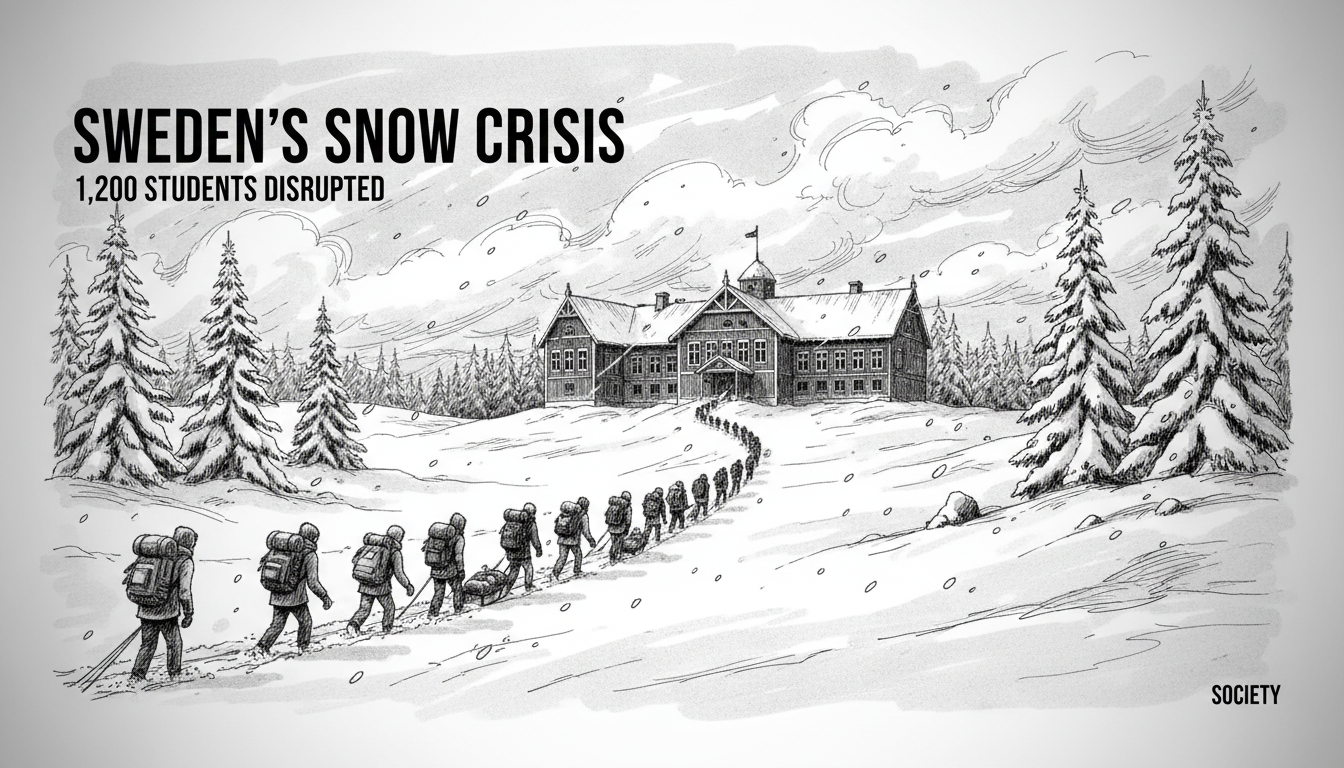
Sweden's major cities faced widespread educational disruption as a severe snowstorm forced school closures and exam cancellations. Gothenburg's municipal high schools suspended all on-site teaching for Thursday, while 1,200 students at Chalmers University of Technology had exams postponed. The decision highlights the ongoing challenge Swedish municipalities face in balancing safety with educational continuity during extreme weather.
Gothenburg's education chief, Bo Drysén, confirmed the blanket closure in a public statement. "The general direction is that we have no on-site teaching due to the weather situation," Drysén said. He noted potential exceptions where individual school administrations would contact affected students directly. This top-down directive from the city's central education office illustrates the municipal government's risk-averse approach during weather emergencies.
A Patchwork of Municipal Responses
While Gothenburg enacted a broad closure, the response varied significantly across western Sweden and within institutions. Uddevalla Municipality, north of Gothenburg, cancelled all school transport for the day but did not initially order full school closures. This created a scenario where schools remained technically open, but many students could not attend. The differing policies between neighboring municipalities often confuse parents and reveal a lack of regional coordination.
Higher education institutions displayed even greater disparity. Chalmers University of Technology postponed all scheduled exams, impacting 1,200 students. These exams were rescheduled for Friday, anticipating improved conditions. Conversely, the University of Gothenburg largely proceeded with exams as planned, despite significant snow and cancelled public transport. A university communicator stated that cancellations were decided by individual departments, leading to an inconsistent experience for students across campuses.
The Infrastructure and Policy Challenge
The storm's impact underscores a critical tension in Swedish public policy between decentralization and coherent crisis management. Sweden's Education Act grants municipalities and individual school principals considerable autonomy. During a crisis, this can result in a fragmented response, as seen in the contrast between Gothenburg's unified closure and Uddevalla's transport-only cancellation. There is no national mandate for weather-related school closures, leaving 290 municipalities to set their own guidelines.
This event is not isolated. Similar disruptions occur almost every winter, prompting debate about preparedness. Critics argue that Swedish cities, particularly coastal ones like Gothenburg, should have more robust plans for maintaining core services. Proponents of local decision-making counter that conditions can vary dramatically between districts, necessitating flexible, localized responses. The Swedish National Agency for Education provides general advice but no binding rules, placing the operational burden on local politicians and officials.
Economic and Social Ripple Effects
Beyond education, such closures create immediate economic and social pressures. Parents, often with little notice, must arrange childcare or take time off work. For single-parent households or families in precarious employment, this can mean lost income. The closures also interrupt school-based services like free lunches, which are a vital support for many children. These social costs are rarely quantified in municipal decision-making processes focused primarily on immediate safety.
For students, especially those in their final year of gymnasium (high school) or preparing for university entrance, cancelled exams create anxiety and logistical headaches. Rescheduling requires coordinating venues, invigilators, and student timetables, often compressing the academic calendar. Universities face administrative burdens and potential delays in grading, which can affect graduation timelines and subsequent admissions. The 1,200 Chalmers students affected must now recalibrate their study schedules under pressure.
Analyzing the Decision-Making Process
The decision to close schools is multifaceted. Municipal officials like Drysén must assess weather forecasts, road conditions from the Swedish Transport Administration, and public transport status. They consult with emergency services and consider the safety of students and staff travelling from outlying areas. The choice often comes down to a precautionary principle: erring on the side of safety to avoid even a single serious accident. This principle, while morally sound, has operational consequences that ripple across society.
In Gothenburg's case, the decision likely considered the city's notorious vulnerability to snow. Its coastal location can lead to wet, heavy snow that quickly paralyzes transport networks. The municipality's centralized decision for all its high schools suggests a judgment that the risk was widespread and uniform. This contrasts with a potential model where each school principal assesses their specific local conditions, which might allow some schools in less-affected areas to remain open.
A Comparative Look at Nordic Preparedness
Sweden's experience invites comparison with its Nordic neighbors. Norway, with more predictable and heavier winter conditions, often has more ingrained protocols. Finnish cities like Helsinki are famed for their efficient snow clearance, minimizing disruptions. Sweden's southern and western coastal regions, however, experience more volatile winter weather—fluctuating between rain, sleet, and snow—which complicates planning and response. This meteorological reality makes perfect preparedness a significant and costly challenge.
The Swedish government's role is largely indirect. While the Swedish Civil Contingencies Agency (MSB) promotes societal resilience, it does not mandate specific actions for schools. Ultimately, the political accountability rests with municipal councils and their appointed education chiefs. Voters in affected areas may judge their local politicians based on the perceived balance struck between caution and unnecessary disruption. These winter episodes become periodic tests of local government competence.
The Path Forward: Technology and Policy
Future improvements may lie in better technology and clearer communication. Enhanced, hyper-local weather modeling could allow for more precise, district-by-district decisions. Unified digital communication platforms could ensure parents receive consistent, timely information from all schools and municipalities. Some policy analysts suggest developing a tiered alert system, similar to those for storms or floods, with predefined actions for different warning levels from the Swedish Meteorological and Hydrological Institute (SMHI).
However, any move toward standardization conflicts with Sweden's deep-seated principle of municipal self-rule. A mandate from the Swedish government or the Riksdag requiring specific closure protocols would be politically contentious. The more likely evolution is a soft coordination, where municipalities voluntarily align their guidelines and share best practices. The Swedish Association of Local Authorities and Regions (SALAR) often facilitates such cooperation, but it remains non-binding.
This week's closures serve as another annual stress test for Sweden's decentralized public administration. They reveal the strengths of local accountability and the weaknesses of inconsistent responses. As climate change potentially increases the frequency of extreme weather events, the pressure to find a more seamless balance between safety, education, and societal function will only intensify. The snow will melt, but the policy debate it triggers is perennial. The fundamental question remains: in a modern society, how much disruption from snow is acceptable, and who gets to decide?