
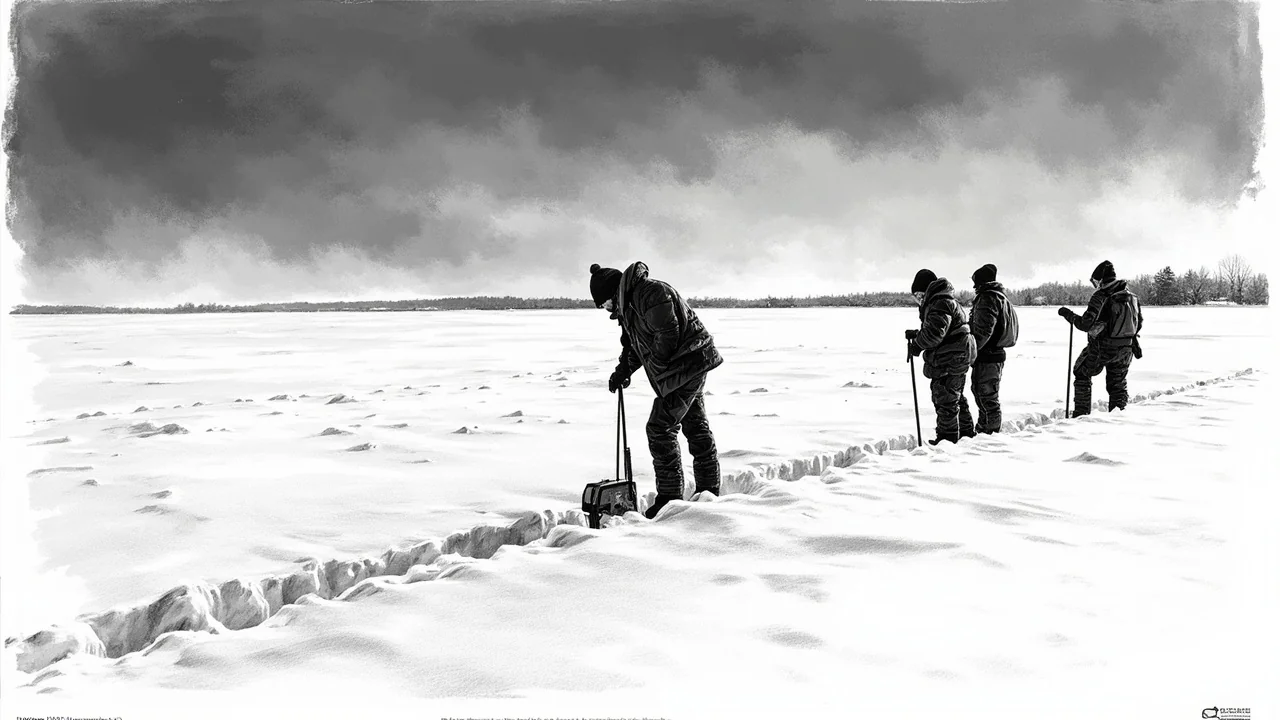
Sweden's official weather data relies on citizens like Micael Broberg, who measures snowfall at 7 AM daily. In Gullunge, north of Stockholm, he recently recorded a snow depth of 55 centimeters after a severe winter storm. This measurement is part of a critical national network managed by the Swedish Meteorological and Hydrological Institute (SMHI). Broberg's work provides the raw data that shapes national weather warnings, informs infrastructure planning, and influences climate policy debated in the Riksdag.
Every morning at seven, regardless of weekend or holiday, Broberg steps onto his property. He is one of hundreds of volunteer weather observers across Sweden who maintain personal measurement stations. His location in Gullunge, a rural area outside Norrtälje, was specifically chosen by SMHI for its ideal conditions. "I report to SMHI how much it has rained or snowed and what the temperature is outside," Broberg explains. His routine is a small but vital cog in Sweden's environmental monitoring bureaucracy.
The Science Behind the Snow Gauge
The precision of these measurements is paramount. Broberg does not simply measure in one spot. To obtain an accurate average snow depth, he takes measurements at several locations within his designated area. "It should be an open place where snow doesn't drift into piles," he notes, describing the strict site criteria. This method prevents anomalous readings from wind-blown drifts, ensuring data reflects genuine precipitation. Gullunge has been one of the hardest-hit areas in Stockholm County during recent snowstorms, making Broberg's consistent readings particularly valuable for regional authorities.
The 55-centimeter reading is significant. It represents a substantial snowfall event that tests municipal resources and triggers specific emergency protocols. This data point flows directly into SMHI's models, which are used by the Swedish Transport Administration (Trafikverket) to deploy snowplows and by energy companies to forecast heating demand. The Swedish government's crisis preparedness agency, MSB, also monitors such data to coordinate regional responses if necessary.
From Garden to Government Policy
The chain of data from Broberg's garden to the halls of Rosenbad, the Swedish government offices, is a testament to decentralized public administration. SMHI's network of observers creates a high-resolution picture of Sweden's climate. Long-term datasets from these stations are crucial for tracking climate change impacts, a central issue for the Swedish Parliament. Policy decisions on infrastructure investment, environmental targets, and carbon taxation are all informed by this grassroots-collected information.
While not a direct government employee, Broberg's role is formalized. SMHI provides training and equipment, standardizing measurements across the country. This system, blending professional oversight with civic participation, is a cost-effective model for national data collection. It embodies a Swedish approach to public knowledge: systematic, reliable, and built on broad societal contribution. The data influences everything from local school closure decisions to national reports submitted to the European Environment Agency.
The Human Factor in a Digital Age
In an era of automated weather stations and satellite surveillance, the human observer remains irreplaceable for certain parameters. Snow depth, particularly in varied terrain, requires a human judgment call to find a representative, undisturbed area. Observers like Broberg also note qualitative conditions like ice formation on lakes or the onset of ground frost, details automated systems might miss. Their consistent, long-term presence at a fixed location provides a stable data series that is gold standard for climatologists.
"There's a lot to shovel," Broberg remarks with the understatement characteristic of those performing essential, unglamorous work. This simple statement underscores the real-world implication of the numbers he records. Heavy snowfall disrupts daily life, closes roads, and strains public services. The accuracy of his measurement helps predict the scale of that disruption. It allows neighboring municipalities to gauge the severity of the weather event hitting their region and prepare accordingly.
Analysis: Data Integrity and Democratic Accountability
The reliability of Sweden's environmental policy rests on the integrity of data gathered by people like Micael Broberg. When ministers in Stockholm announce climate adaptation funds or new emissions targets, they are ultimately relying on thousands of individual measurements taken in fields and backyards. This creates a direct, though often invisible, link between citizen science and high-level government policy in Sweden. The system functions on trust and a strong civic ethos.
Potential challenges for this model include recruiting new observers in a digital age and maintaining funding for SMHI's coordination role. However, the value of this granular, localized data is only increasing as climate change makes weather patterns more volatile and unpredictable. The detailed snowfall maps generated from this network are used by researchers modeling hydrological cycles, which affect water management and energy production from hydroelectric power.
Ultimately, the morning ritual in Gullunge is more than a personal hobby. It is a small act of civic participation that strengthens the empirical foundation of the Swedish state. In a country where policy is intensely data-driven, from the Riksdag's committee reports to municipal snow clearance budgets, the individual observer's contribution, though modest, is structurally significant. The quiet dedication of these volunteers ensures that Sweden's understanding of its own environment is rooted in observable, recorded fact, not just satellite imagery or computer models. As winter tightens its grip, the nation's response depends on the accuracy of their readings.