
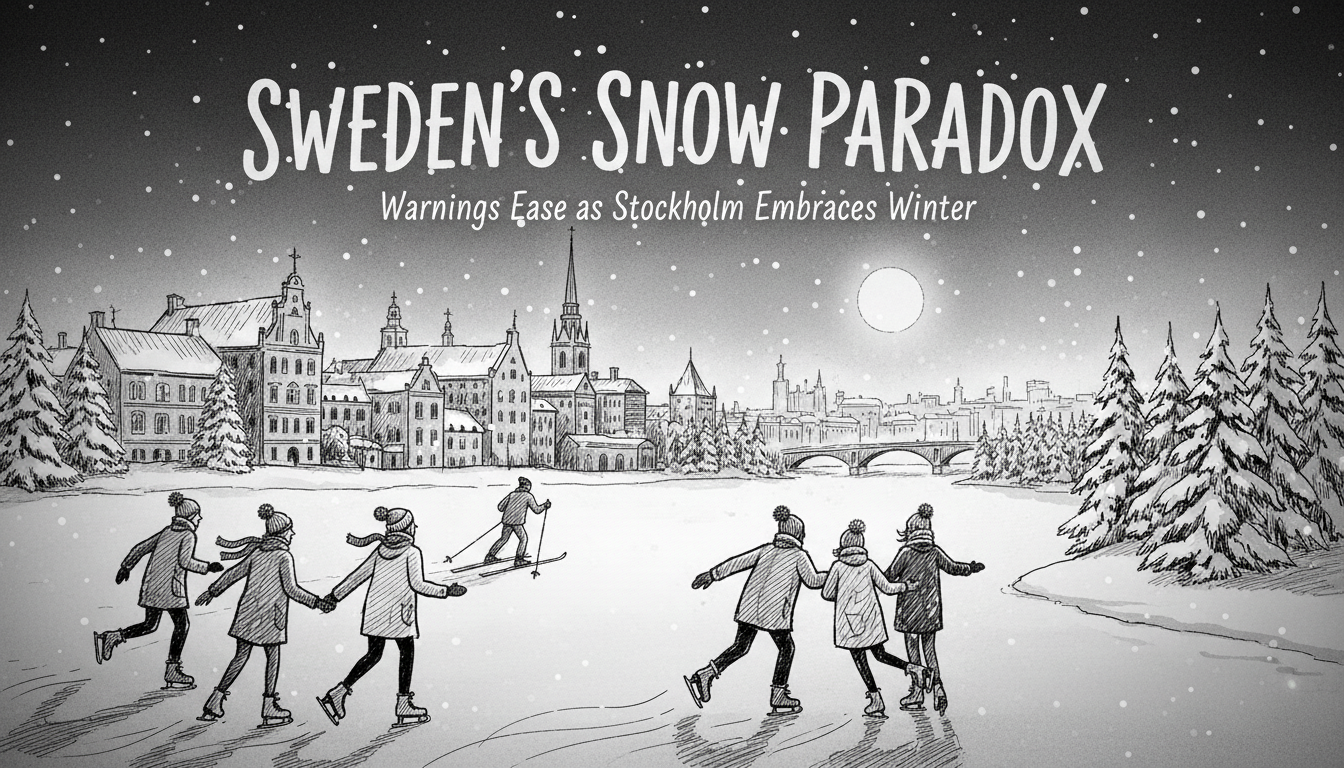
Sweden's latest snowstorm brought official warnings and travel chaos, but across Stockholm, a different story unfolded. As the Swedish Meteorological and Hydrological Institute (SMHI) lifted its orange and yellow weather alerts earlier than planned, residents met the heavy snowfall not with frustration, but with widespread contentment. The orange warning for intense snowfall ended at 3:00 AM instead of the forecasted 12:00 PM Sunday. The yellow warning also concluded early, at 6:00 AM Sunday morning. This shift reflects the storm passing quicker than expected, yet the city's mood remained brightly fixed on the snow itself.
"It absolutely lights up the whole city," said Elias Berg, a barista in Vasastan, sweeping fresh powder from the sidewalk outside his café. "The grey November gloom is gone. Everyone looks happier, even if they're slipping a bit." His sentiment echoed across Stockholm's social media feeds and neighborhood squares. In Vitabergsparken in Södermalm, children on sleds shrieked with joy. On Djurgården, cross-country skiers glided through fresh tracks. The anticipated disruption transformed into a citywide, if temporary, embrace of winter's arrival.
The Forecast Versus the Feeling
SMHI's warnings were serious and standard for the region. An orange warning signals a high impact on society, with the potential for major traffic disruptions and power outages. A yellow warning advises the public to be cautious. The decision to lift them early was based on updated models showing the intense snowfall concentrating over southern Stockholm and towards Nynäshamn, then passing. "The worst of the precipitation has moved through the central areas," a meteorologist at SMHI explained in a statement. "The risk remains for localized issues, but the broader, intense warning is no longer justified for the entire region."
This professional caution contrasts sharply with the public's reception. For many Stockholmers, especially those who remember milder winters, a proper snowfall is a cultural event. It triggers a collective memory of childhood winters and reshapes the urban landscape into a quieter, softer version of itself. The sound of the city muffles. The lights from shop windows and streetlamps reflect off a clean, white blanket. "There's a 'mysig' feeling that comes with it," said Lena Forsberg, a teacher in Årsta, using the Swedish term for cozy or snug. "It forces you to slow down, to put on proper clothes, to maybe walk instead of bike. It's a reminder of the season."
Navigating the Practical Challenges
Of course, the snow presented real hurdles. Commuters faced delays on the Pendeltåg commuter rail and bus lines. Road conditions required extra vigilance, and city snowplows worked through the night. At Arlanda Airport, some flights experienced delays due to de-icing procedures. For new arrivals to Sweden, the experience can be daunting. "My first winter here, a snowstorm like this would have terrified me," admitted Anika Sharma, who moved from Mumbai five years ago and now lives in Kungsholmen. "Now I understand the system. The plows come quickly. People help dig out cars. You learn to wear layers. It's a practical challenge the city is built for."
This preparedness is key. Stockholm's infrastructure, from its heated bus stops in some areas to its fleet of plows, is designed for this weather. The early lifting of the SMHI warnings indicates the system worked as predicted, allowing authorities to scale down their alerts. Yet, the societal response goes beyond mere logistics. It touches on a fundamental aspect of Swedish lifestyle: "friluftsliv," or open-air life, regardless of the weather. The snow becomes an invitation, not a barrier.
A Cultural Embrace of the Elements
In Sweden, winter is not something to be merely endured but often actively enjoyed. The snowfall coincided with the beginning of Advent, a period rich with light-themed traditions against the darkness. The sudden whiteness amplifies the glow of candlelit windows and the stars of Lucia Day preparations. In parks across the city, from Hagaparken to Tantolunden, you'll see people of all ages on skis, a normal mode of winter transportation. "I skied to the grocery store," said Magnus Edström, a retiree in Bromma. "It's faster than walking through the snow, and it's fun. Why wouldn't you?"
This attitude is a cornerstone of Swedish society. It reflects a relationship with nature that accepts its extremes. The snowstorm, therefore, is framed differently here than in many other European capitals. While it is a meteorological event with concrete impacts, it is also a seasonal marker, a source of beauty, and a catalyst for outdoor activity. The buzz in local Facebook groups wasn't just about road closures; it was about the best hills for sledding and which forest trails had been freshly groomed for skiing.
Looking Ahead at a Changing Climate
The positive reaction to this storm also exists against a backdrop of climate anxiety. Recent years have seen worryingly mild and snow-poor winters in southern Sweden. Scientists have consistently linked this trend to broader global warming patterns. A substantial early-winter snowfall, therefore, can feel like a return to normalcy, a comforting sign of a stable seasonal cycle. "Every good snowfall like this is a relief," said Karin Lundström, an environmental scientist. "It provides insulation for plants and groundwater recharge. But we have to look at long-term trends. One storm doesn't change the concerning pattern of warmer average winter temperatures."
This adds a layer of poignancy to the public joy. The snow is appreciated not just for its immediate beauty and fun, but perhaps subconsciously for its familiarity in a changing world. It represents the winter Swedes remember and hope to preserve. The sight of children building a snowman in a park is not just a cute scene; to many, it's a hopeful symbol of seasonal continuity.
The Stockholm Snow State of Mind
As Sunday dawned with the warnings lifted and the skies clearing, Stockholm was left transformed. The city moved from a state of alert to a state of enjoyment with remarkable speed. The snowplows continued their work, but so did families heading out for winter walks. Cafés filled with people in snow-dusted jackets. The storm passed, but the light it brought—both literal and metaphorical—remains.
The Swedish approach to a snowstorm offers a lesson in resilience and perspective. It involves heeding official warnings and preparing for disruption, but then consciously choosing to find the value in the weather itself. It is a blend of practical preparedness and philosophical acceptance. In the end, the biggest story wasn't the chaos the snow might have caused, but the quiet contentment it delivered. As the sun sets on a white Stockholm, one question lingers: in an era of climate uncertainty, will future generations get to experience this same, simple winter joy?