
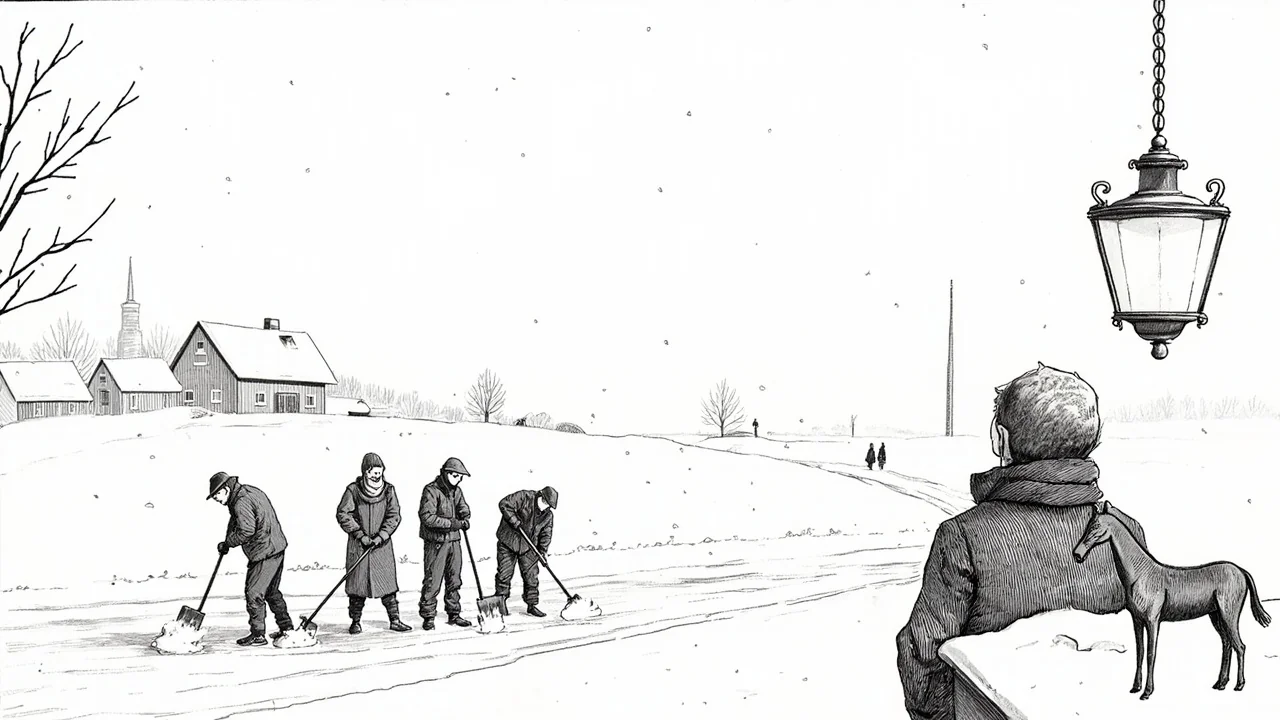
Swedish workplace culture faces a stress test when heavy snow paralyzes Gothenburg. Two of the city's largest employers took starkly different paths this week. Liseberg amusement park paid all scheduled staff their full wages despite the shutdown. Meanwhile, the Sahlgrenska University Hospital required employees to use vacation or flex time. This split reveals a deeper conversation about responsibility, security, and Sweden's famed social contract during climate uncertainty.
A City Grinds to a Halt
Wednesday morning transformed Gothenburg's streets into impassable white ribbons. Buses stopped. Trams stalled. For many, the commute was impossible. This left thousands facing a dilemma: risk a dangerous trip or stay home and lose pay. In Sweden, there's no universal legal right to paid leave for weather disruptions. The decision falls squarely on employers. This creates a patchwork of policies that employees often discover only when the snow falls. The contrast between Liseberg and Sahlgrenska, two pillars of the city's community, put this issue in sharp relief.
The Amusement Park's Guarantee
Liseberg, a cornerstone of Gothenburg's identity, made a clear choice. They announced all employees scheduled for Wednesday would receive their standard pay. The park was closed, but the payroll wasn't. This decision aligns with the company's familial reputation. It treats its seasonal and permanent staff as valued members, not just hourly labor. In a statement, management emphasized stability for their team during unpredictable events. For a young ride operator or a café worker, this meant financial security during a chaotic day. It’s a policy that builds long-term loyalty in a competitive service industry.
The Hospital's Practical Reality
Sahlgrenska, one of Northern Europe's largest hospitals, operates under different pressures. Essential medical staff were needed on-site, crisis or not. But for many administrative and support roles, working remotely was an option. The hospital's directive asked non-essential staff who couldn't make it in to use vacation days or flex time (komp). From a strict operational view, it makes sense. Healthcare budgets are perpetually tight. Yet, for a nurse administrator or a lab technician, being forced to use precious vacation time for a snow day feels punitive. It highlights the tension between public sector budget constraints and employee welfare.
The Cultural Context of 'Lagom'
This situation touches the heart of Swedish 'lagom' – the idea of just the right amount. Is the 'right' amount of responsibility on the individual to get to work, or on the employer to provide a safety net? Swedish employment law (LAS) and collective bargaining agreements (kollektivavtal) provide strong protections, but they are silent on snow days. Traditionally, a spirit of mutual understanding has filled this gap. Employees show effort, and employers show flexibility. Increased extreme weather events are straining this informal system. The question becomes whether 'lagom' needs a formal definition for the 21st century.
Expert Perspective: A Shifting Social Contract
I spoke with Karl Strand, a labor law researcher at Gothenburg University, for analysis. "This isn't just about snow," he explained. "It's about how we adapt our renowned Nordic model to new pressures. Liseberg's approach is an investment in social capital. Sahlgrenska's is a reflection of the immense cost-pressure in public healthcare. Neither is inherently right or wrong, but they create a visible inequality." Strand notes that while Sweden lacks specific weather-disruption laws, the Basic Agreement (Huvudavtalet) between employer and employee unions encourages good practice. "The real risk," he adds, "is a race to the bottom. If major institutions don't show goodwill, smaller firms may follow suit, eroding trust."
Strand points to the long-term implications for talent attraction and retention. "In a tight labor market, being known as a guaranteed-pay employer is a powerful brand. It signals stability. The cost of one day's wages may be far less than the cost of high turnover and low morale."
The Employee Experience in Vasastan and Majorna
Talk to residents in neighborhoods like Vasastan or Majorna, and you hear personal stories. Anna, a bookstore worker, was grateful her small employer followed Liseberg's model. "It meant I didn't panic. I could stay safe and make hot chocolate for my neighbors." Conversely, Erik, a IT specialist at a public agency, had to use flex time. "It feels unfair. I can work remotely perfectly, but the rule was 'no commute, no pay unless you use your time.' It discourages people from making safe choices."
Looking Ahead to a Snowier Future
Climate scientists predict more frequent and intense winter weather for coastal Sweden. This week's disruption in Gothenburg won't be the last. The debate started by Liseberg and Sahlgrenska's contrasting policies is only beginning. Will unions push for clearer clauses in collective agreements? Could the state introduce a tax deduction for employers who pay during official 'force majeure' disruptions? The Swedish model is built on negotiation and compromise. This new challenge will require all parties – employers, employees, unions, and the state – to find a balanced solution that preserves the security at the core of Swedish society. As the snow melts, the conversation must not.