
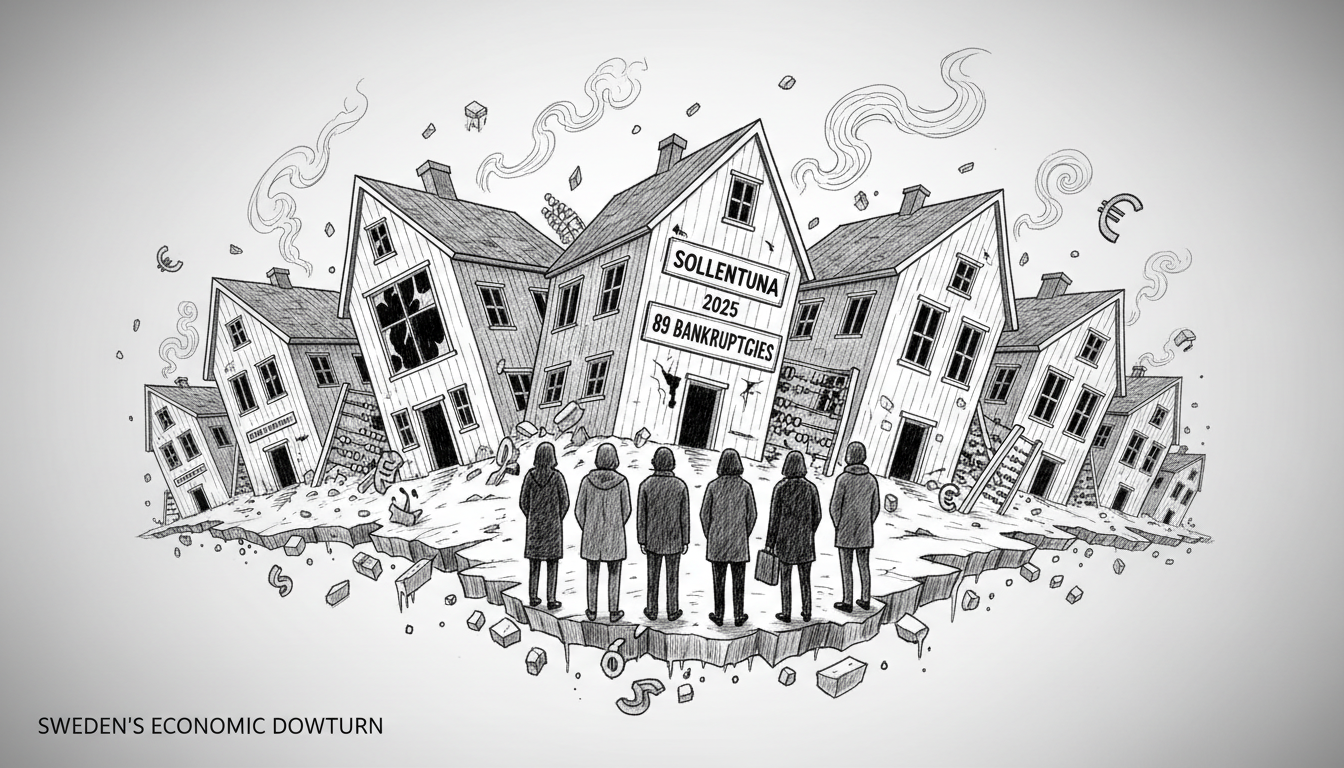
Sweden company bankruptcies hit a grim record in one Stockholm suburb last year. Sollentuna municipality saw 89 local firms declare bankruptcy in 2025. This is the highest number recorded since at least 2015. The figure represents a dramatic 48% increase from the 60 bankruptcies filed in both 2023 and 2024. For the eight years prior, the annual average was a steady 40. The data, compiled from official statistics, signals acute distress in a key suburban business district.
The collective economic footprint of these failed companies was significant. They reported a combined turnover of nearly 380 million Swedish kronor (approximately €33 million). Over 100 employees lost their jobs as a direct result. The largest firm by revenue to fall was Solution Markteknik i Mälardalen AB. It had an annual turnover of 90.6 million SEK. The company with the most staff was logistics firm Dekargo AB, which employed 40 people.
A Suburban Economic Bellwether
Sollentuna, located just north of Stockholm's city center, is not an industrial backwater. It is a mixed residential and commercial hub, home to many small and medium-sized enterprises (SMEs) that serve the greater capital region. The concentration of failures here acts as a leading indicator for the wider Swedish economy. When suburban SMEs, often in construction, retail, logistics, and business services, begin to fail en masse, it points to systemic pressures.
"This isn't just bad luck for 89 companies," says economist Lars Bergström, a senior analyst at the Nordic Economic Research Institute. "Sollentuna is a microcosm. These businesses are the backbone of the local and regional economy. A near-doubling of bankruptcy rates in two years tells us the economic environment has turned sharply hostile for mainstream SMEs." Bergström notes that while Stockholm's inner-city districts like Östermalm often dominate fintech headlines, the health of suburban business parks is a better gauge of national economic stability.
The Perfect Storm of Economic Pressures
Analysts point to a confluence of factors battering Swedish SMEs. The Riksbank's aggressive interest rate hikes to combat inflation have been a primary driver. Many companies that took on debt during the era of near-zero rates now face crippling financing costs. Consumer spending has tightened as household budgets are squeezed by higher mortgage payments and living costs. This directly hits B2C companies and reduces demand for B2B services.
Supply chain disruptions, while improved from pandemic peaks, have left a legacy of higher input costs and inventory imbalances. For a company like Dekargo AB, operating in logistics, these combined pressures likely proved fatal. Rising fuel costs, lower shipping volumes, and expensive leases on warehouse and truck fleets create a narrow margin for error. A downturn in construction activity, a key sector in suburban economies, would have also impacted firms like Solution Markteknik.
"The Swedish model relies on a robust ecosystem of small employers," explains business consultant Eva Karlsson. "They are less resilient to sudden economic shocks than large corporates. They lack massive cash reserves and negotiating power with lenders. When banks tighten credit and customers delay payments, they can collapse very quickly. The Bankruptcy Act process is then the only formal option."
The Human and Community Cost
Behind the statistic of "over 100 employees" are individual careers, families, and local economic networks. Bankruptcies mean more than lost jobs. They often result in delayed or lost wages, damaged pension contributions, and significant personal stress for founders who have invested years, and often personal assets, into their ventures. The loss of 89 business entities also erodes the commercial fabric of Sollentuna. It reduces competition, leaves vacant commercial spaces, and diminishes the local tax base, which can affect municipal services.
The spike suggests that traditional safety nets and business support mechanisms have been overwhelmed. While Sweden has strong unemployment benefits, the rapid failure of stable companies indicates problems occurring faster than adaptation can happen. It raises questions about the adequacy of business advisory services and crisis financing available to SMEs during a sharp downturn.
A Broader Swedish Trend?
While Sollentuna's data is stark, the critical question is whether it is an outlier or the tip of the iceberg. National bankruptcy statistics for 2025 are not yet fully compiled, but leading indicators suggest a rising trend across Sweden. The Swedish economy entered a technical recession in late 2024, and business confidence surveys have remained pessimistic. Sectors like construction and real estate are particularly vulnerable, and many of Sollentuna's failed firms likely operated in these adjacent fields.
"We monitor bankruptcy filings as a key pulse check," says Bergström. "A concentrated spike in a well-connected suburb like Sollentuna is a red flag. It suggests the economic contraction is moving from financial markets and large corporations into the heart of the everyday business community. We would expect to see similar, if less extreme, patterns in other suburban municipalities around Stockholm, Gothenburg, and Malmö."
The performance of the Swedish economy in 2026 will depend heavily on whether inflation continues to fall, allowing interest rates to ease, and if consumer confidence returns. For now, the record number in Sollentuna serves as a sobering case study. It demonstrates how global economic headwinds—monetary policy, inflation, weak demand—translate into local business collapse.
Looking Ahead: Resilience or Further Decline?
The trajectory from 40 to 60 to 89 bankruptcies in Sollentuna shows accelerating distress. The crucial unknown is whether 2025 represents a peak or a new, higher plateau. Much depends on macroeconomic policy. However, business experts also argue that this crisis should trigger a review of how Sweden supports its SME sector during volatile times.
Are current business advisory services proactive enough? Is there sufficient access to restructuring finance short of formal bankruptcy? For municipalities like Sollentuna, there may be a role in fostering local business networks for mutual support and early warning systems. The high bankruptcy rate is a failure metric, but it also outlines the community of businesses that need the most urgent attention.
The 89 closed companies in Sollentuna are more than a record. They are 89 experiments in the market that ended, 89 sources of employment extinguished, and 89 contributions to the local economy gone. Their collective failure is a powerful signal that the economic weather has changed for Sweden's small businesses. The question for 2026 is how many more will be caught in the storm before it passes.