
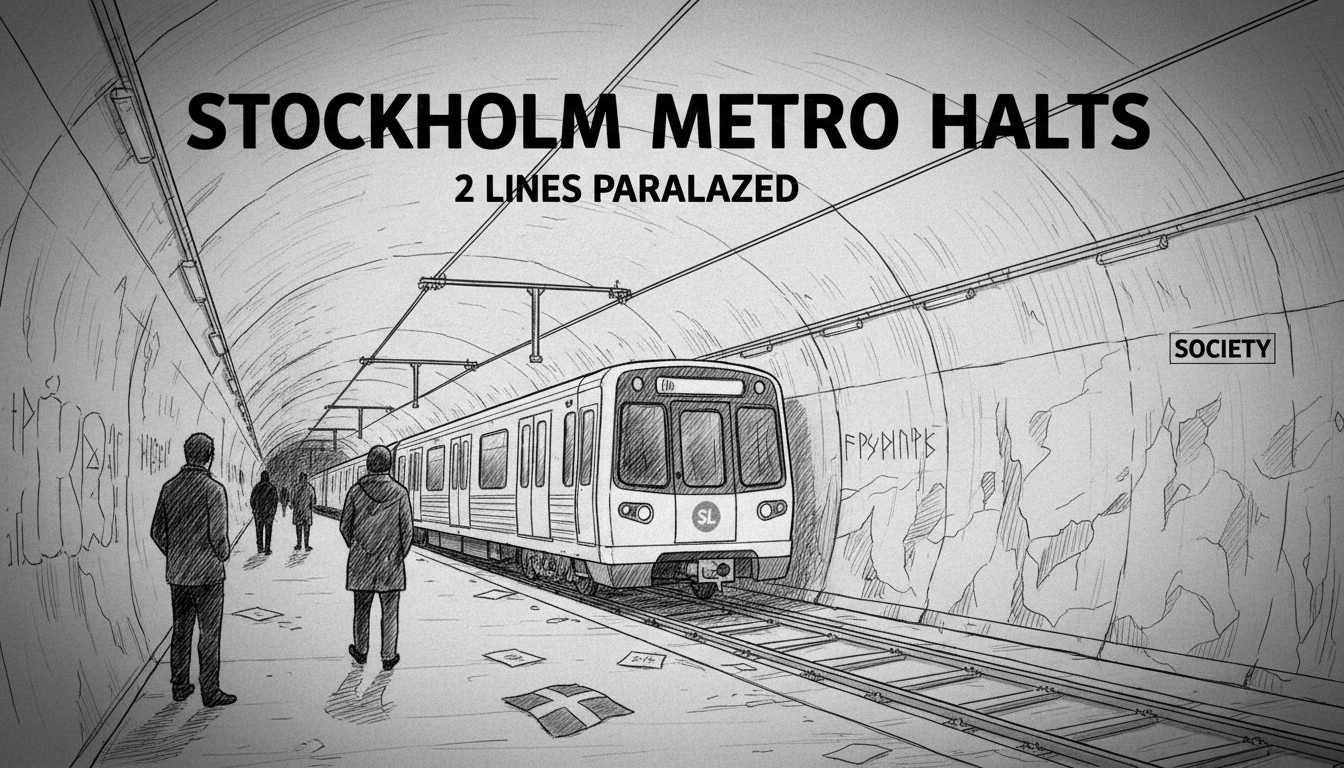
Stockholm public transport delays caused major disruptions Wednesday after a technical fault halted the city's metro. Both the Green and Red lines experienced a complete stoppage between key central stations, with irregular service and cancelled departures continuing for hours. The incident stranded thousands of commuters and highlighted persistent vulnerabilities in the capital's critical infrastructure.
Natalie Nordenswan, press spokesperson for the Traffic Administration, confirmed the cause was a technical fault on the track. The specific section affected was between Mariatorget and T-Centralen on the Red Line and between Slussen and T-Centralen on the Green Line. By 13:30, operator SL reported trains were moving again but warned of ongoing irregularities. This core network disruption paralyzed a significant portion of the city's rapid transit system during a weekday.
A City Grinds to a Halt
The immediate impact was chaos during the midday period. Commuters faced sudden cancellations, overcrowded platforms, and significant uncertainty. Alternative bus services and regional trains experienced spillover pressure, creating secondary congestion. For a city where the Tunnelbana is the backbone of daily movement, such a central failure has outsized consequences. Business schedules, medical appointments, and school pickups were thrown into disarray across multiple districts.
Stockholm's metro system first opened in 1950 and now stretches approximately 108 kilometers. It serves 100 stations, with 47 located underground. The Green and Red lines form crucial arteries through the city center, connecting southern and western suburbs to the downtown core. A simultaneous failure on these lines effectively severs major transit corridors. The reliance on this aging system makes it a single point of failure for metropolitan mobility.
Infrastructure Under Scrutiny
Transport analysts frequently point to the aging infrastructure of the Stockholm Metro as a root cause for such disruptions. While extensive modernization projects are underway, including new rolling stock and signal systems, the core track and tunnel network requires constant, costly maintenance. "These incidents are not random; they are symptoms of a system operating at the edge of its design life," said Lars Fahlén, a public transport analyst at the Stockholm School of Economics. "The political debate in the Riksdag often focuses on new projects, but operational reliability depends on invisible, ongoing investment."
The financial responsibility for maintenance and upgrades is a complex issue involving multiple government layers. Funding decisions made in the Riksdag directly affect the budget of the Swedish Transport Administration, which owns the infrastructure. SL, the county-owned operator, then manages daily services. This split can sometimes lead to gaps between long-term capital needs and short-term operational pressures. Recent government policy in Sweden has emphasized climate-friendly transport, but analysts argue reliability is equally critical for achieving modal shift goals.
Communication and Public Trust
During the disruption, SL's communication strategy came under immediate scrutiny. Initial information via apps and signs was vague, stating only "technical faults." As hours passed, frustrated passengers sought more detailed explanations and reliable recovery timelines. The effectiveness of crisis communication directly impacts public trust in the system. "Clear, frequent, and honest updates are essential," stated communication researcher Eva Berglund. "When people understand the scope and cause, even bad news, they can adapt. Uncertainty breeds anger and erodes confidence in the operator."
This event will likely prompt reviews at SL's headquarters in Slussen. The agency has previously invested in improving its real-time information systems. However, systemic failures test these protocols to their limits. The incident also raises questions about contingency planning for bus bridging services when core metro segments fail. The narrow streets of central Stockholm limit the capacity for effective large-scale bus replacements, a geographical constraint that intensifies disruption.
The Political and Economic Ripple Effect
Persistent public transport reliability issues inevitably land on desks at Rosenbad, the seat of the Swedish government. Ministers for Infrastructure and Climate are held accountable for national transport policy outcomes. While regional authorities manage daily operations, major investment frameworks are set by national government policy. Stockholm's congestion problems have economic costs; a 2022 study by the Chamber of Commerce estimated that major transport disruptions cost the regional economy millions of kronor per hour in lost productivity.
Discussions in the Riksdag building often center on grand infrastructure projects like the Stockholm Bypass (Förbifart Stockholm) or high-speed rail. Yet, as Wednesday showed, the mundane reality of maintaining existing rail tracks is equally politically significant. Opposition parties often use such events to critique the governing majority's allocation of resources. The debate touches on broader themes of urban livability, economic efficiency, and Sweden's environmental commitments.
Looking Down the Track
The Stockholm Metro disruption is a stark reminder of the challenges facing mature urban transit networks worldwide. Balancing necessary maintenance with uninterrupted service is a formidable logistical and financial task. For Stockholm, the path forward involves continued strategic investment, potentially accelerated by political pressure following high-profile failures. It also requires transparent communication with the public who depend on the system daily.
Will this incident serve as a catalyst for a renewed focus on maintenance funding in the next state budget? Can Stockholm modernize its century-old transit backbone without imposing constant disruption on its citizens? The answers to these questions will determine whether scenes of stranded commuters become a rare occurrence or a recurring feature of city life. The reliability of the Tunnelbana is not just a transport issue; it is a measure of the city's basic functionality.