
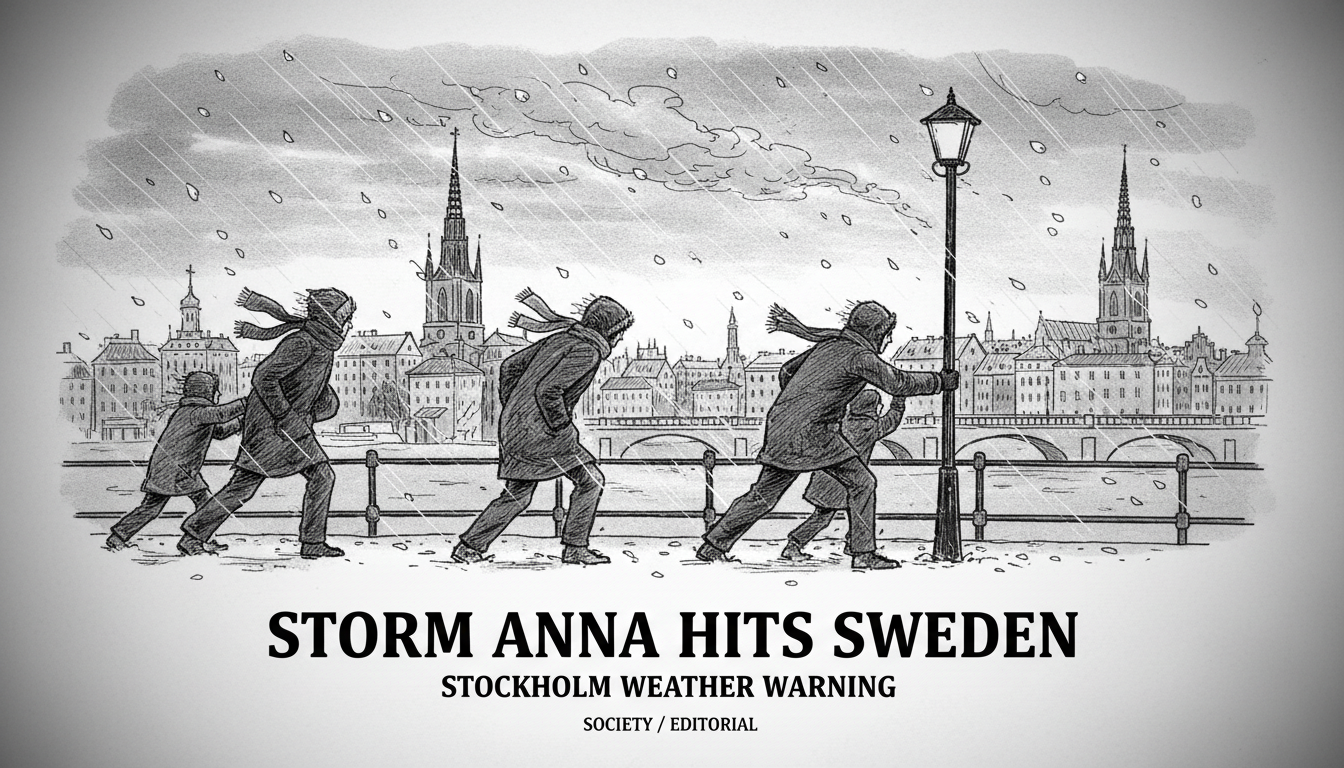
Sweden's latest winter storm, Anna, has triggered an official SMHI weather warning for northern Stockholm, as the nation begins 2026 much like it ended 2025—bracing against powerful winds and heavy snow. The yellow-level alert urges residents in suburbs like Sollentuna, Täby, and Danderyd to prepare for continued snowfall and difficult travel conditions on Friday, following the storm's arrival on New Year's Day. For commuters and emergency services, it’s a familiar, wearying script.
"You learn to read the sky here," says Erik Lundström, a taxi driver waiting for a fare outside Odenplan in central Stockholm. His phone displays the SMHI app, which he checks as routinely as his mirror. "After Storm Johannes last week, you could feel Anna coming. The air changes. My advice to customers today is simple: if you don't have to go out, stay in. Have some more glögg."
The Swedish Meteorological and Hydrological Institute (SMHI) is the authoritative voice for weather warnings in the country. Their system uses a color-coded scale: yellow for potential disruptions, orange for significant impact, and red for extreme danger. The current yellow warning for northern Stockholm signals expected snowfall that could lead to slippery roads and reduced visibility. Police have already reported multiple vehicles skidding off roads in the region, including one car ending up in a field, and are urging extreme caution.
A New Year, A Familiar Foe
Storm Anna made landfall on January 1st, a symbolic start to the weather year. It follows closely behind Storm Johannes, which swept across Scandinavia in the final days of 2025. This back-to-back nature is what captures the attention of climate researchers. While Sweden is no stranger to harsh winter storms, the frequency and intensity are under constant scrutiny. Meteorologists note that while individual storms cannot be directly linked to climate change, the broader pattern of more energetic weather systems in the North Atlantic aligns with warming global temperatures.
"The worst is expected to be over by tomorrow," a meteorologist said on Thursday, offering a note of relief. The forecast suggests a gradual improvement over the weekend, but the immediate focus remains on public safety. For Stockholm's municipality, the protocol is well-rehearsed. Gritting trucks have been active on main arterial roads since the early hours, prioritizing routes to hospitals and public transport hubs.
The Societal Rhythm of a Storm
In Sweden, a weather warning does more than just advise on travel. It alters the daily rhythm. School administrations in the warning zone send out SMS alerts to parents. Employers adopt a more flexible attitude toward start times. The concept of 'fika'—the cherished coffee break—becomes an indoor, communal affair rather than a dash to a local café. In neighborhoods like Vasastan, where I live, you see the shift. The usual morning bustle is subdued, replaced by the steady scrape of snow shovels on sidewalks as neighbors quietly perform their civic duty to clear the path.
This collective response is deeply ingrained in Swedish culture, a concept tied to 'folkvett'—common sense for the common good. Heeding an SMHI warning is part of that social contract. "It’s about trusting the system and each other," explains Karin Fjellström, a sociologist at Stockholm University. "The SMHI warning isn't seen as an overreaction; it's trusted information that allows society to preemptively slow down and avoid accidents. We minimize risk individually to reduce the burden on collective services like healthcare and police."
Beyond the City: The Wider Impact
While Stockholm's northern suburbs are the current focus, Storm Anna's effects have been felt more broadly. In coastal regions, orange warnings were issued for high winds. Ferry services in the archipelago saw cancellations, isolating some smaller island communities. For long-distance train operator SJ, the storm meant implementing contingency schedules, with delays rippling across the network. This kind of disruption highlights Sweden's vulnerability and its resilience. Infrastructure is built for winter, but the goal is always adaptation, not imperviousness.
Driving becomes the central concern during these events. The Swedish Transport Administration reiterates its winter driving advice: ensure your tires are properly studded or marked with the Three-Peak Mountain Snowflake symbol, keep a half-tank of fuel, and pack an emergency kit with a blanket, flashlight, and snacks. Many of the incidents reported by police in the last 24 hours involved drivers who were likely caught off-guard by a sudden patch of black ice or reduced visibility in a snow squall.
Looking Ahead: A Season of Vigilance
With the worst of Anna expected to pass, the question becomes what the rest of the winter holds. SMHI's seasonal forecasts suggest a typical Nordic winter with periods of severe weather. For experts, the key takeaway is the public's role in risk management. "A yellow warning is a tool," says a climate researcher familiar with SMHI's work. "Its effectiveness isn't just in the accuracy of the forecast, but in how people and institutions use that information. In Sweden, that relationship is generally very effective."
As Friday evening approaches, Stockholmers are checking the forecast one more time. The sky over Hornstull is a uniform, heavy grey, but the snowfall has lightened to a flutter. The storm is moving on. The city will dig out, the roads will be cleared, and life will return to its normal winter pace. Yet, the lesson of Anna and Johannes remains—a reminder of nature's force and the value of a society that knows when to pause, prepare, and wait for it to pass. In an era of changing climates, that communal preparedness may be our most crucial tradition.
Will this winter's storms become the new normal, or are they simply a reminder of the old one? For now, the focus is on the cleared path ahead and the hot coffee waiting at home.