
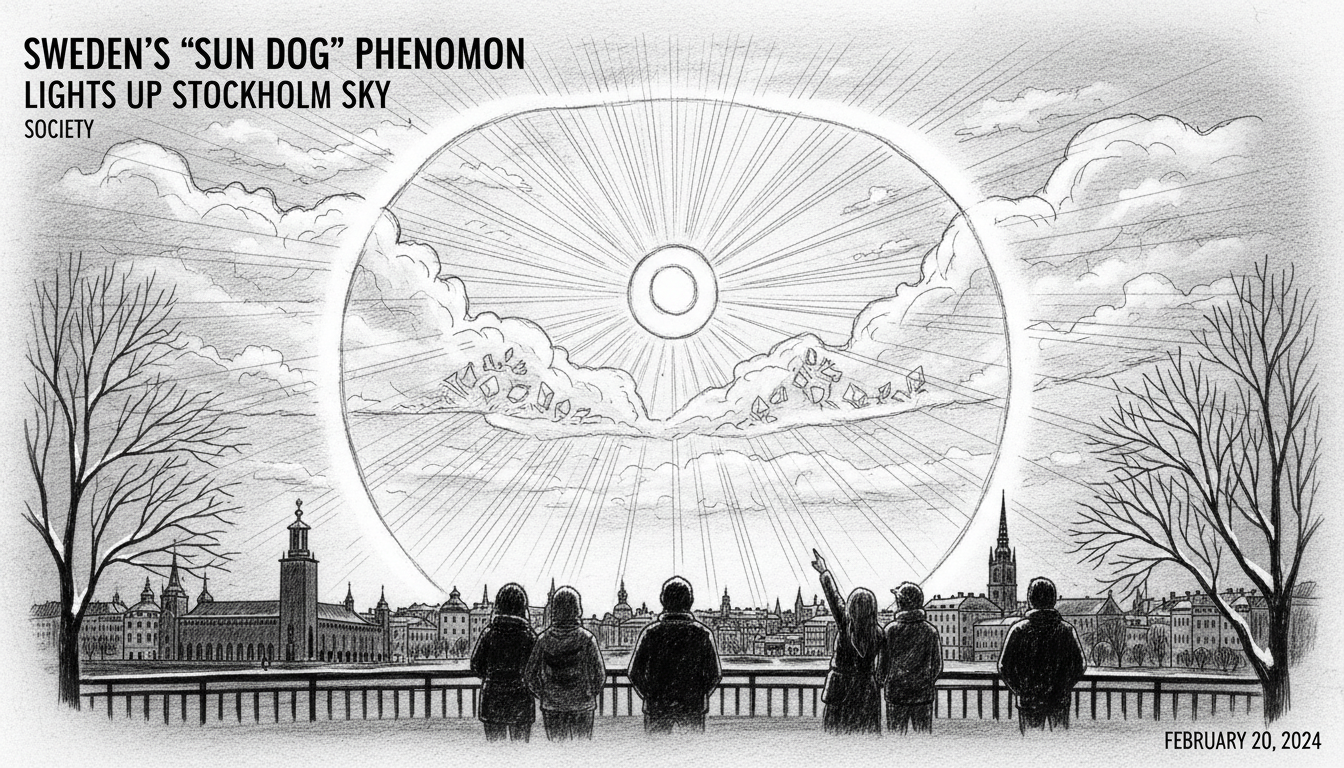
Sweden's capital was treated to a stunning celestial display on Wednesday as a rare 'sun dog' halo phenomenon appeared over Stockholm. The event, captured by residents around Årstaviken and across the city, transformed an ordinary winter day into a moment of shared wonder, offering a perfect blend of Swedish nature and culture.
I was walking near Hornstull when I saw it. People had stopped on the bridge, pointing phones at the sky instead of at the water. A luminous ring, shimmering with faint rainbow colors, encircled the sun. In a city known for its long, dark winters, this sudden burst of atmospheric magic felt like a gift. It was a classic Swedish winter phenomenon, but one that never fails to captivate.
"When you see the arcs on either side of the sun, we usually call it a 'solhund' or sun dog," explained Max Schildt, a meteorologist at the Swedish Meteorological and Hydrological Institute (SMHI). His simple explanation belies the complex beauty of what Stockholmers witnessed. "A halo is a light phenomenon that occurs under cold winter conditions when there's a certain type of ice crystal in the air," Schildt said. "It forms around the sun. You get a ring on either side like a light amplification, and you can see some rainbow colors too."
The Science Behind the Spectacle
This isn't magic, though it feels like it. It's precise physics playing out in the frigid Scandinavian sky. The phenomenon occurs when sunlight refracts through millions of hexagonal ice crystals suspended high in the atmosphere, typically in cirrus or cirrostratus clouds. These crystals act like tiny prisms, bending the light at a 22-degree angle to create the luminous ring. The term 'sun dog' refers specifically to the bright spots that often appear on the halo, flanking the sun like loyal companions.
Schildt notes that observing a halo can actually tell us something about the weather. "When halos form, it can be a clue about what the clouds are made of," he said. In Swedish folklore, such rings around the sun or moon were often seen as harbingers of changing weather, usually predicting rain or snow. It’s a beautiful intersection where ancient observation meets modern meteorology.
A Moment of Shared Stockholm Culture
What struck me most wasn't just the scientific explanation, but the social reaction. In neighborhoods from Södermalm to Östermalm, people looked up. In a typical Stockholm winter, gazes are often downcast, focused on navigating icy sidewalks or hurrying to the next warm cafe. This phenomenon forced a collective pause. Social media feeds filled with images tagged #solhund and #stockholmsky, creating a digital gallery of the event.
This shared experience is a core part of Swedish culture, where nature's displays are deeply woven into the national identity. From the midnight sun to the northern lights, Swedes have a vocabulary and a reverence for celestial events. The 'solhund' fits right into that tradition. It’s a reminder that even in a bustling, modern metropolis like Stockholm, we remain at the mercy and beauty of the natural world.
I spoke to Lena, a photographer who captured the halo from her balcony in Kungsholmen. "It’s moments like these that make the winter bearable," she told me, her breath visible in the cold air. "You’re reminded that the cold creates beauty too. It’s not just grey skies and slush." Her sentiment echoes a common Swedish resilience—finding light and color in the darkest, coldest season.
More Than Just a Weather Event
Beyond the spectacle, events like this serve as informal cultural touchstones. They become stories. Parents explain it to their children. Colleagues discuss it over fika. Visitors witness it and take a piece of unique Swedishness home with them. In a way, the sun dog is a perfect metaphor for Swedish society: often understated, requiring specific conditions to reveal its full beauty, and best appreciated when you stop to look closely.
It also highlights the Swedish relationship with weather. Here, weather isn't small talk; it's a constant companion that dictates lifestyle, from the design of homes to the planning of festivals. The appearance of a sun dog during a standard Wednesday in Stockholm breaks the monotony, injecting a dose of awe into the daily routine. It’s a free public art exhibit, courtesy of the atmosphere.
Looking Ahead: When Might It Return?
For those who missed it, you might wonder when the next show will be. Unfortunately, you can't mark it on your calendar like a concert at Globen or a festival at Skansen. The conditions need to be just right: high, thin clouds filled with plate-shaped ice crystals, a sun positioned correctly in the sky, and the observer standing in the perfect spot. It’s this rarity that makes sightings so special.
Meteorologist Schildt confirms that while not everyday occurrences, these halos are a regular winter feature in the Nordic climate. "They are a sign of the specific cold conditions we have here," he said. So, while not predictable for a specific date, they are a recurring character in the long Swedish winter narrative. The key is to keep looking up, especially on those bright, bitterly cold days when the sky looks washed with high, wispy clouds.
As the short daylight faded on Wednesday, the halo dissolved. People put their phones away and continued their walks. The winter returned to its usual palette of grey and white. But for a brief period, Stockholm was united by a ring of light, a reminder of the quiet wonders that Swedish nature holds in reserve. In a season defined by its lack of light, the sun dog offered a double portion, proving that sometimes, the most memorable Stockholm events aren't on the ground, but painted across the vast Nordic sky. Will you be looking up for the next one?