
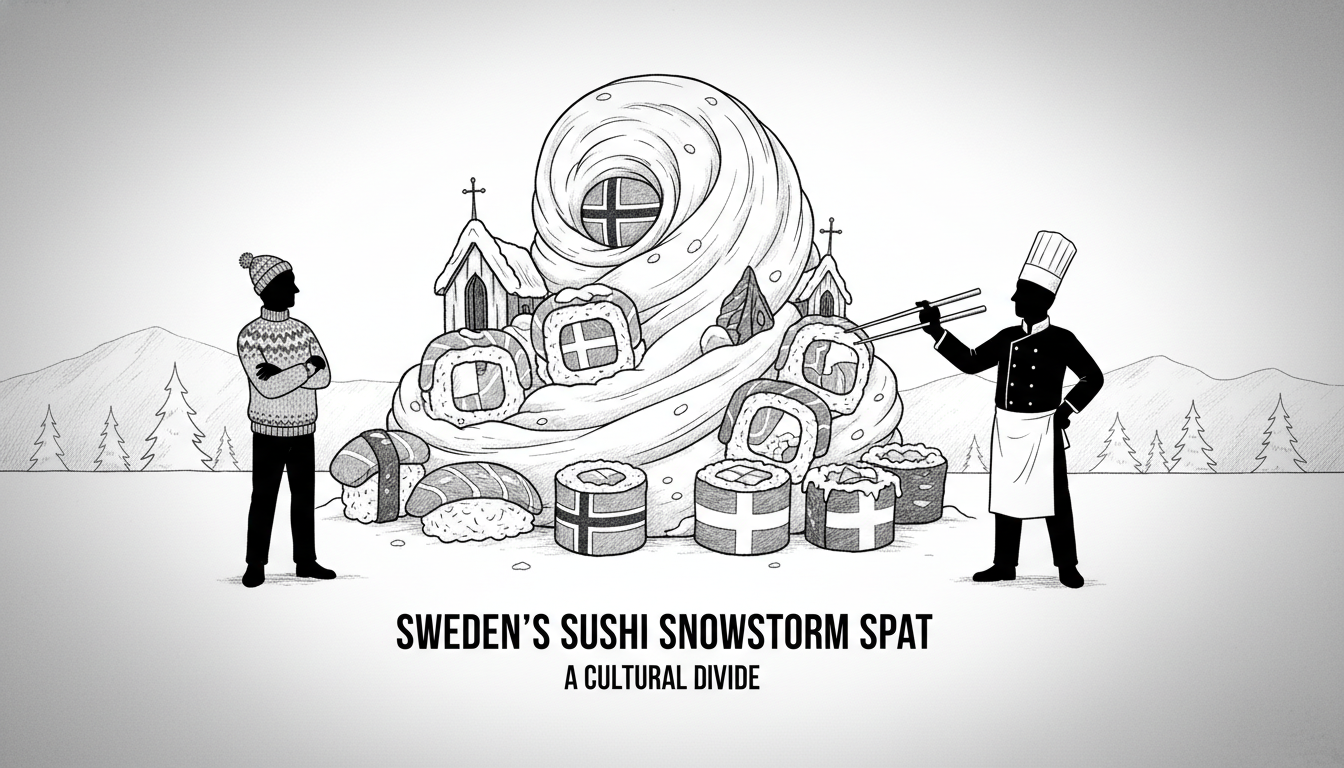
Swedish police on January 2nd singled out a beloved takeaway meal in a winter storm warning, sparking a debate about cultural norms and fair messaging. A routine snow advisory from Stockholm's traffic police has unexpectedly snowballed into a conversation about cultural identity, business fairness, and the sometimes clumsy language of authority. The trigger was a Facebook post advising against unnecessary car travel during heavy snow, which explicitly stated that driving to buy sushi was "NOT a necessary trip." For Sam Elzer, manager of Lulu poké and sushi in Sundbyberg, the specific call-out felt personal and unfair.
"It's a shame that you should 'pinpoint' one type of restaurant when it's about being careful in traffic," Elzer said. "It sounds like they're naming sushi as the big villain in all this." While he couldn't quantify a direct sales drop from the post, the implication stung. In a city where international cuisine is a point of pride, the comment struck many as oddly targeted.
The Swedish Winter Compact
This incident touches a deep nerve in Swedish society: the unspoken social contract during winter. Sweden has a well-established tradition of official public safety communication, especially during harsh weather. Authorities like the Swedish Transport Administration (Trafikverket) and the police regularly issue guidance to keep roads clear for emergency services and winter maintenance crews. The public generally respects these advisories, viewing cautious behavior as a collective responsibility—a concept rooted in the Nordic principle of 'folkvett,' or common sense for the common good.
So why did this particular message backfire? The intent was standard: reduce non-essential travel. But the execution, by naming a specific culinary desire, moved the advice from the general to the personal. It shifted the focus from a universal safety principle to judging the worthiness of a particular craving. In doing so, it inadvertently highlighted a tension between Sweden's communal safety ethos and its modern, diverse consumer culture.
Beyond Raw Fish: The Business Impact
For restaurant owners like Sam Elzer, the post represented more than a minor slight. The past few years have been particularly challenging for the hospitality sector, with establishments adapting to survive. Takeaway and delivery became crucial lifelines. A public suggestion from an authoritative body that obtaining your food is 'unnecessary' can feel damaging, even if the core safety message is valid.
"It's not just about sushi," explained a Stockholm-based restaurant analyst who asked not to be named. "It's about the power of suggestion. When an official source names one thing, it can cast a shadow on an entire category of small businesses. The next time it snows, will people hesitate to order any takeaway, thinking it's socially irresponsible? The police likely didn't intend that, but communication has consequences."
This is especially poignant in suburbs like Sundbyberg, where local restaurants are community hubs. They're not just food providers; they are meeting spots and employers. The police message, while aimed at drivers, landed in the feeds of potential customers, creating an unintended association between a local business and irresponsible behavior.
A Question of Crisis Communication
Crisis communication experts suggest the police's approach, while well-intentioned, could have been more effective. "The golden rule is to keep public safety messaging broad, clear, and non-judgmental about personal choices," said Karin Möller, a lecturer in strategic communication at a Swedish university. "Instead of naming specific destinations like 'the mall' or 'a sushi restaurant,' it's more powerful to frame it around the trip's purpose. Phrases like 'avoid trips for non-essential goods' or 'postpone discretionary travel' achieve the same goal without singling out any one business or cuisine."
Möller notes that Swedish authorities are typically excellent at factual, neutral communication. This instance seems to be an attempt to use relatable, colloquial language to make the warning stick. The risk is that relatability can tip into perceived arbitrariness. Was sushi chosen because it's popularly seen as a non-essential luxury? If so, the message carries a subtle value judgment that many in multicultural, metropolitan Stockholm find outdated.
Sushi in the Swedish Psyche
To understand the reaction, one must understand sushi's place in modern Sweden. It's not a niche exotic food; it's a mainstream staple. The Swedish sushi buffet, or 'sushiombord,' is a common weekly treat for families. Sushi stands are as ubiquitous as kebab shops. For many, picking up sushi on a Friday night is as ingrained a ritual as picking up tacos—another adopted 'national dish.'
By highlighting sushi, the police message inadvertently tapped into a broader cultural conversation about what is considered 'normal' or 'essential' in today's Sweden. It exposed a gap between a perhaps traditional view of necessary consumption and the reality of Sweden's diverse, globalized palate. The backlash wasn't just from business owners; it bubbled up on social media from ordinary Stockholmers who felt their everyday choices were being unfairly stereotyped as frivolous.
Looking Ahead: The Next Snowfall
The real test will come with the next major snowstorm. Will the police adjust their messaging? A broader, more inclusive advisory would likely be welcomed by both the public and business communities. The goal of keeping roads safe is unquestioned and widely supported. The method of achieving that goal, however, now seems to require greater cultural awareness.
This small storm in a social media teacup reflects a larger evolution in Swedish society. It's a society that still deeply values collective safety and 'folkvett,' but one where the collective is increasingly diverse in its habits and tastes. Effective public communication must bridge that gap, speaking to universal values without alienating segments of the community it serves. The sushi incident serves as a reminder that in a nation where winter is a constant, the words used to navigate it carry significant weight. They can either unite people around a common purpose or create unexpected divisions. As the days slowly grow lighter, the hope is that the lesson from this culinary commotion leads to clearer, more considerate conversations during the next bout of winter's darkness.