
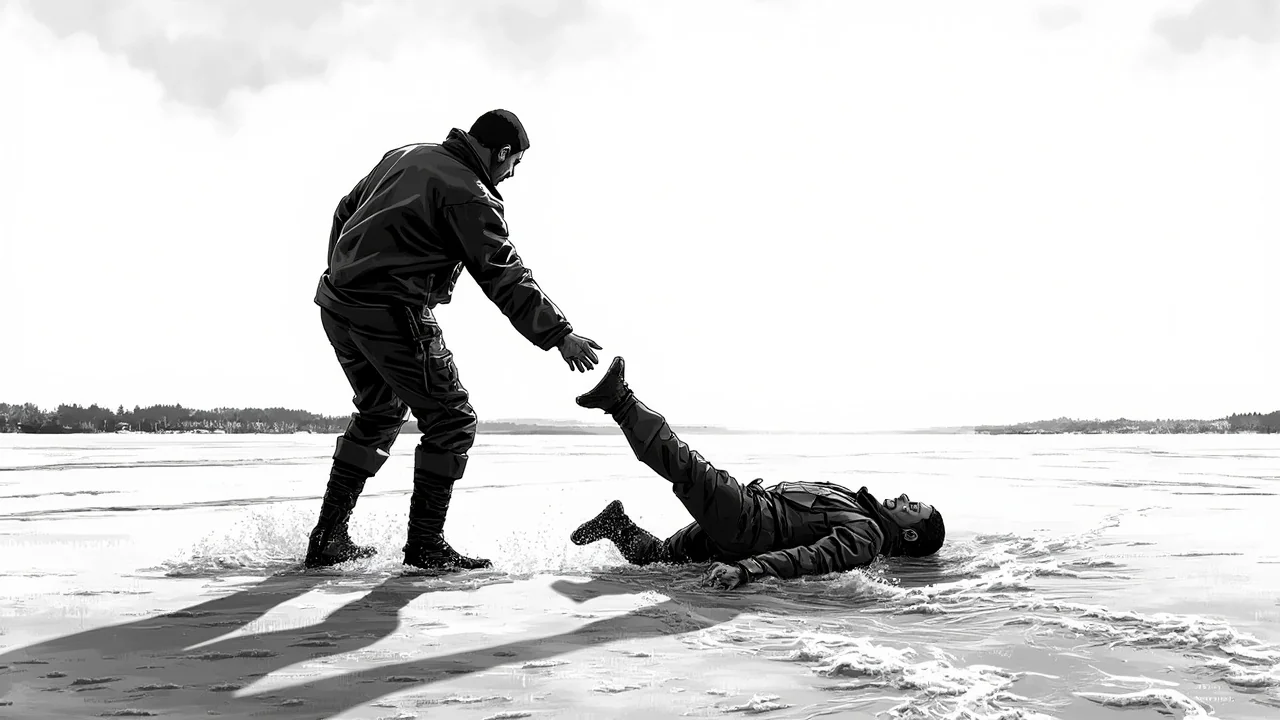
Sweden's winter waters nearly claimed another victim today as emergency services rushed to save one person who fell through the ice on Skattkärrsviken bay near Karlstad. The individual plunged into the frigid water about 30 meters from shore during a morning incident that tested Sweden's famed rescue response. Private citizens first responded by throwing ropes and hoses toward the struggling person before professional help arrived. By 10:30 AM, police confirmed the person was safe and secure, marking another successful intervention in a dangerous seasonal ritual.
A Frantic Morning Call
The alarm came in to SOS Alarm, Sweden's emergency dispatch center. Team leader Ilona Lindholm described the chaotic initial moments. 'Private individuals were trying to help by throwing out some form of rope or hose,' she said in a statement. This immediate citizen response is common in Sweden, where the principle of 'dugnad'—communal helping—is deeply ingrained. The location, Skattkärrsviken, is a bay on Lake Vänern, Sweden's largest lake. Its ice conditions in late winter can be notoriously deceptive, with currents and springs creating weak spots that aren't visible from the surface.
Rescue services, including the Swedish Sea Rescue Society (SSRS), firefighters, and ambulance crews, were all dispatched. The coordinated response is standard procedure for 'person through the ice' calls, which peak during the March and April thaw. The victim was roughly the length of an Olympic swimming pool from the shoreline, a distance that feels immense when trapped in freezing water.
The Race Against Hypothermia
Survival in such situations depends on minutes. Cold water shock can incapacitate a person within seconds. Hypothermia sets in rapidly, slowing motor functions and clouding judgment. Sweden's rescue teams train extensively for these scenarios, often using sleds, floating suits, and specialized ice picks. The successful rescue today highlights the effectiveness of this training.
Local reports suggest the individual was on the ice for recreational purposes, possibly walking or ice fishing. These activities are pillars of Swedish 'friluftsliv,' or open-air life, even as the seasons change. Every spring, authorities issue warnings that are often met with a mix of heedfulness and recklessness. The allure of the last days of ice is strong in a culture that celebrates winter.
A Cultural Dance with Danger
Why do people risk it? I put this question to Lars Frisk, a veteran outdoor safety instructor from Dalarna. 'It's about tradition and optimism,' he told me over the phone. 'We have a long relationship with frozen lakes. They are our winter roads and playgrounds. Judging ice thickness becomes second nature, but nature is unpredictable. One weak patch is all it takes.'
Frisk notes that immigrant communities, unfamiliar with Nordic winters, are particularly at risk. They may not have grown up with the tacit knowledge passed down through generations of Swedes—like avoiding ice near reed beds or listening for cracking sounds. Public safety campaigns now target information in multiple languages.
This incident occurs during the riskiest period. Daytime warmth softens the ice, while nights still bring freezing temperatures. This creates a brittle, honeycombed structure that looks solid but collapses under weight. The Swedish Civil Contingencies Agency (MSB) records dozens of such incidents annually, with outcomes ranging from rescue to tragedy.
The Systems Behind the Rescue
Today's positive outcome was not luck. It was the product of a well-funded public safety ecosystem. The Swedish Sea Rescue Society, a nonprofit organization with massive public support, plays a key role. Unlike many countries, Sweden's coastal and lake rescue is not solely a state operation. It relies on volunteers and donations, creating a unique blend of community duty and professional skill.
The efficiency of SOS Alarm in coordinating police, fire, and medical units is also critical. Their operators are trained to guide callers through first-response actions, like the rope-throwing seen today. This integrated model is studied worldwide. It ensures that from the moment a 112 call is placed, a rescue machine is set in motion.
Learning from a Close Call
What can we learn from the Skattkärrsviken rescue? First, community response matters. The bystanders who acted bought crucial time. Second, proper equipment is non-negotiable. Every winter, authorities plead with people to carry ice claws and life lines. Few do. Third, knowledge must be shared broadly. As Stockholm, Gothenburg, and Malmö become more multicultural, sharing survival wisdom is an integration issue.
Anders Granström, a safety researcher at Lund University, emphasizes this point. 'Our data shows a clear need for targeted education. We assume everyone knows the dangers of spring ice. They don't. A simple, nationwide lesson in schools and community centers could save lives. It should be as fundamental as learning to swim.'
He advocates for using today's successful rescue as a teaching moment, not just a news headline. The conversation needs to move beyond 'be careful' to specific, actionable skills: how to distribute weight when lying on ice, how to use everyday objects as rescue tools, and the absolute necessity of calling for help immediately.
The Bigger Freeze
This event is a small drama in Sweden's long winter narrative. It speaks to our relationship with nature—a mix of respect, familiarity, and occasional defiance. As climate change alters freeze-thaw cycles, these risks may evolve. Thinner, less stable ice could become more common, challenging centuries of accumulated knowledge.
For now, the story ends well. One person is safe. Emergency services performed flawlessly. Neighbors helped neighbors. It's a very Swedish story of collective responsibility in the face of nature's indifference. But it’s also a stark reminder. The ice gives no second chances. As the sun strengthens and the days lengthen, the beautiful, solid white surface over Sweden’s lakes becomes a fragile lid on freezing water. Today, that lid held just long enough.