
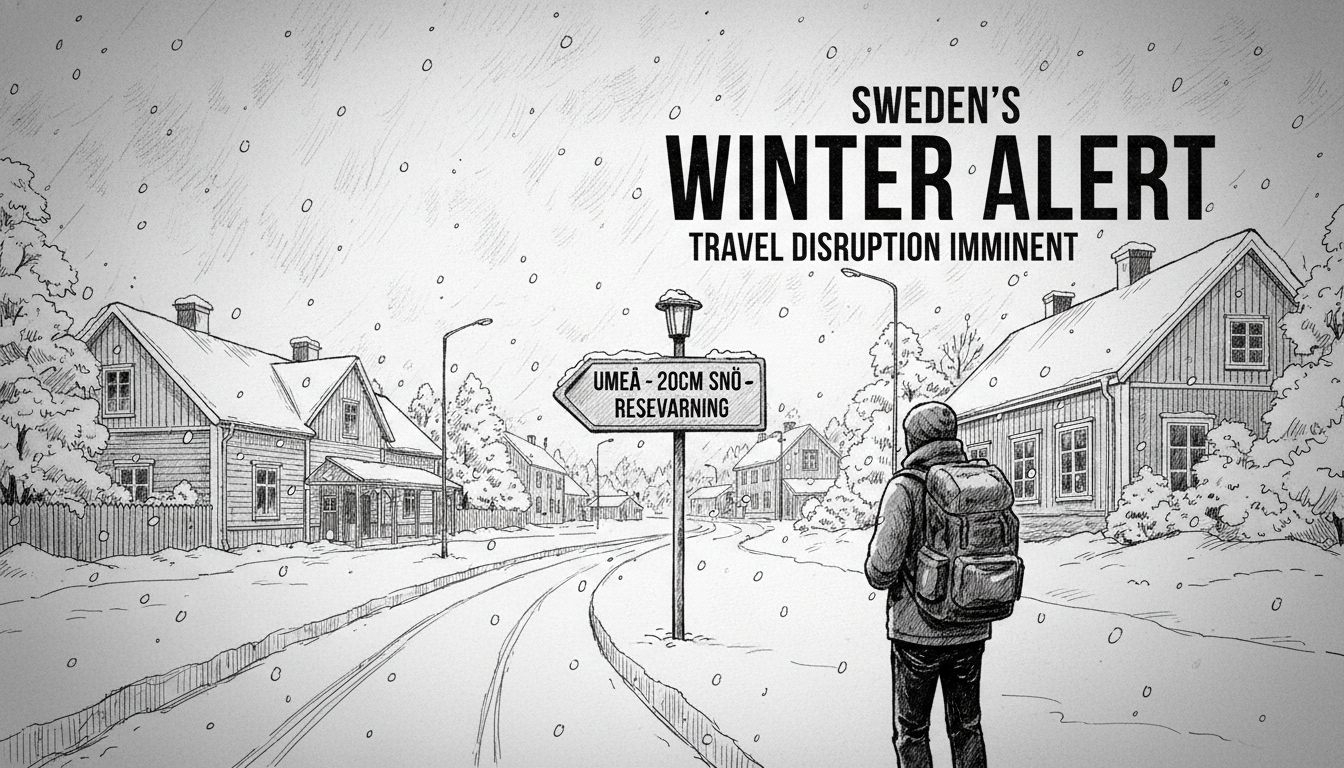
Sweden's northern city of Umeå is preparing for a major winter blast. The Swedish Meteorological and Hydrological Institute (SMHI) has issued a yellow warning for heavy snowfall starting at 1 PM. Forecasters predict 10 to 15 centimeters of snow, with some local areas potentially seeing over 20 centimeters. The warning remains in effect until 11 PM. For residents of this university town, it’s a familiar but disruptive seasonal challenge. The snow is expected to cause significant travel problems across the Västerbotten region. Near the coast, a mix of rain and freezing temperatures raises the additional threat of treacherous black ice.
A City Accustomed to Snow, But Never Complacent
Umeå is no stranger to harsh winters. As a regional hub and home to a large university, its daily rhythm is often set against a backdrop of snow. Yet each significant snowfall brings its own unique set of challenges. The yellow warning from SMHI is a serious alert, prompting immediate action from municipal services and requiring citizens to adjust their plans. "It’s the uncertainty that’s tricky this time," a local meteorologist explained in a statement. "Predicting exactly where the heaviest bands of snow will set up is difficult, especially with the coastal influence. We could see dramatic local differences—one neighborhood gets 10 centimeters, another just a few kilometers away gets 20."
This variability complicates the response. Road maintenance crews must be ready across a wide area, not just along predictable corridors. For the thousands of students at Umeå University and the University Hospital staff, the warning means deciding whether to commute or work from home. Parents check school and daycare notifications, while bus companies review their winter contingency plans. The societal machinery of a northern Swedish city begins to shift into its winter mode.
The Coastal Wildcard: When Snow Turns to Ice
While inland areas brace for deep powder, communities closer to the Gulf of Bothnia face a different hazard. The forecast indicates rain near the coast, which on frozen ground creates instant ice. This phenomenon, known as 'ishalka,' is often more dangerous than snow. It creates a thin, nearly invisible layer of ice on roads and pavements, leading to sudden slips and skids. "A snowfall you can see and prepare for," said a veteran taxi driver from the Holmsund port area. "Black ice is a sneak attack. You don't see it until your wheels have no grip. That’s when the real accidents happen."
This dual threat of snow and ice stretches emergency services thin. It requires a two-pronged approach from road teams: plowing for snow and salting or sanding for ice. The SMHI warning explicitly mentions this risk, urging extra caution for drivers and pedestrians in coastal zones. For the elderly, a simple walk to the store becomes a calculated risk. The local culture of 'fika'—the cherished coffee break—might see more people opting to stay indoors at cafes like 'Rex' or 'Bagel Street' rather than venturing out on icy sidewalks.
Life Slows Down: The Human Impact of a Winter Warning
The immediate effect of such a weather warning is a collective slowdown. Authorities have advised travelers to allow significantly more time for any journey and to drive with extreme caution. Potential traffic accidents and blocked roads are a primary concern. Bus schedules become tentative, and the reliable Swedish rail system can also face delays from ice on the tracks. "It’s about planning and patience," said a student from the Ålidhem campus district. "My lecture might not be canceled, but the bus to get there might be. You learn to check the traffic apps constantly and to always have a backup plan."
This disruption has a tangible economic and social cost. Deliveries are delayed, appointments are missed, and workers are late. Yet, there is also a communal aspect. Neighbors check on each other. Social media groups light up with updates on which roads are clear and which stores are still open. There’s a shared, if grudging, acceptance of nature’s force. In a society that prizes efficiency and punctuality, the snow forces a different rhythm—one that acknowledges that some things are beyond human control.
Beyond the Plows: The Science of a Northern Winter
The frequency of these events in Umeå is rooted in its geography. Located just 400 kilometers south of the Arctic Circle, it sits in a climate zone where cold continental air from the northeast frequently meets milder, moist air from the Atlantic. This collision is a perfect recipe for substantial snowfall. SMHI’s warning system—color-coded from yellow to orange to red—is a crucial tool for public safety. A yellow warning signifies potentially dangerous weather that could impact the public, prompting the public to stay informed and consider altering their routines.
Meteorologists note that climate change is adding complexity to these winter events. While winters may be warming on average, they can also become more volatile, with intense precipitation events becoming more common. The prediction of "large local variations" in today’s forecast reflects this growing uncertainty. It’s not just about how much snow, but exactly where it will fall hardest—a forecasting challenge that has real-world consequences for where to deploy the snow-clearing resources.
A Community Prepared, But Never Immune
As the first flakes begin to fall, Umeå’s well-rehearsed winter response swings into action. Municipal snowplows hit the priority routes. Salt trucks target bridges and coastal roads. Yet, preparedness only goes so far. The warning serves as a reminder that in the face of a true Nordic winter, adaptation is key. The city’s infrastructure, from its heated bicycle paths to its sheltered bus stops, is designed for this, but nature always has the final say.
By nightfall, if the forecast holds true, Umeå will be transformed. The familiar landscapes of the Ume River and the town square will be blanketed in white. The hustle of the day will give way to a quieter, more cautious evening. The true test will come during the Thursday morning commute, when the results of the night's snowfall and the effectiveness of the cleanup efforts will be fully revealed. For now, the city watches the sky, heeds the warning, and prepares to embrace the inevitable, beautiful inconvenience of a northern Swedish snowstorm. Will this be the storm that defines the winter, or just another chapter in Umeå's long, frozen story?