
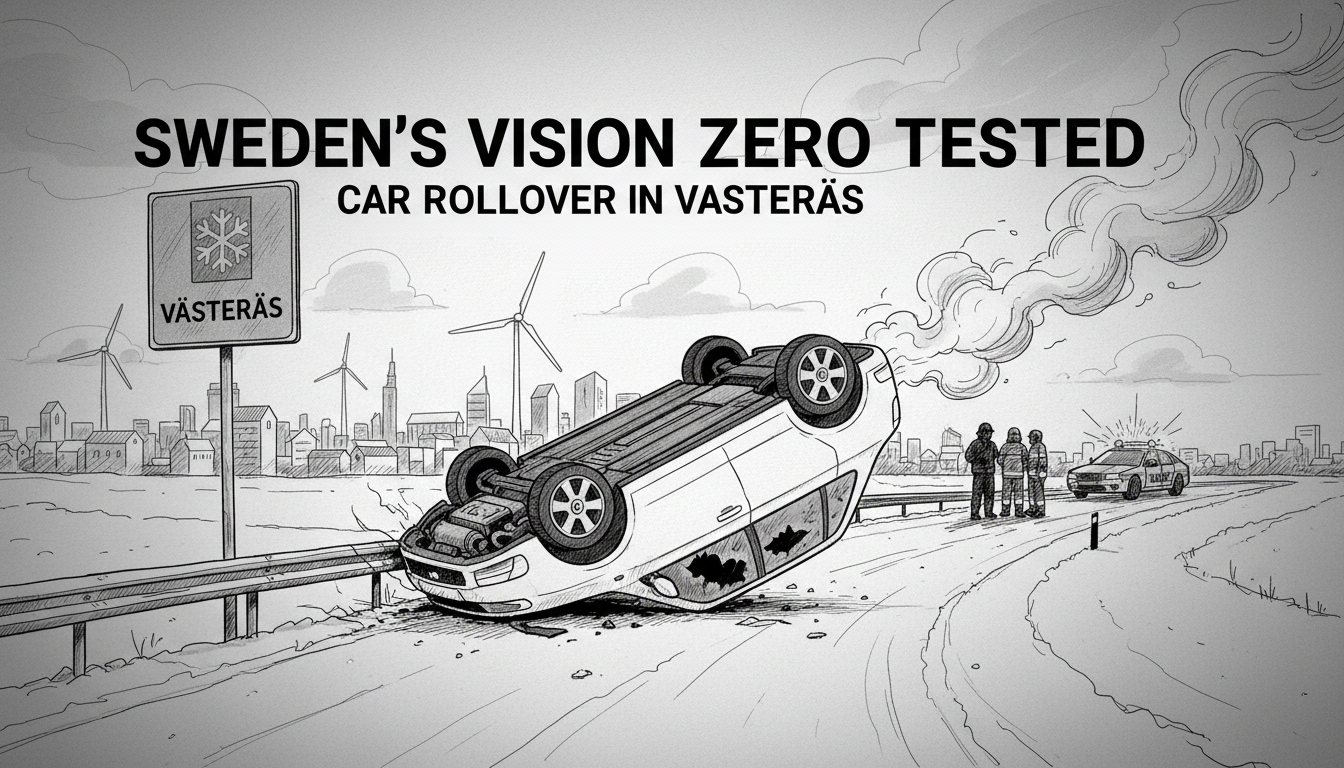
Swedish police are investigating a single-vehicle rollover accident on national road 56 near the city of Vasteras, an incident that highlights the persistent challenge of road safety even in a nation with globally admired standards.
The emergency services were alerted just after 12:30 PM on a recent Saturday afternoon. A car had left the roadway and overturned. The scene, on the northbound side of Route 56 outside Vasteras, was closed to traffic for approximately half an hour as responders worked. Authorities left the location shortly before 1:30 PM.
No injuries were reported, and police press spokesperson Maria Hall stated there was no immediate suspicion of a crime. While the outcome was fortunate, the incident serves as a quiet reminder of the risks present on even Sweden's well-maintained thoroughfares.
A Close Call on a Central Artery
Road 56 is a vital vein connecting central Sweden, running from Norrköping in the south to Gävle in the north, passing the industrial and cultural hub of Vasteras. The road skirts Lake Mälaren, a region popular with commuters and weekend travellers. Single-vehicle accidents, or singelolyckor, are a common classification in Swedish traffic reports, often involving cars veering off the road without colliding with another vehicle.
Factors can be manifold. “At this time of year, we are in a transitional period with weather,” notes a traffic safety analyst I spoke with, who requested not to be named as the official investigation is ongoing. “One moment the road is dry, the next you can hit a patch of frost or wet leaves. Driver distraction or a momentary lapse in concentration is often a factor when no other vehicles are involved.”
The Vision Zero Backdrop
The accident occurs against the backdrop of Sweden’s pioneering ‘Vision Zero’ (Nollvisionen) policy, adopted by the Swedish parliament in October 1997. This ambitious framework aims to eliminate all traffic fatalities and serious injuries. The approach represents a fundamental ethical shift: it places the ultimate responsibility for safety on system designers—road engineers, car manufacturers, policymakers—rather than solely on the individual driver.
The policy has driven tangible changes: extensive 2+1 roadways with median barriers, lower urban speed limits, and stricter enforcement. It has made Swedish roads among the safest in the world. Yet, the goal of zero remains a work in progress.
According to the latest official data from the Swedish Transport Administration (Trafikverket), there were 240 fatal road accidents in Sweden in 2022. Each one represents a deep failure within the Vision Zero system, prompting renewed analysis and countermeasures. The Vasteras rollover, while non-fatal, is precisely the type of common incident that safety engineers study to prevent more serious outcomes in the future.
The Human Factor in a Safe System
Experts agree that while infrastructure is crucial, human behavior remains a key variable. “The Swedish approach is to create a forgiving system,” explains Lars Ek, a traffic psychologist based in Stockholm. “The roads are designed to accommodate human error. But we also must talk about fatigue, the use of mobile phones, and speed adaptation. A safe car on a safe road driven by an alert, prudent driver—that is the ideal combination.”
In Västmanland County, where Vasteras is located, local traffic planners have consistently worked on improving high-risk road sections. Route 56 has seen upgrades over the years, but like many regional highways, it traverses varied landscapes, from open fields to forested areas, presenting challenges like wildlife crossings and changing light conditions.
A Community's Response
For residents in the towns and villages along Route 56, such accidents, though often minor, are a familiar part of life. “You hear the sirens and hope everyone is okay,” says Anna Bengtsson, who lives in a village near the accident site. “This road is generally good, but you have to be mindful. In the autumn, with the sun low and the deer moving, it demands your full attention.”
This community awareness is another layer of Sweden’s safety culture. From rigorous driver’s education to near-universal use of winter tires within the mandated seasonal period (December 1st to March 31st, depending on conditions), a collective commitment to safety is ingrained.
Looking Beyond the Crash Barrier
The non-injury outcome of the Vasteras incident is a positive data point, but not a reason for complacency. Every such event is logged and analyzed. Was there an infrastructure flaw at that specific curve? Was the signage adequate? Could a vehicle-based safety system have prevented the run-off?
Sweden’s journey toward Vision Zero is a continuous process of improvement, where even minor accidents provide learning material. The focus is steadily expanding to include greater protection for vulnerable road users like cyclists and pedestrians in urban areas, and combating new risks like distraction from in-car entertainment systems.
As the car was towed from the grassy verge on Route 56 and traffic resumed its normal flow, the invisible work of prevention continued. The incident file will be closed, but the data it contributes feeds into the larger, ongoing mission—to make the simple act of travel as safe as humanly and systematically possible. The question remains: can any society ever truly achieve zero, or is the relentless pursuit of it the real victory?