
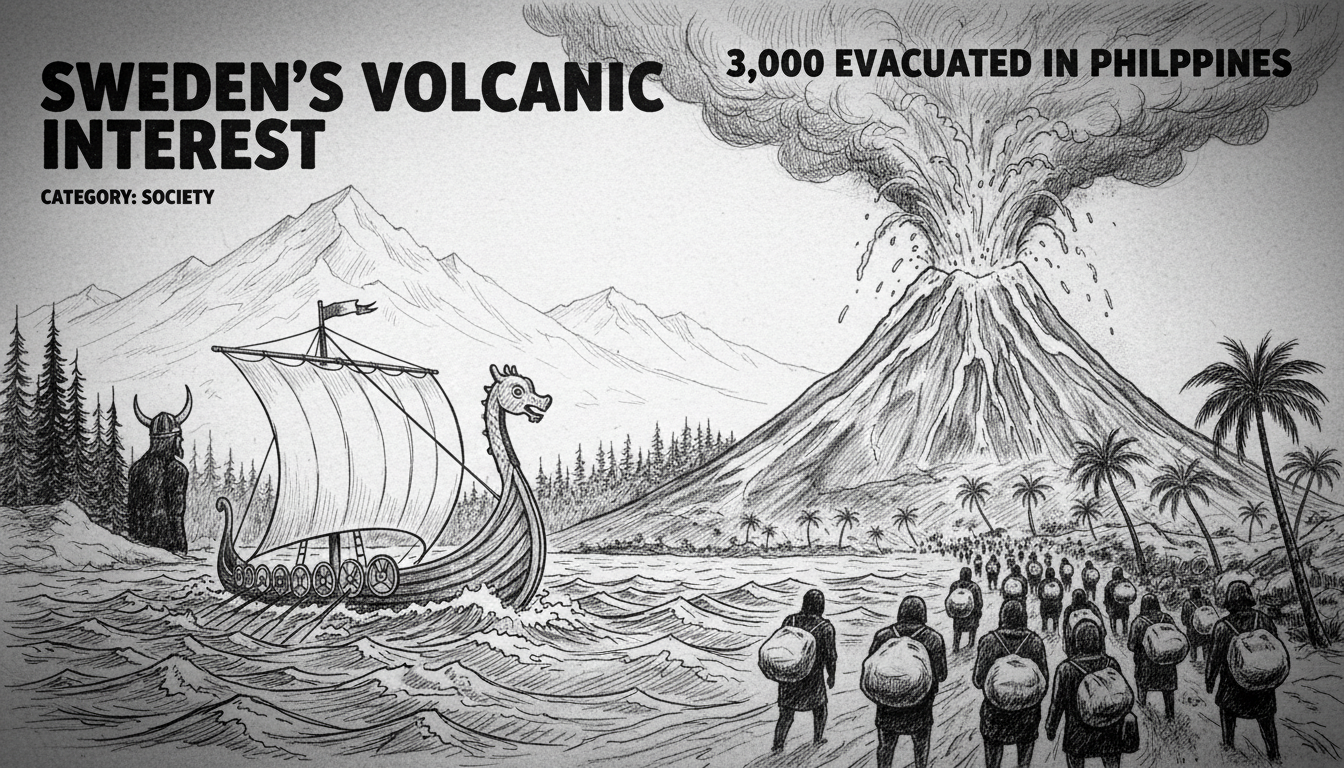
Swedish interest in volcanic activity is surging as the Philippines evacuates 3,000 people. The news from the Pacific Ring of Fire resonates here, where safety and preparedness are cultural cornerstones. While Sweden has no active volcanoes, the story taps into a deep-seated Nordic concern for global events and natural disaster response. I spoke with Swedes in Stockholm to understand this unexpected connection.
"We see it on the news, and of course, we think about our own trips," said Lars Bengtsson, a travel agent from Vasastan. "Many Swedes travel to Southeast Asia. This isn't just a distant event; it feels connected to us." This sentiment is common. Sweden's high level of international travel and its focus on global citizenship make distant natural disasters feel personally relevant. The search data confirms a collective pause, a moment of shared concern scrolling through phones on the tunnelbana.
From Nordic Calm to Pacific Fire
The contrast is stark. Our Nordic environment is largely stable and predictable. The greatest natural threats here are winter storms or forest fires, often manageable with well-rehearsed public systems. The Philippines, with over 20 active volcanoes, exists in a state of constant geological negotiation. The Pacific Ring of Fire, a horseshoe-shaped zone around the Pacific Ocean, is responsible for about 90% of the world's earthquakes. It's a fundamental part of life there.
The Philippine Institute of Volcanology and Seismology (PHIVOLCS) is now the central authority. They monitor the subtle, terrifying language of the earth: magma movement, gas emissions, and tremors. Their alerts trigger the evacuation of thousands. This process of orderly retreat in the face of raw planetary power is something that fascinates and horrifies the Swedish mind, which values control and planning.
The Swedish Lens on Global Crisis
Why does this story capture Swedish attention? The answer lies in our societal values. Sweden has a strong culture of 'beredskap' – preparedness. From the Home Guard to widespread first-aid knowledge, the idea of being ready for crisis is ingrained. Watching another nation execute a large-scale evacuation prompts a natural, comparative analysis. Are their systems effective? How do they communicate risk?
Furthermore, the Swedish relationship with nature, or 'friluftsliv', is profound but tame. We seek solace in quiet forests and by still lakes. The image of a volcano, nature's most violent and untamable expression, is compellingly alien. It represents a force that cannot be managed with 'lagom' or moderation. This story is a reminder of a world beyond our controlled, socially-engineered environment.
"It makes you feel small," said Elin Krantz, a university student in Södermalm. "We worry about grades and summer plans. Then you see an entire mountain that could decide to reshape the landscape. It's humbling." Her words echo a common reflection. In a society focused on innovation and the future, volcanic activity is a primal callback to the planet's immense, indifferent power.
The Science That Bridges the Distance
While we lack volcanoes, Sweden is no stranger to world-class geology and environmental science. Experts here watch events like these with professional interest. Volcanologists stress that monitoring magma movement is crucial. It's the deep, hidden signal before the explosion. Predicting eruptions is an imperfect science, but evacuation based on magma movement and gas data is the best tool to save lives.
This scientific thread creates a bridge. Swedish researchers in fields like geology, disaster risk reduction, and climate science engage with these global events. The data from PHIVOLCS contributes to international models that improve safety everywhere. For the academically inclined Swedish public, understanding the science behind the headlines adds a layer of engagement beyond the initial shock.
Tourism and the Thread of Connection
The most tangible link for many Swedes is tourism. Thailand, the Philippines, Indonesia – these are popular destinations for long-haul travel seeking sun and culture. A volcanic eruption can disrupt travel plans, close airports, and redirect the flow of thousands of tourists, including Swedes. Travel advisories from the Swedish Ministry for Foreign Affairs become suddenly relevant.
This practical connection fuels interest. Travel forums and news sites see increased traffic as people check for updates. It transforms the story from a global news item into a potential personal inconvenience or safety concern. This blend of altruistic worry and self-interest is a very human response, seen from the cafes of Gothenburg to the offices of Malmö.
A Culture of Preparedness Meets the Unpreparable
At its heart, the Swedish fascination with this story may be philosophical. Our society is built on the premise that most problems can be solved with good planning, rational debate, and social welfare. A volcano does not negotiate. It does not respond to policy papers or public debate. It is a force that demands respect and retreat.
Watching the orderly evacuation of 3,000 people is, in a way, reassuring. It shows that human systems – when functioning well – can mitigate even the most awesome natural threats. This aligns with the Swedish worldview. The story isn't just about chaos; it's about the response to chaos. It's about the protocols, the warnings, and the buses arriving to move people to safety. That part, we understand deeply.
As the situation develops in the Philippines, Swedes will continue to follow it. It's a story about the planet we share, the trips we take, and the unsettling reminder that beneath the surface of our orderly lives, the earth itself is alive and restless. The search for 'magma' in Sweden is a search for understanding, a digital reaching out to comprehend a force we are fortunate never to face at home. It asks a silent question we all consider: how would we respond when the ground itself decides to speak?