
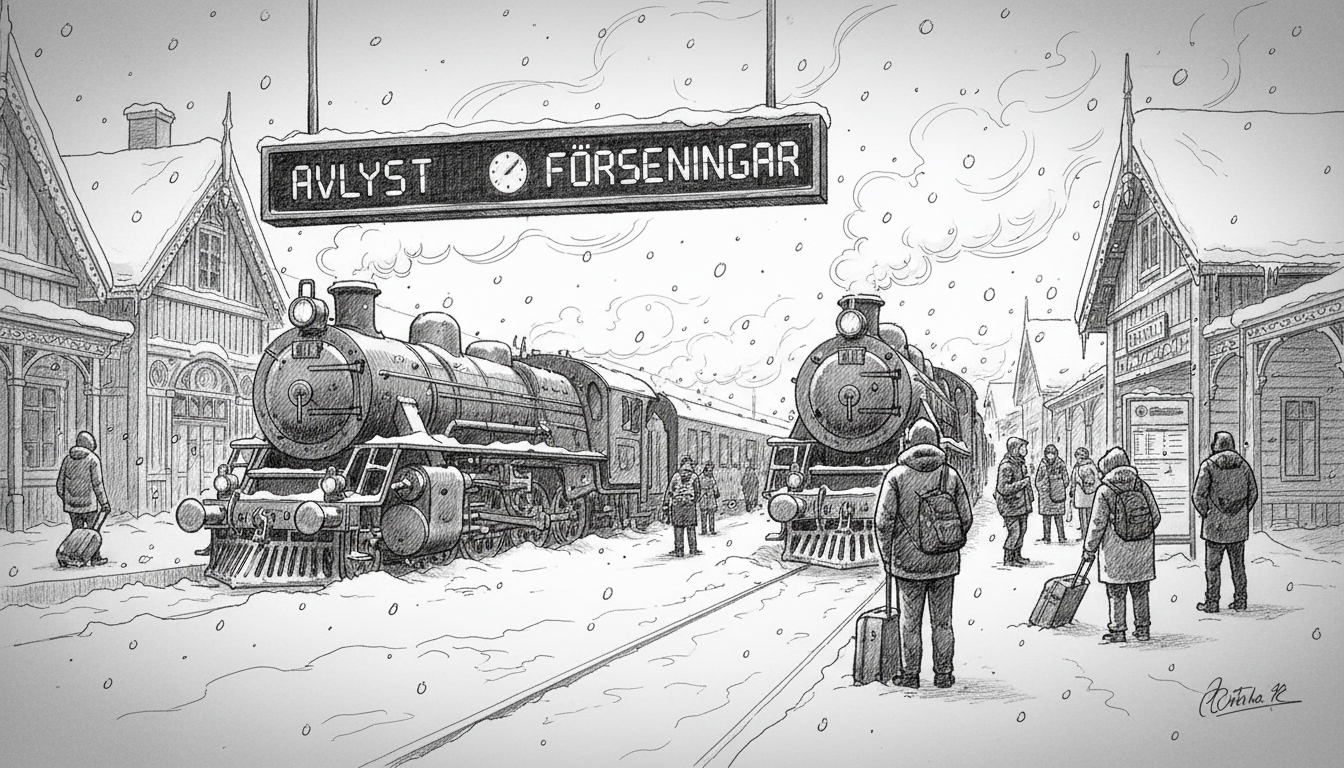
Stockholm train delays have paralyzed the weekend plans of hundreds of thousands, as a relentless snowstorm forces a drastic, extended shutdown of critical commuter lines. Swedish Transport Administration Trafikverket has heightened its preparedness level, mandating all operators to run fewer trains than normal. This measure, initially set until Tuesday, now stretches through Sunday, leaving the sprawling suburbs of Sweden's capital straining under the weight of the weather.
“We’ve had no choice but to extend the reduced timetable for the entire weekend,” a spokesperson for SL, Stockholm’s public transport authority, said in a statement. The cuts specifically impact the crucial Märsta to Södertälje centrum and Nynäshamn to Bålsta commuter rail lines. For a city that prides itself on orderly, efficient transit, the prolonged disruption feels like a system failure. “It’s not just an evening commute,” the spokesperson added. “It’s a whole weekend of people’s lives affected.”
A Weekend of Disruption
For Stockholm residents, the pendeltåg is more than a train. It is the essential artery connecting outer boroughs like Sollentuna and Täby to the city center, and linking southern hubs like Södertälje to the north. On a normal Saturday, these trains ferry families to shopping trips in the city, students to libraries, and workers to their shifts. This weekend, those platforms in stations like Odenplan and T-Centralen will be unusually quiet. SL's announcement means a skeleton service will operate, with waits of up to an hour between trains on the affected lines—a dramatic drop from the typical 10-15 minute frequency.
The decision by Trafikverket to maintain a high preparedness level comes despite a forecast of stable, albeit frigid, weather from Sweden’s meteorological agency, SMHI. The paradox is not lost on commuters: clear skies, yet crippled service. The issue, authorities explain, is not the falling snow but the aftermath. Infrastructure, including switches and signaling, remains compromised from the heavy snowfall earlier in the week, and extreme cold poses its own set of maintenance challenges. “The system needs time to recover fully,” a Trafikverket engineer noted, speaking on background. “Operating at full capacity now risks more severe, long-term breakdowns.”
The Human Cost of Delays
In Märsta, a northern terminus, the mood was one of resigned frustration on Friday afternoon. Lisa Bergman, a nurse scheduled for weekend shifts at Karolinska University Hospital, was recalculating her three-hour round trip. “What is normally a 40-minute direct train ride now involves two buses and the subway,” she said, checking her phone for the SL travel planner. “I leave in darkness and return in darkness. This storm stole my daylight.” Her story is echoed across the region. For those in Nynäshamn, a coastal town south of the city, the isolation is more acute. The reduced service severs a key link to Stockholm’s economy and social life.
The economic ripple effects are significant. Retailers in central Stockholm, who rely on weekend foot traffic from the suburbs, anticipate a quiet few days. “A big part of our Saturday customers come from outside the city core,” said Erik Lundqvist, who manages a clothing store on Drottninggatan. “When the trains stop, so do they.” Meanwhile, the cost of the disruption to regional productivity is immense. While no official figure is available for this event, previous studies have shown that major transit outages in Stockholm can cost the regional economy tens of millions of kronor per day in lost work time and productivity.
Infrastructure Tested by a New Climate
Transport experts see this event as part of a troubling pattern. “Our infrastructure was built for a different climate,” said Dr. Elin Mårtensson, a researcher in urban transport systems at KTH Royal Institute of Technology. “While Sweden is no stranger to snow, the intensity and frequency of these disruptive events are increasing. We are seeing more freeze-thaw cycles and heavier precipitation. Our systems are facing stresses they weren't designed to handle consistently.”
This incident raises hard questions about resilience. Is the Swedish model, famous for its dependability, prepared for a future of climate volatility? Trafikverket's preparedness levels are a tried-and-tested tool, but critics argue they are a reactive, not a proactive, solution. Investment in winter-proofing infrastructure—from heated switches to more resilient power lines—is costly but may become unavoidable. “Every time this happens, we talk about adaptation,” Dr. Mårtensson added. “But then the snow melts, and the urgency melts with it. The conversation needs to continue under clear skies.”
Navigating a Frozen City
For Stockholmers this weekend, adaptation is personal. The advice from SL is to work from home if possible, check real-time travel apps religiously, and allow for massive extra travel time. Many are turning to alternatives, but the options are strained. Long queues formed at taxi stands near major stations on Friday night, and ride-share prices surged. The bus network, attempting to fill the gaps, is contending with the same snowy, icy roads.
There is a distinct cultural dimension to this disruption. Swedish society operates on a foundation of trust in collective systems—the pendeltåg timetable is one of them. When it falters, it chips away at that social contract. The famous Swedish tålamod (patience) is being tested. Yet, there’s also a shared, grudging understanding. “It’s nature,” sighed Anders Fjellström, waiting on a chilly platform in Upplands Väsby. “You can’t fight it. But you’d think we’d be better at this by now. We are Swedes, after all.”
As Sunday night approaches, the city will hope for a full restoration of service on Monday morning. The deeper question lingers in the cold air: How many more weekends like this will Stockholm have to endure before its celebrated transit system is fortified for the new normal of extreme weather? The snow will eventually melt, but the pressure on Sweden’s transport authorities is only building.