
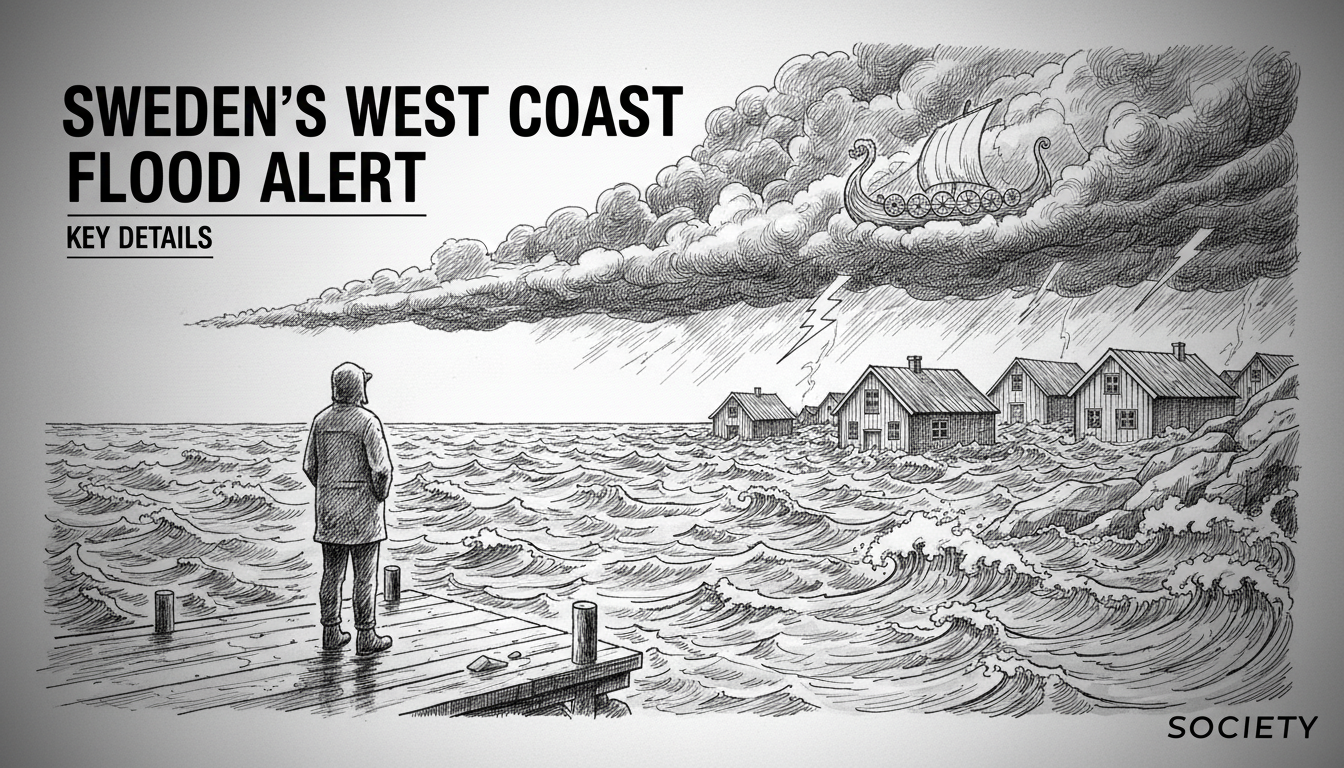
Sweden's meteorological agency SMHI has issued a high water level warning for the nation's western coastline, highlighting a recurring environmental challenge. The alert, active through Thursday afternoon, specifically targets areas from Marstrand to Strömstad on the northern West Coast and southern Halland coast. SMHI oceanographer Jörgen Öberg, the duty officer, simultaneously downplayed immediate major risk while confirming the elevated water data. 'Water levels at this height, even higher, happen several times a year,' Öberg stated around 10 a.m. local time.
The warning indicates that low-lying piers, buildings, and the clearance under bridges could be compromised. Moored vessels are also at potential risk, particularly between 11:00 and 14:00 on Thursday. This event underscores the persistent vulnerability of Sweden's extensive coastline to North Sea and Atlantic weather systems. Government policy in Sweden increasingly focuses on long-term climate adaptation, with SMHI's forecasts forming a critical part of national preparedness.
A Familiar Threat with Evolving Risks
High water events are not uncommon along the Västkusten. The region's topography and exposure make it susceptible to surges driven by wind and low-pressure systems. SMHI operates a sophisticated monitoring network that triggers warnings based on precise thresholds. These alerts are integrated into municipal and regional crisis management plans, often coordinated from command centers in Stockholm and county administrative boards.
While today's warning carries a yellow-level designation, suggesting limited impact, it fits a broader pattern. Climate scientists note that rising global sea levels and shifting weather patterns are altering the baseline for coastal hazards. 'What we consider a notable high-water event today may become a more frequent occurrence in the coming decades,' explains a coastal hydrology researcher at the University of Gothenburg, who requested anonymity as they are not an official SMHI spokesperson. This reality pressures the Swedish government to continuously evaluate its coastal defense and zoning strategies.
How SMHI's Warning System Operates
The Swedish Meteorological and Hydrological Institute functions as the primary national authority for weather and water warnings. Its three-tiered color system—yellow, orange, red—communicates escalating severity to the public and agencies. A yellow warning, like the one currently in effect, signals that conditions are potentially dangerous and the public should stay informed. The criteria are specific: for high water levels, factors include the predicted height above mean sea level, wave action, and the duration of the event.
Data is collected from a network of tidal gauges and weather stations along the coast. Oceanographers at SMHI's headquarters in Norrköping analyze this real-time data alongside forecast models. The decision to issue a warning involves assessing the probability of exceeding threshold values that could lead to property damage or threat to life. This process, while highly technical, has direct implications for local authorities in coastal communities from Gothenburg to Halmstad.
Government Policy and Coastal Management
Long-term adaptation to coastal flooding falls under the purview of multiple Swedish government ministries. The Ministry of Climate and Enterprise oversees broad strategy, while the Ministry of the Environment handles specific environmental quality standards. Municipalities, however, bear the primary responsibility for land-use planning. This division of responsibility can create challenges for implementing a unified national approach to climate resilience.
Recent Riksdag decisions have aimed to strengthen the legal framework for climate adaptation. Legislation now requires municipalities to conduct risk and vulnerability assessments for flooding. The Swedish government has also allocated specific funding for protective infrastructure, though experts argue the scale of investment must increase significantly. 'Our coastal management needs to be proactive, not reactive,' states a policy analyst familiar with submissions to the Riksdag's environment committee. 'The costs of inaction, as seen in other North Sea countries, will far exceed the costs of preventative measures.'
Immediate Impacts and Local Response
For residents and businesses along the affected coasts, the SMHI warning triggers practical precautions. Marina operators secure loose equipment, and property owners in known low-lying areas may deploy temporary barriers. The Swedish Maritime Administration monitors bridge clearances, issuing navigational advisories to vessel traffic. These localized actions, though seemingly small, represent the frontline of Sweden's response to hydrological threats.
The economic impact of repeated, moderate flooding can accumulate over time. Saltwater intrusion damages infrastructure, erodes foundations, and disrupts tourism—a key industry for West Coast towns like Marstrand and Smögen. Insurance claims data from previous similar events informs both private insurers and government disaster relief planning. This feedback loop between incident, cost, and policy adjustment is continuous.
Analysis: A Test for National Preparedness
This specific warning, while not catastrophic, serves as a live test of Sweden's early warning systems and inter-agency coordination. The effectiveness of communication between SMHI, the Swedish Civil Contingencies Agency (MSB), and local rescue services is paramount. Success is measured not just in prevented damage, but in the public's understanding of the risk. In an era of climate change, public trust in scientific agencies and clear official guidance becomes a critical societal asset.
The Swedish model relies on accurate information and voluntary compliance. There are no widespread mandatory evacuations for a yellow-level water warning. Instead, the system expects informed citizens and responsible local officials to take appropriate steps. This approach reflects a broader Scandinavian principle of shared responsibility between state and individual. The coming hours will show how well that compact holds under the pressure of rising waters.
Looking Beyond the Current Alert
Once water levels recede later today, the work for planners and policymakers continues. Each event provides valuable data on flood patterns, infrastructure performance, and community response. SMHI will incorporate this data into its models, refining future forecasts. Research institutions will analyze the event to better understand the interplay between sea-level rise and storm surges.
The long-term question for the Swedish Parliament and government is one of investment and priority. Balancing the protection of existing coastal communities with the need for sustainable development in vulnerable zones is a complex political task. Future Riksdag decisions will determine whether Sweden chooses to fortify its coastlines, strategically retreat from certain areas, or employ a combination of strategies. The water lapping at piers today is a tangible reminder that these decisions cannot be postponed indefinitely. The nation's relationship with its coastline is entering a new, more challenging phase, where vigilance and adaptation are no longer optional but essential components of national security.