
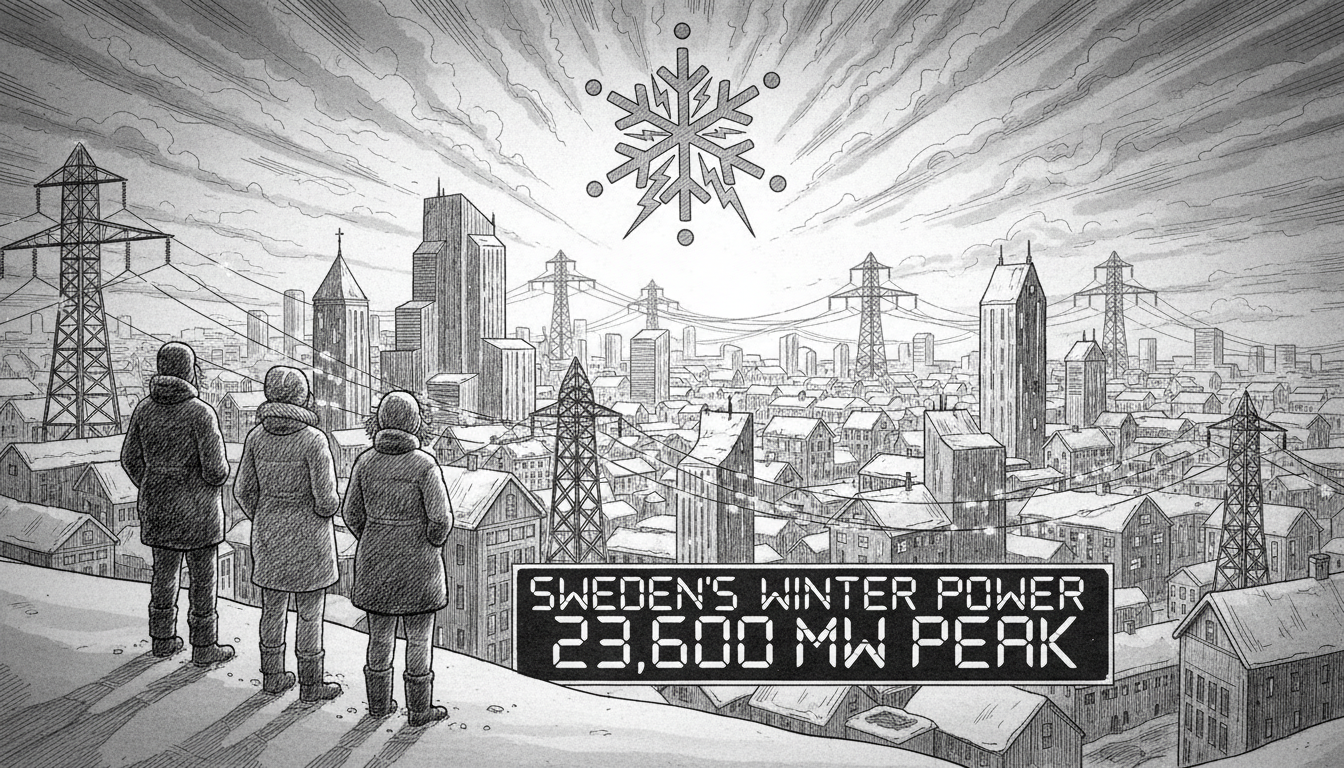
Sweden's electricity consumption surged to 23,600 megawatts on Wednesday, marking the highest demand level of the winter so far. The spike followed a return to work after the holidays and a deep freeze across the nation. Despite the peak, analysts report the grid remains stable with no immediate risk of blackouts or dramatic price surges. "It looks stable," said Johan Sigvardsson, an electricity analyst at trading firm Bixia. He predicts consumption will climb even higher next week as temperatures remain low.
This annual winter stress test highlights the complex balancing act of the Nordic energy market. Sweden's power system, integrated with Norway, Denmark, Finland, and the Baltics via the Nord Pool exchange, relies on a mix of nuclear, hydro, and wind generation. The current stability is a sign of adequate planning and reservoir levels, but it focuses attention on the long-term challenges of decarbonization and grid capacity.
A Stable Grid Amidst a Deep Freeze
The demand peak coincided with sub-zero temperatures gripping virtually the entire country, with particularly harsh conditions in the north. This pattern is classic for Swedish winters: economic activity resumes while heating systems work overtime. The 23,600 MW figure represents a significant draw on the national grid, yet system operator Svenska Kraftnät reported no major strain. This resilience stems from several factors, including strong hydro power reserves and available nuclear capacity.
Johan Sigvardsson's analysis provides crucial context. "And it will become even higher next week," he noted, indicating that Wednesday's peak was not an anomaly but part of a rising trend. This forecast pushes planners and traders to look ahead, evaluating generation schedules and cross-border transmission flows. The absence of panic or price alarms suggests Sweden entered the winter with a healthy buffer of generation capacity.
The Mechanics of Nordic Power Pricing
Understanding why prices haven't skyrocketed requires a look at the regional market. Sweden does not operate in isolation. Its electricity market is part of the vast Nord Pool system, one of the world's first multinational power exchanges. Prices in Stockholm, Malmö, or Luleå are set by the marginal cost of producing the last megawatt needed to meet demand across the entire bidding zone, often influenced by conditions in neighboring countries.
When Swedish demand rises, the market can import power from Norwegian hydro plants or Danish wind farms, provided transmission lines have available capacity. Conversely, when Swedish wind generation is high, it can export surplus electricity. This interdependence smooths out price volatility. A cold snap in Sweden might coincide with strong winds in Denmark or ample water in Norwegian reservoirs, keeping a lid on costs. The current stability suggests such a favorable alignment is in place.
The Swedish Energy Mix: Strength and Vulnerability
Sweden's domestic generation portfolio is a key pillar of its winter security. A significant portion of its electricity comes from hydro and nuclear power—sources that are largely dispatchable and not dependent on daily weather fluctuations, unlike wind. Hydro power, in particular, acts as a massive battery. Reservoir levels, carefully managed through autumn, are now being drawn upon to meet heating demand.
However, the system is not without pressure points. The government's ambitious decarbonization goals are driving a phase-out of fossil-based thermal power and a massive expansion of wind energy. While wind is crucial for the climate transition, its intermittent nature poses a challenge for grid stability during long, cold, and still winter periods. This winter's peak demand is a live test of how the existing reliable baseload—nuclear and hydro—supports the system as the energy mix evolves.
Expert Perspective on Long-Term Stability
Energy analysts like Sigvardsson monitor more than just daily consumption figures. Their focus includes reservoir levels for hydro power, long-term weather forecasts for wind generation, scheduled maintenance at nuclear plants, and the health of the transmission grid. "It looks stable," is a simple statement backed by a complex array of data points. This professional calm is reassuring but comes with caveats.
Experts consistently emphasize that grid stability requires continuous investment—not just in new renewable generation, but in grid reinforcement and energy storage solutions. The Nordic market's efficiency at handling a 23,600 MW peak today is the result of decades of infrastructure investment and market design. Maintaining that reliability through the energy transition, especially as electrification of transport and industry increases base demand, is the next great challenge. A sudden outage at a major plant or an unexpected drop in wind across Northern Europe could still test the system's limits on a day like Wednesday.
What High Demand Means for Consumers and Businesses
For Swedish households and companies, the immediate impact of this consumption peak has been muted. Electricity bills this week reflect the higher demand but have not seen the extreme spikes witnessed in some previous winters or in other parts of Europe recently. This is the primary benefit of a well-functioning, integrated regional market: it protects consumers from the full brunt of local shortages.
Nevertheless, the event is a reminder of the link between weather and energy economics. Industries with high power consumption, from steel mills to data centers clustered in the Stockholm business district and beyond, monitor these trends closely. Their operational costs and sustainability pledges are directly tied to the grid's carbon intensity and price volatility. A stable grid under peak demand supports Sweden's reputation as a reliable base for energy-intensive businesses.
Looking Beyond the Winter Peak
As Sweden's consumption is set to rise again next week, the broader question is about future winters. The nation's climate and energy policies aim to create a fossil-free, electrified economy. This will inevitably place greater demand on the electricity grid. Every peak demand period provides data and lessons for managing this transition.
Will the combination of new nuclear reactors, expanded wind power, grid-scale batteries, and a stronger Nordic grid be enough to handle a future winter peak of 25,000 MW or 30,000 MW? The calm handling of this week's 23,600 MW demand is a positive sign, but it is not a guarantee. It demonstrates the current system's robustness while quietly underscoring the scale of the investment needed in the decade ahead. The true test will come when today's reliable baseload generation has been further reshaped by the imperatives of the green transition.