
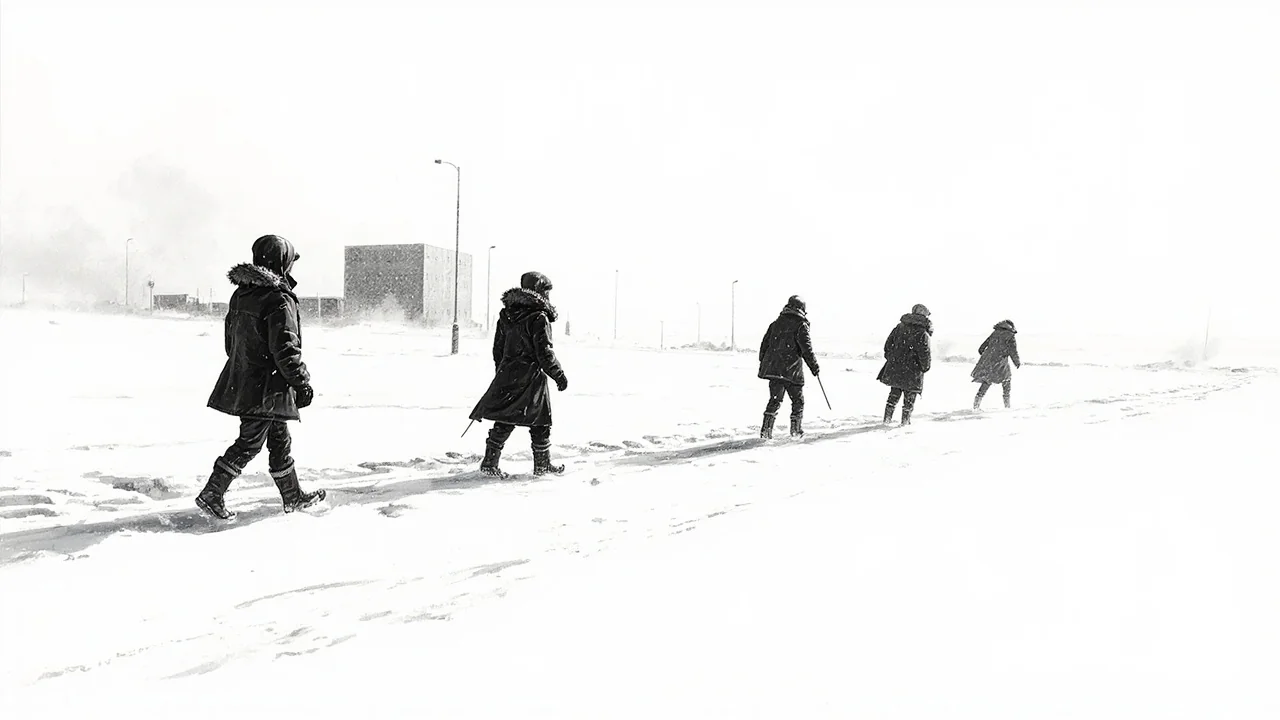
Sweden's winter workforce logs thousands of hours in sub-zero temperatures, with food delivery riders, arborists, and postal workers leading the frontline against the cold. Their uniform is simple: double layers of everything. "Sometimes when I'm delivering food, my hands shake," says Ronny Kodego, a food courier navigating Stockholm's icy bike lanes. His thermal layers are a personal armor against a climate that sees average winter temperatures of -3°C, with dips far below. This is the reality for thousands whose offices have no walls.
The Daily Deep Freeze
Marie Långmark, an arborist inspecting trees in Stockholm's Humlegården park, views the snow differently. "I'd rather have snow than rain," she says, brushing powder from a pine branch. "You can work yourself warm." Her job involves assessing tree health, a crucial task in a city famed for its urban forests. While many Stockholmers hurry between cozy cafés, Marie's workday is spent in silent, frosty dialogue with ancient oaks and elms. She describes a learned resilience, a physical adaptation to conditions that would send others indoors.
For postal workers, the challenge is logistical. Slippery stairs, frozen mailbox locks, and reduced daylight hours compress delivery windows. "The bag gets heavier with all the extra gear," one carrier notes, referencing reflective vests worn over bulky jackets. In residential areas like Södermalm or Vasastan, the rhythm of the delivery round changes. It becomes slower, more deliberate. Every step on untreated ice requires focus. The cultural expectation of service continuity—the belief that the mail should always get through—meets the physical reality of a Swedish winter.
Layers and Logistics
The core strategy is universal: insulation. Workers swear by wool base layers, windproof shells, and the sacred double sock technique. Heat escapes fastest from extremities, making quality gloves and boots a non-negotiable investment. Ronny, the food courier, often takes short breaks in building lobbies, not just to check his phone, but to let his phone work. Batteries die quickly in the cold. His earnings are directly tied to how many deliveries he can complete, a race against both time and thermodynamics.
Street maintenance crews face a different scale. They operate the plows and salt spreaders that keep the city moving. Their work often happens in the darkest, coldest pre-dawn hours. They speak of a quiet pride in clearing paths for the first commuters. It’s a behind-the-scenes role vital to Stockholm's functioning. A successful morning means the average office worker might never notice the effort it took to make their bus route safe.
The Human Cost of Cold
Beyond discomfort, there are real risks. Prolonged exposure can lead to frostbite or hypothermia. Cold stress reduces manual dexterity and cognitive function, potentially leading to accidents. "You have to listen to your body," Marie emphasizes. She knows the signs of pushing too hard. The social safety net, including strong union protections and strict workplace environment (Arbetsmiljö) laws, theoretically guards against the worst. Employers are required to provide protective clothing and schedule warm breaks. But in the gig economy, where Ronny operates, those lines can blur. Is he an employee or a contractor? Who provides his gloves?
This friction points to a broader societal shift. As service economies grow, more people work in non-traditional, exposed settings. The classic image of Swedish industry—the factory, the office—is now complemented by the rider on the e-bike. The systems designed to protect workers are being tested by new models of employment. The cold doesn't discriminate between a postal worker with a century-old union agreement and a modern app-based courier.
Expert Perspective on a Frozen Economy
"We are socialized to accept winter as a fact of life, but we must scrutinize its economic and human impacts," says Dr. Elin Mårtensson, a researcher at the Swedish School of Sport and Health Sciences. "The assumption that 'you can work yourself warm' is physiologically incomplete. Energy expenditure in the cold is significantly higher, leading to fatigue. We need to see thermal comfort as a component of productivity and worker retention, not just safety."
Dr. Mårtensson points to studies showing performance decline in motor tasks below 10°C. For jobs requiring precision, like handling small parcels or tools, the effect is pronounced. Her analysis suggests that the true cost of winter includes hidden inefficiencies. A delivery that takes 5 minutes in August might take 8 in February. The solution isn't to stop work, but to innovate around it. Could delivery windows be longer? Could more charging points and warm hubs be integrated into city planning?
Unions like Kommunal, which represents many municipal workers, emphasize the right to proper equipment and adjusted schedules. "The 'fika' break isn't just a cultural luxury," a union representative notes. "In winter, it's a necessary reset for body temperature. We negotiate over the quality of boots, not just salaries." This practical approach reflects a Swedish pragmatism. The problem is identified, then systematically addressed through collective agreement.
A Cultural Resilience
There is a shared, unspoken ethos among these workers. They frame the hardship through a lens of capability. Conquering the cold is a point of personal and professional pride. It connects to a larger Scandinavian concept of 'friluftsliv'—open-air life—that values engagement with nature in all seasons. The blizzard is just another condition to be met, another problem to solve with good gear and a sensible plan.
As the sun sets early over Riddarfjärden, casting a blue light on the ice, the winter workforce continues its rounds. The layers come off in doorways and depot break rooms. Wet socks are changed. Thermoses of coffee are emptied. They perform an essential, often invisible, function: keeping the rhythms of daily life uninterrupted by the weather. Their commute is a battle against the elements, fought one double-layered step at a time. In a nation shaped by its climate, they are the human infrastructure that makes winter work. How much longer, however, can personal grit compensate for systemic gaps in the modern cold economy?