
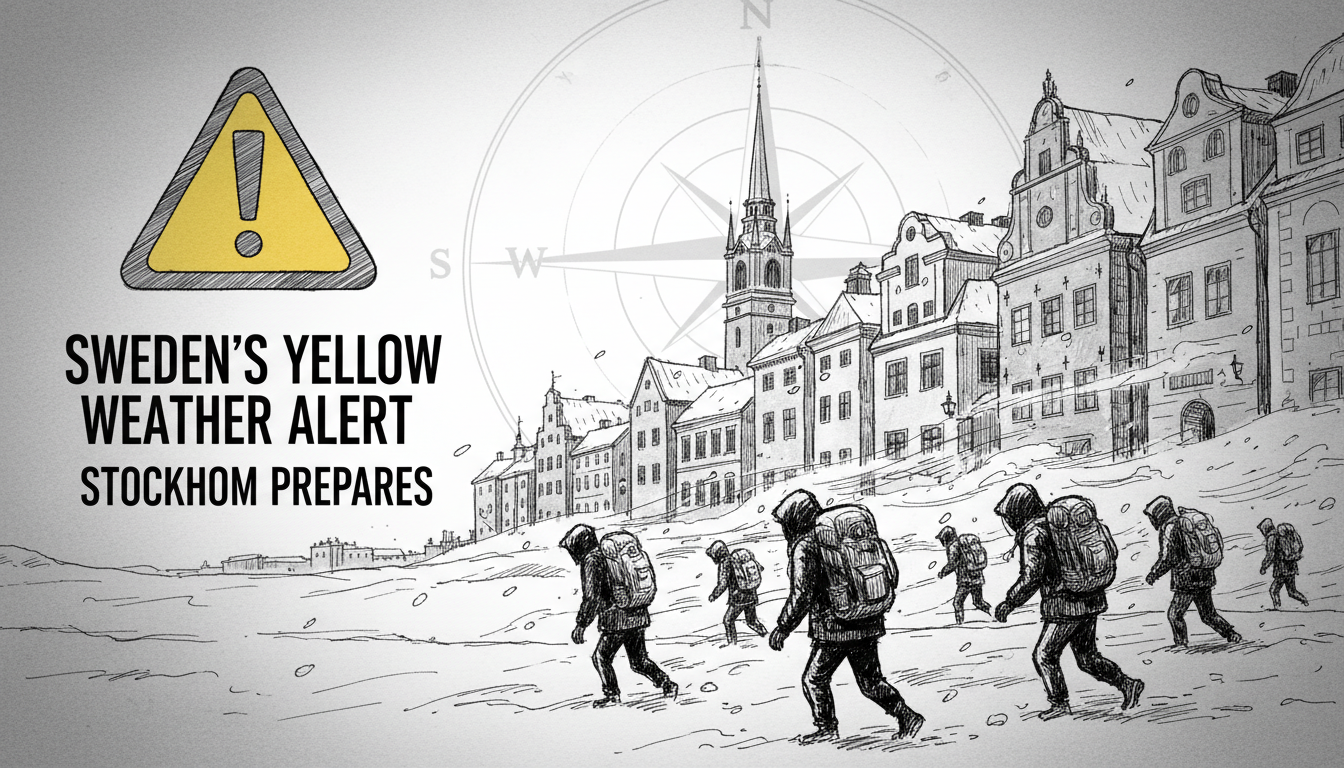
Sweden's meteorological authority has issued a yellow weather warning for Stockholm County and southeastern regions. The alert from the Swedish Meteorological and Hydrological Institute (SMHI) covers southern Svealand, parts of Östergötland, Kalmar, Karlskrona, and Öland. It is in effect from 6 PM Monday until 3 PM Tuesday, signaling potentially disruptive conditions for commuters and residents.
Stockholmers are checking their weather apps with a familiar mix of curiosity and mild concern. A yellow warning, or 'gul vädervarning,' sits one level below the more severe orange alert that swept through over the weekend. While not an emergency, it is a clear signal from SMHI to pay attention. The sky over Södermalm is a battleship grey, and a brisk wind tugs at scarves along Götgatan. This is the practical reality of Swedish autumn—a season of swift change where preparedness is part of the cultural fabric.
What a Yellow Warning Really Means
In Sweden's color-coded warning system, green means all clear. Yellow indicates weather that could cause some public disruption or pose a minor danger. Orange warns of dangerous weather with significant impact. Red is reserved for extreme, potentially catastrophic events. "A yellow warning is not a reason for alarm, but it is a reason for awareness," explains a meteorologist from SMHI. "It means the conditions are there for locally troublesome weather. It could be strong gusts affecting ferries in the archipelago, heavy rain causing slippery roads, or wet snow on higher ground."
The key word is 'locally.' While the broader region is under alert, the impacts will be patchy. One neighborhood might see a calm drizzle, while another, perhaps on the higher terrain of Lidingö or in the open areas around Arlanda airport, could face stronger winds. This granularity is why Swedes are encouraged to follow local updates, not just the regional headline. The warning is a nudge to think twice about that evening cycle ride or to secure garden furniture that could become airborne in a sudden squall.
The Swedish Relationship with Weather
Weather is not small talk in Sweden; it is a central character in daily life. The shift from last weekend's orange warning to Monday's yellow alert is a perfect example of the dynamic conditions. Swedes have a pragmatic, almost respectful relationship with their climate. They are experts in layering—the 'påklädningssystem' of base layers, mid-layers, and shells is a national skill. This yellow warning is a prompt to employ that system.
Local traditions are often weather-dependent. An outdoor 'fika' in a park like Tantolunden might be moved indoors. Parents will ensure children have proper rain gear for the walk to school. Commuters on the Roslagsbanan or Saltsjöbanan railways will check for potential delays before heading out. This collective, low-key preparedness is a hallmark of Swedish society. It is less about fear and more about practical adaptation, a concept deeply ingrained from the northern reaches of Norrland to the southern coast of Skåne.
Expert Advice for Navigating the Alert
Meteorologists stress that the public should use the warning as a planning tool. "The purpose is to give people and authorities time to adjust," the SMHI expert says. "For most, it means checking the forecast before traveling and allowing extra time. For authorities, it's a signal to have resources on standby." Emergency services and municipal workers in Stockholm will be briefed. They might pre-position equipment for clearing fallen branches or monitor flood-prone areas more closely.
For the average Stockholmer, the advice is straightforward. If you are driving, be aware of potential aquaplaning on highways like the E4 or E18. Cyclists should be cautious on bridges and open stretches where crosswinds are stronger. Those with plans to take a ferry to the archipelago for a late-season outing should verify departures. The underlying message is one of informed caution. It is the difference between being caught in a downpour and choosing to carry an umbrella.
Beyond the Forecast: A System Built on Trust
The SMHI warning system works because of public trust. Swedes generally heed official advice, a trait evident during the pandemic and during extreme weather events. The system is clear, consistent, and based on measurable thresholds for wind, precipitation, and temperature. This yellow warning, while minor, reinforces that channel of communication. It keeps the public in the loop and maintains a baseline of readiness that can be scaled up if conditions worsen.
This cultural infrastructure is as important as the physical one. It is why news outlets and weather services provide frequent updates. It is why the phrase "så ska du tänka" (this is how you should think) accompanies the warning—it is instructional, not just informational. It guides behavior, encouraging a shift from passive observation to active consideration.
Looking Ahead: Autumn's Unpredictable Turn
As the warning period runs through Tuesday afternoon, life in Stockholm will proceed with a slight adjustment. Outdoor markets might be a bit quieter. Cafés with cozy indoor seating will see a boost. The vibrant autumn colors in Djurgården will be deepened by the rain. This is the rhythm of the season.
The yellow alert serves as a reminder of nature's agency in a highly modernized society. Sweden can engineer fantastic infrastructure, but a gust of wind can still delay a train. The system acknowledges this, aiming not to control the weather but to manage our response to it. As the light fades early and the air turns crisp, this minor warning is a rehearsal for the more serious winter storms to come. It tests the system and the public's response, ensuring that when a true crisis hits, the mechanisms of awareness and action are well-practiced. For now, it is a simple directive: look at the sky, check the app, and maybe choose the waterproof shoes today.