
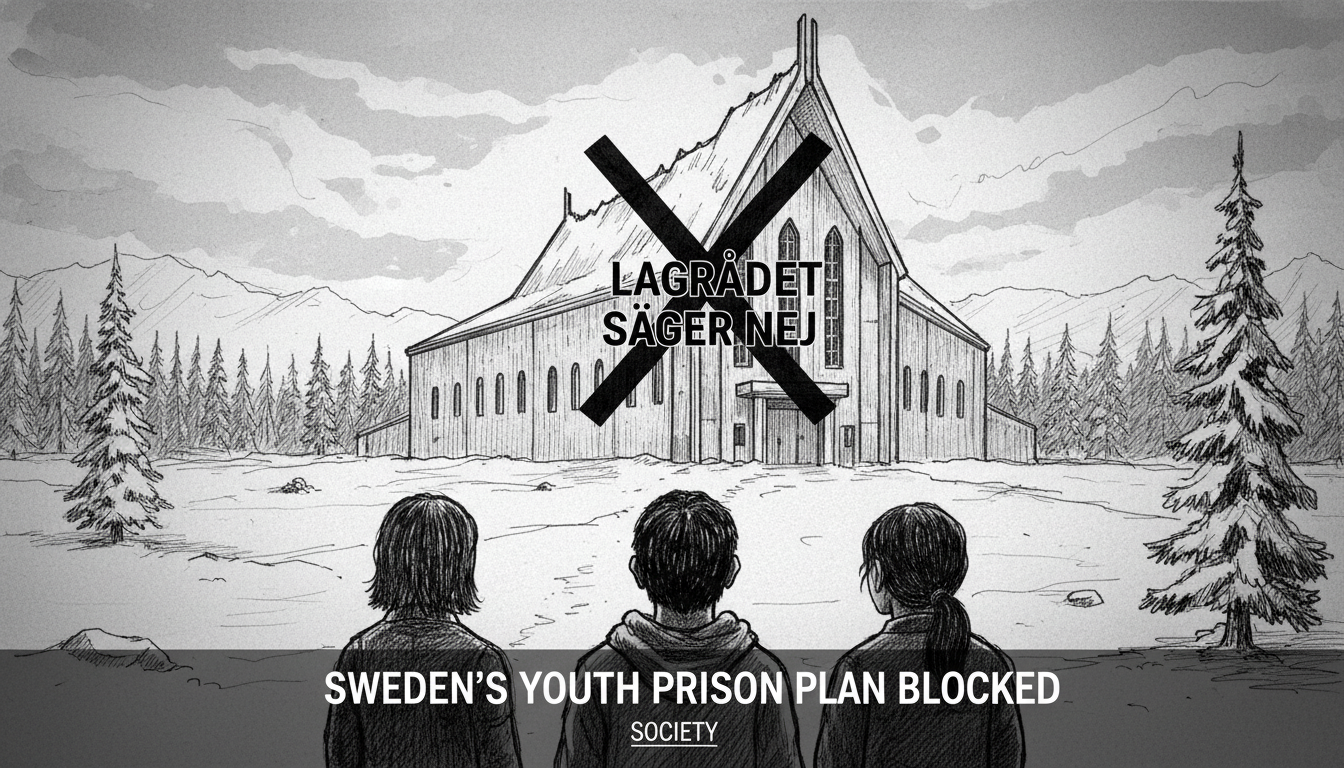
Sweden's Council on Legislation has delivered a sharp rebuke to the government's flagship proposal to introduce prison sentences for 15 to 17-year-olds. The independent legal review body, known as Lagrådet, has advised against the draft law, citing fundamental flaws in its preparation and significant deviations from the original inquiry's recommendations. This decision represents a major setback for Justice Minister Gunnar Strömmer and the governing coalition, which had championed the policy as a necessary tool against serious youth crime.
The proposal, sent to the Council for review earlier this autumn, sought to replace 'sluten ungdomsvård' (secure youth care) with standard prison sentences for young offenders in severe cases. It was built upon a government inquiry report finalized in August 2023. In its formal opinion, the Lagrådet concluded the legislative draft was inadequately prepared. The Council stated the proposal diverged extensively from the inquiry's suggestions on both substantive legal matters and technical implementation.
A Foundational Legal Critique
The Lagrådet's rejection is not a political opinion but a technical-legal assessment of the bill's quality and constitutionality. Its core function is to examine whether proposed legislation is consistent with Sweden's legal system and fundamental laws. A negative opinion carries significant weight, historically causing governments to withdraw or substantially rewrite proposals. The Council found the current draft lacked the necessary precision and coherence required for a change of this magnitude in criminal law.
"When the Lagrådet identifies such broad deficiencies, it signals the government has moved too hastily," said Professor Eva Lindell, a constitutional law expert at Uppsala University. "The criticism suggests the proposal was not grounded in a thorough analysis of its consequences for the legal framework surrounding young offenders." The Council's scrutiny focused on how the new rules would interact with existing sentencing principles and the overarching goals of the juvenile justice system.
Diverging from the Official Inquiry
A central point of the Lagrådet's criticism is the government's departure from the official inquiry's groundwork. The independent inquiry, which spent months researching and consulting experts, presented a specific framework for introducing youth prisons. The government's subsequent bill altered key components of that framework. The Lagrådet noted these changes were made without sufficient justification or supporting analysis, weakening the proposal's legal robustness.
This gap between inquiry and bill raises questions about the policy development process within the Ministry of Justice. It suggests political priorities may have overridden the detailed preparatory work. The Council's opinion implies the government failed to build a legally sound bridge between the inquiry's conclusions and its own desired political outcome. This is a serious procedural critique in Sweden's consensus-driven legislative tradition.
The Political Battle Over Youth Sentencing
The proposal to introduce youth prisons has been a polarizing element in the Swedish political debate. The governing coalition, led by the Moderate Party, argues that the current system of secure youth care is insufficient for the most serious crimes, such as lethal violence or bombings. They contend that a prison sentence carries greater symbolic weight and provides a clearer societal response to heinous acts. Justice Minister Gunnar Strömmer has repeatedly stated the need for "clearer consequences" for young perpetrators.
Opposition parties, alongside many criminologists and social workers, have fiercely opposed the change. They argue that prison environments are detrimental to adolescent development and reduce the chances of successful rehabilitation. The Swedish National Board of Institutional Care (SiS), which administers secure youth care, emphasizes its focus on therapy, education, and addressing the root causes of criminal behavior—a focus often diluted in adult prison settings.
The Rehabilitation Versus Punishment Dilemma
The blocked legislation sits at the heart of a perennial conflict in justice policy: rehabilitation versus retribution. Sweden's approach to young offenders has historically leaned toward rehabilitation, viewing crime as a symptom of social and personal dysfunction. The proposed shift toward punitive prison sentences marked a significant philosophical change. Legal experts warn that imprisoning adolescents could violate international conventions, including the UN Convention on the Rights of the Child, which mandates that detention of children be a last resort.
"The scientific evidence is clear that incarceration of adolescents often leads to worse long-term outcomes," noted criminologist Dr. Lars Hällgren. "It increases the risk of reoffending and disrupts the crucial social and educational development that occurs in the late teens. Secure youth care, while far from perfect, is designed with that development in mind." The Lagrådet's opinion may have indirectly considered whether the proposal adequately balanced these evidence-based concerns against the stated need for deterrence.
Next Steps for the Government
The government now faces a critical choice. It can withdraw the proposal entirely, a move that would be seen as a major political defeat. Alternatively, it can revise the bill extensively to address the Lagrådet's criticisms and resubmit it. This process would require several more months of legislative work and likely necessitate concessions that dilute the original proposal's scope. A third, more confrontational path would be to ignore the Lagrådet's advice and force the bill through the Riksdag, though this is rare and considered damaging to legislative integrity.
Any revised proposal must meticulously align with the foundational inquiry and provide robust legal reasoning for each clause. The Ministry of Justice will need to demonstrate precisely how youth prison sentences would be applied, how they differ procedurally from adult sentencing, and how they comply with Sweden's international obligations. This is a complex task that cannot be rushed.
Implications for Sweden's Legal Landscape
This decision reinforces the Lagrådet's role as a guardian of legislative quality in Sweden. It acts as a crucial check on government power, ensuring that laws are well-crafted and legally coherent before they reach the parliament floor. The Council's intervention highlights the risks of crafting criminal justice policy in a heated political climate, where the demand for swift action can overshadow methodological rigor.
The debate will continue in the Riksdag's Committee on Justice and in public discourse. However, the Lagrådet's opinion has fundamentally altered the terms of that debate. The question is no longer solely about the merits of youth prisons, but about the government's ability to construct a legally viable model for them. The government's next move will be closely watched as a test of its commitment to both its political agenda and the principles of sound lawmaking.
Does this setback signal a need for a more nuanced approach to youth crime, one that combines accountability with proven rehabilitation methods? The path forward requires navigating a complex intersection of legal principle, political will, and evidence-based social policy.