
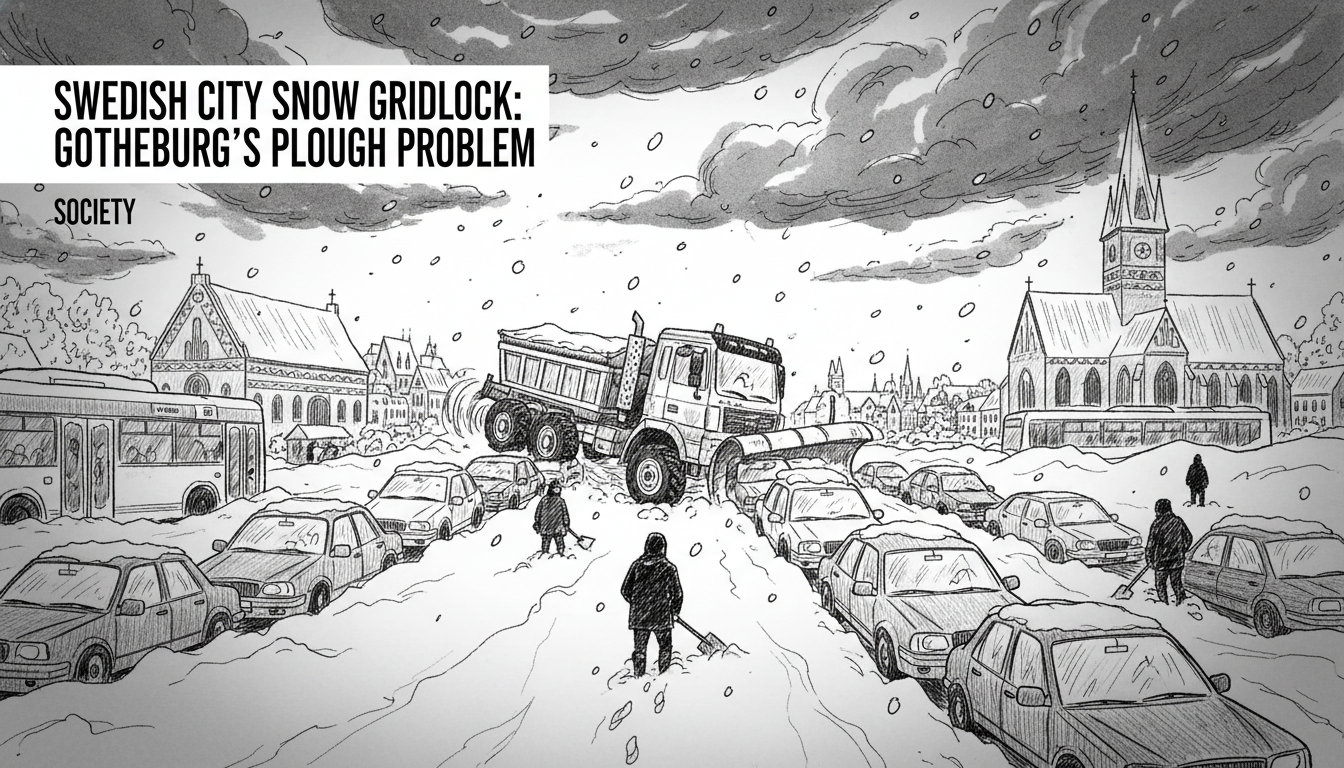
Gothenburg's snow removal system faces its most severe test since the benchmark chaos of 1995. City officials confirm a flood of resident complaints regarding unplowed streets and obstructive snowdrifts. The Stadsmiljöförvaltningen (City Environment Administration) is deploying all resources to manage the crisis, prioritizing critical infrastructure above all else. This operational challenge highlights the perennial tension between municipal resource allocation and public expectation during harsh Swedish winters.
A Resident's Frustration Meets Municipal Reality
For many Gothenburg residents, this winter's heavy snowfall has transformed simple commutes into arduous journeys. Blocked sidewalks and impassable residential streets have sparked hundreds of direct inquiries to the city government. Evelyn Gredesjö, a unit manager at the Stadsmiljöförvaltningen, is on the front line of the response. Her department within the operation and maintenance division holds direct responsibility for winter road upkeep. Gredesjö acknowledges public frustration but stresses the rigid prioritization protocol governing all snow-clearing activities. Sidewalks and cycle paths receive attention only after vital societal functions are secured. This hierarchical system, while logical from a crisis management perspective, often leaves residents feeling neglected. The city advises individuals to file specific reports through its official contact center for localized issues.
The Hierarchy of Winter Maintenance
Gothenburg's snow removal strategy follows a clear, legally-informed cascade. The primary network of main roads receives absolute top priority. This ensures that public transport buses and trams can maintain scheduled services. Emergency service vehicles also require these arterial routes to remain open. Secondary priorities include access roads to essential facilities like hospitals, schools, and dense housing areas. Residential streets, pedestrian walkways, and recreational paths form the final tier of the clearance schedule. Evelyn Gredesjö explicitly stated that no special priority exists for cycle and footpaths outside this structure. This policy framework originates from national guidelines adopted by the Swedish government and implemented by local municipalities. The Riksdag has debated funding for local infrastructure maintenance for years, directly impacting cities like Gothenburg.
Echoes of 1995 and Evolving Preparedness
The current situation inevitably draws comparisons to the notorious 'snökaoset' (snow chaos) of 1995. That event paralyzed Gothenburg and became a national case study in municipal winter response failure. Officials now use it as a key benchmark for evaluating current operations. Gredesjö noted that despite recent heavy precipitation, overall accessibility has improved since the initial snowfall earlier in the week. This, she credits, is due to the relentless work of the city's snow removal teams. The shadow of 1995 has driven significant investments in planning and equipment over the past three decades. Stockholm politics often scrutinize how major cities handle such crises, seeing them as tests of local administrative competence. Gothenburg's performance is monitored closely, with implications for future regional funding and autonomy.
The Logistics and Economics of Snow Fighting
Winter road maintenance consumes a substantial portion of Gothenburg's annual municipal budget. The costs encompass far more than just fuel and labor for ploughs. Strategic stockpiling of salt and gravel, equipment maintenance, and contractor fees create a complex financial equation. Severe winters strain these allocated funds, sometimes requiring supplementary budget decisions from local politicians. The environmental impact of salt and chemical de-icers also factors into modern planning. Experts in Scandinavian urban management argue for smarter, more sustainable practices. They suggest integrating climate data and traffic analytics to optimize routes and material usage. Such efficiency gains could potentially free resources to address lower-priority streets more quickly, easing public frustration.
Expert Analysis: A Systemic Balancing Act
Urban planning specialists view Gothenburg's dilemma as a classic case of competing public goods. Professor Lars Bengtsson, a transportation infrastructure expert at Chalmers University of Technology, provided context. 'A municipality's duty is to ensure the basic functionality of the city,' Bengtsson said. 'This creates a non-negotiable hierarchy. The economic and social cost of a blocked bus line far exceeds that of a blocked residential cul-de-sac.' He notes that Swedish law supports this prioritization, mandating access for essential services. However, he acknowledges the policy's social friction. 'The challenge is communication. Residents understandably see the snow outside their door as their primary reality. The city must manage the entire urban organism.' This gap between systemic and individual perspectives lies at the heart of the current public discontent.
The Path Forward and Policy Implications
The immediate path forward relies on weather conditions and the continued efforts of crews. Long-term solutions, however, may involve policy reviews at the city council level. Some opposition politicians in Gothenburg are already calling for increased investment in winter maintenance budgets. They argue that climate volatility necessitates greater resilience. Others propose technological solutions, such as GPS-tracked ploughs for real-time public tracking. The national government policy framework for municipal support could also see renewed debate. As climate patterns shift, the frequency of extreme winter weather events may increase. Swedish Parliament decisions on infrastructure funding will directly affect the tools available to cities. The current situation in Gothenburg serves as a live stress test, providing valuable data for future planning across the Nordic region.
Ultimately, the snow in Gothenburg's streets is more than a seasonal inconvenience. It is a visible manifestation of complex policy, budget constraints, and logistical triage. While the ploughs focus on main arteries, the residents of un-cleared side streets wait. Their patience is a resource the city cannot afford to deplete entirely. The balance between cold operational logic and the warm-blooded need for clear passage home remains the eternal challenge of every Swedish winter. The question for Gothenburg's leaders is whether this year's response will be remembered as a managed crisis or a trigger for systemic change.