
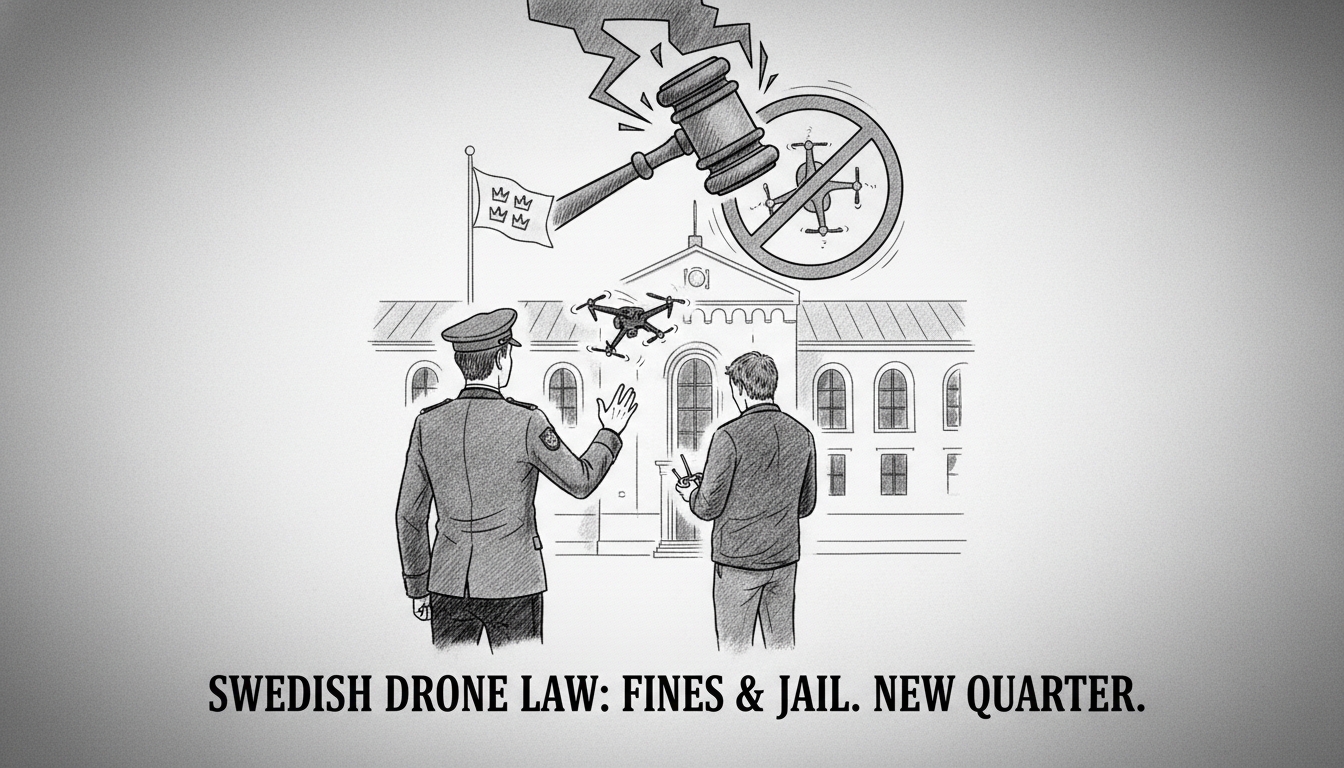
The Swedish government has enacted a significant tightening of penalties for drone offenses, a move approved by the Riksdag to address growing airspace congestion. From the start of the Third Quarter, violations can result in day fines or imprisonment, marking a decisive shift in enforcement strategy. The policy change originates from extensive work within the government offices at Rosenbad, reflecting a broader push for enhanced public safety in Stockholm and across the nation.
Karl-Axel Edén, a flight inspector at the Swedish Transport Agency, stated the reforms aim to increase public security. He explained the rationale stems from a traffic-wise increasingly crowded airspace. More operators necessitate better safety protocols to reduce the proportion of accidents, Edén noted in an official briefing. The official clarified that while intent matters, the new framework establishes clear legal consequences for negligence where previously there were often none.
Currently, operator registration is required for any drone with a camera or sensor, regardless of weight. A specific drone license is mandatory for devices over 250 grams. Until now, practical enforcement was limited. Edén drew an analogy, comparing the old system to jaywalking without causing an accident—no fine was issued. This permissive era ends with the new Riksdag decisions.
Approximately 45,000 drone licenses have been issued in Sweden since their introduction. The Swedish Armed Forces estimated a national fleet of half a million civilian drones recently, many under the 250-gram threshold. This vast, lightly regulated segment is now fully encompassed by the updated penalties. The rules apply to all air traffic, not solely drones, Edén confirmed.
Recent incidents involving drones near protected objects and airports have highlighted regulatory gaps. Officials stress the legislative process began long before these reports, indicating a proactive rather than reactive government policy in Sweden. The bureaucratic process, managed from the government districts in Stockholm, focused on future-proofing regulations.
The legal framework rests on two pillars: operator registration and the drone license. From the effective date, careless conduct in air traffic risks 30 to 150 day fines, set at 50 kronor per day, or up to six months' imprisonment. For gross negligence, the maximum penalty is two years in prison. This represents a substantial escalation in deterrence.
Analysts view this as a necessary step to manage technological proliferation. The Swedish Parliament has consistently adapted transport laws to new realities, from automobile regulations to aviation rules. This update continues that tradition, applying established legal principles to a modern tool. The clear message from Stockholm politics is that Swedish airspace sovereignty and safety are non-negotiable. The government is betting that stricter penalties will compel compliance where guidance alone has failed. The real test will be in consistent application across the country's diverse landscapes.