
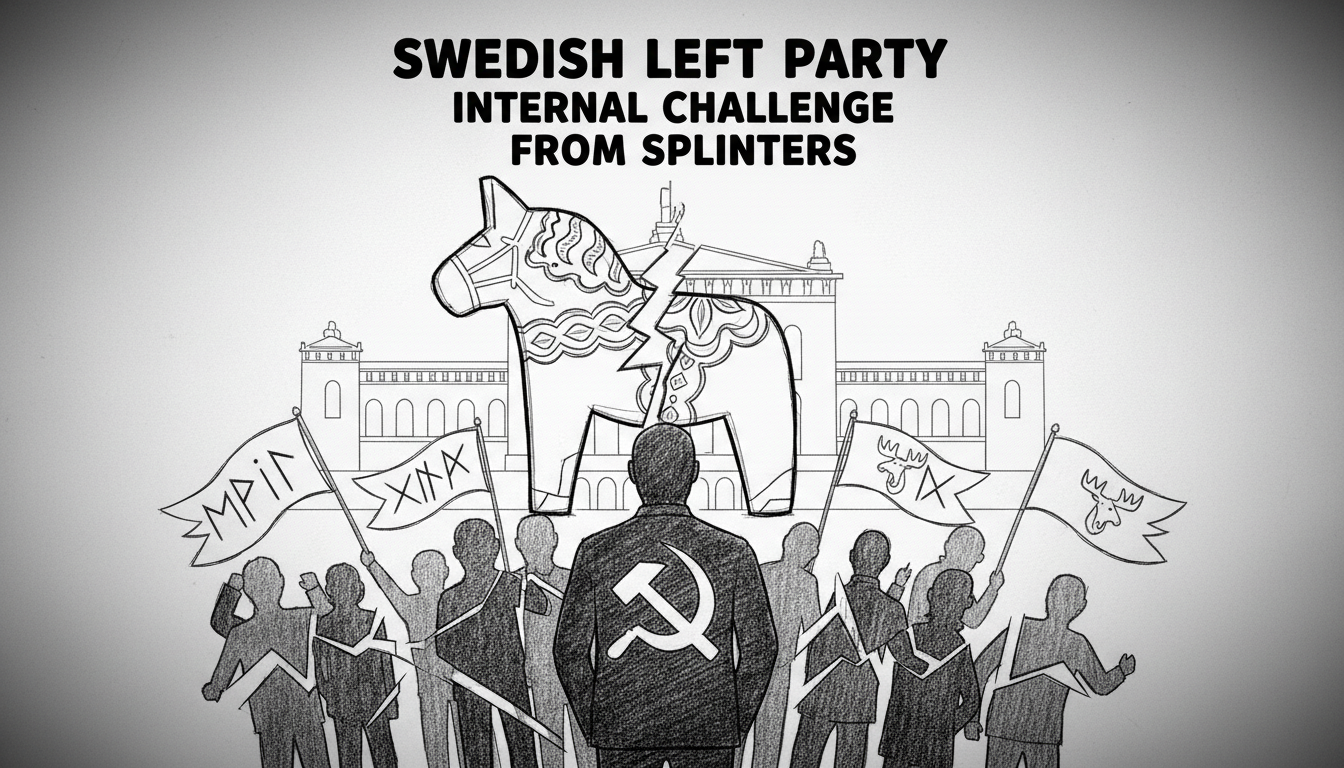
Swedish left-wing politics is experiencing internal tremors as new splinter parties seek to carve out space on the ideological flank. The formation of a local branch in Gothenburg by Framtidens Vänster (Future's Left), a party founded by Left Party defectors, marks the latest challenge to Nooshi Dadgostar’s leadership. Dadgostar, the Left Party leader since 2020, publicly dismisses the threat from these breakaway groups. Her stated indifference belies a more complex struggle for relevance within Sweden's evolving political landscape, where traditional party loyalties are being tested.
This development is not an isolated incident but part of a persistent pattern in Swedish political history. The left-wing spectrum has frequently been a breeding ground for new movements born from ideological dissent or strategic disagreements. The current situation raises critical questions about voter loyalty, policy direction, and the cohesion of the non-socialist left ahead of the next Riksdag election in 2026. The Swedish government's current right-leaning coalition, dependent on the Sweden Democrats, has altered the parliamentary arithmetic, placing new pressures on all opposition parties to define their roles clearly.
Historical Precedents and the Current Fracture
Splinter movements are a recurring feature of Sweden's democratic process. The Green Party's rise in the 1980s and the feminist initiative's various electoral attempts demonstrate how new ideas can crystallize into political entities. The Left Party itself has origins in a split from the Social Democrats. The emergence of Framtidens Vänster follows this tradition, emerging from internal debates over the parent party's direction and strategy. Its founders argue that the Left Party has compromised core principles, particularly regarding NATO membership and economic policy, creating an ideological vacuum they intend to fill.
Nooshi Dadgostar’s leadership has navigated a difficult path since the 2022 election. While the party secured 6.7% of the national vote, maintaining its position as a key parliamentary bloc, its support is geographically concentrated. Strongholds in major urban areas like Stockholm, Malmö, and Gothenburg contrast with weaker performance in rural regions. This concentration makes the party vulnerable to localized challenges, precisely where Framtidens Vänster is now establishing its first municipal association. The Riksdag's political geography means that losing even a small percentage of voters in key cities can impact overall influence.
The Stockholm Perspective and Voter Dynamics
From the government offices in Rosenbad to the parliamentary benches in the Riksdag building, the mainstream political establishment is monitoring these developments. While the direct electoral threat from micro-parties remains statistically small, their symbolic impact can be significant. They can siphon off activist energy, shift media narratives, and force larger parties to address niche issues. For the Left Party, which relies heavily on a motivated base and younger voters, the loss of even a few thousand dedicated supporters to a more radical alternative could affect campaign morale and grassroots organizing.
Political analysts note that the success of any new party in Sweden's proportional system is an uphill battle. The 4% national threshold for Riksdag representation is a formidable barrier. However, at the municipal level, the threshold is lower, allowing for local breakthroughs that can legitimize a party and grant it a platform. Gothenburg, with its history of left-wing activism and a sizable university population, presents a logical testing ground for Framtidens Vänster. Their strategy appears focused on winning city council seats first, building a record, and then attempting a national campaign.
| Party | 2022 General Election Result | Key Voter Base |
|---|---|---|
| Left Party (V) | 6.7% (24 seats) | Urban areas, younger voters, public sector employees |
| Social Democrats (S) | 30.3% (107 seats) | Broad base, union members, older demographics |
| Hypothetical Splinter Impact | Typically 0.1%-1.5% | Disaffected left-wing activists, single-issue voters |
Strategic Calculations and the Road to 2026
Dadgostar's public dismissal of the challenge is a calculated political stance. Acknowledging a threat could grant the splinter group unwarranted credibility. Instead, her focus remains on critiquing the sitting Swedish government's policies and positioning the Left Party as the primary defender of the welfare state. The party's strategy involves sharpening its criticism of the government's tax and welfare reforms while maintaining a clear line against cooperation with the Sweden Democrats, a stance that distinguishes it from other opposition parties.
The coming years will test whether this strategy can consolidate the left-wing vote. Key policy debates around housing, climate action, and inequality offer the Left Party opportunities to mobilize its base. However, if voters perceive the party as insufficiently bold or too integrated into the political establishment, they may seek alternatives. Framtidens Vänster and similar groups will aim to capitalize on any such perceived timidity. They will likely advocate for more aggressive wealth redistribution and a sharper break from NATO-related security policies.
Broader Implications for the Swedish Parliament
The fragmentation of the left-wing vote carries implications beyond a single party. A weakened Left Party could alter the balance in the Riksdag, where its 24 seats are often crucial for blocking right-wing budget proposals or passing motions from the opposition. If support dips close to the 4% threshold, it creates national political instability. Furthermore, the Social Democrats, traditionally the anchor of the Swedish left, may face pressure to shift their own policies to recapture voters drifting further left, potentially affecting their broader electoral coalition.
The bureaucratic process of party registration and ballot access in Sweden is straightforward, encouraging new entrants. The real test comes in building a sustainable organization, developing coherent policies, and securing media attention. For now, the direct electoral impact of Framtidens Vänster on national politics is minimal. Its greater impact may be as a internal critic, holding the Left Party's leadership to account and preventing ideological drift from its core constituency. This internal pressure can sometimes force a larger party to re-energize its platform and reconnect with its base.
In the end, the story of Sweden's left-wing challengers is one of democratic vitality and perpetual debate. The emergence of parties like Framtidens Vänster underscores the dynamic and contested nature of Swedish politics. As the 2026 election approaches, all parties will be gauging the mood of an electorate concerned with economic security, climate change, and national identity. Whether these new voices on the left will fade into obscurity or become a persistent thorn in the side of the establishment depends on their ability to convert discontent into a compelling, and ultimately electable, vision for Sweden's future.