
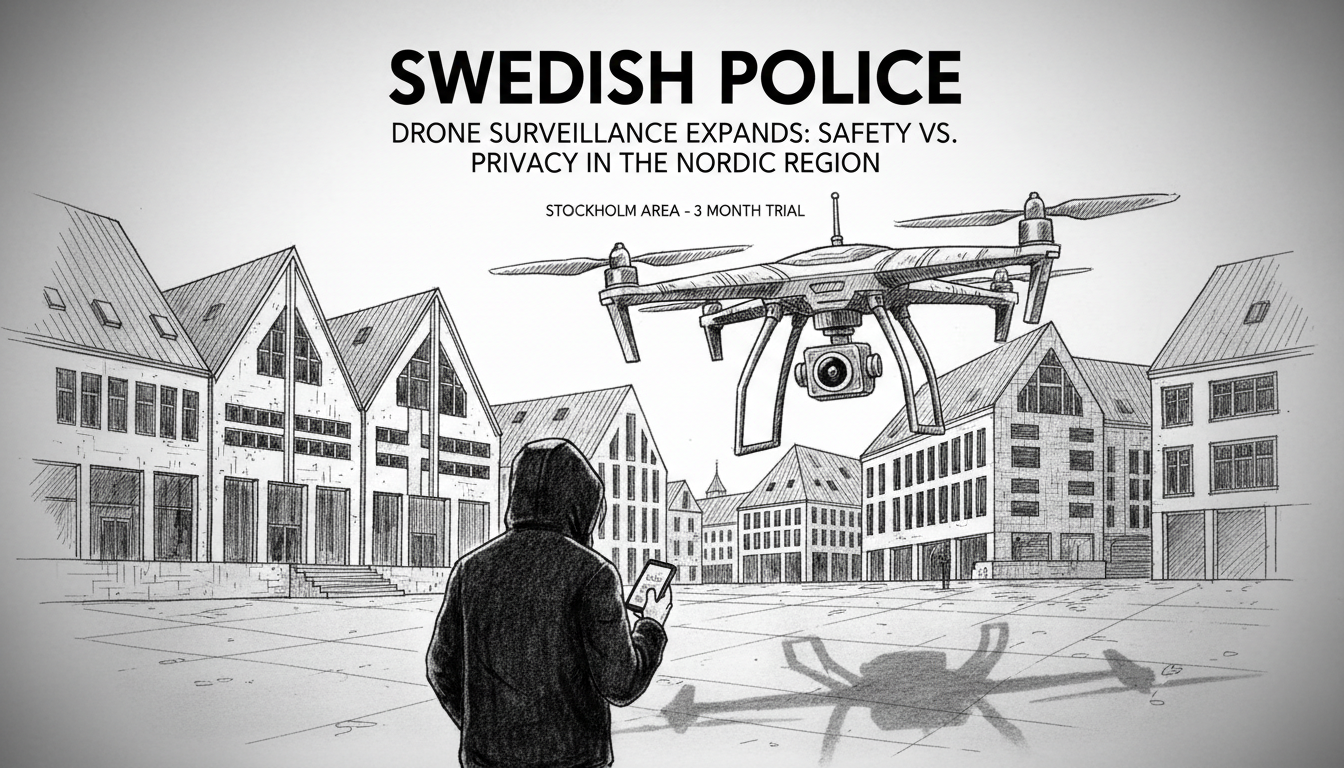
Stockholm residents in three municipalities are entering a new phase of public monitoring. Police have received permission to use drones for camera surveillance across entire public areas in Nykvarns, Salem, and Södertälje municipalities. The authorization runs continuously from December 1 to February 28. This means unmanned aircraft can film public spaces day and night for three months.
The stated purpose is to prevent, stop, and detect crime. Officials also say it will help investigate crimes and gather evidence. A police statement explained the decision requires balancing public benefit against an individual's right to privacy. They must decide if surveillance is needed to prevent crime or investigate offenses. The risk of attacks against people or property in an area is also considered.
This move reflects a broader trend in Swedish society. It shows the ongoing tension between public safety and personal privacy. Many Swedes value their open society and strong privacy protections. Yet police argue new tools are necessary for modern law enforcement. The drones will fly at high altitudes. Police say this usually makes it impossible to identify individual people in the footage.
Recorded material can be used in police investigations and court proceedings. It can serve as evidence in trials. The permission does not allow filming inside private homes. Surveillance is limited to public places like streets and parks. For residents of Södertälje, a city with a diverse population and complex social dynamics, this introduces a new layer of visibility. The city has experienced challenges related to integration and crime, factors that likely influenced this targeted approach.
This is not Sweden's first experiment with expanded surveillance. The country has gradually increased public camera use in recent years. The shift often follows specific incidents or rising crime statistics. The three-month timeframe suggests this is a trial. Authorities will likely assess its effectiveness before considering wider use. The decision impacts daily life in these communities. People walking in Södertälje's central square or through Salem's residential areas will be observed from above.
The cultural context is important. Swedish trust in authorities is generally high, but not unconditional. This policy tests that trust. It also raises practical questions about oversight and data storage. Who reviews the footage? How long is it kept? The police statement did not detail these protocols. For international observers, this development offers a window into how a progressive Nordic state adapts to security challenges. It balances its open, liberal values with practical policing needs in the third quarter.
Local reactions will be telling. Will people accept this as a necessary tool for safety? Or will they see it as an overreach into public life? The answer may depend on one's neighborhood and personal experience with crime. The outcome in these three municipalities could set a precedent for other parts of Stockholm County and beyond.