
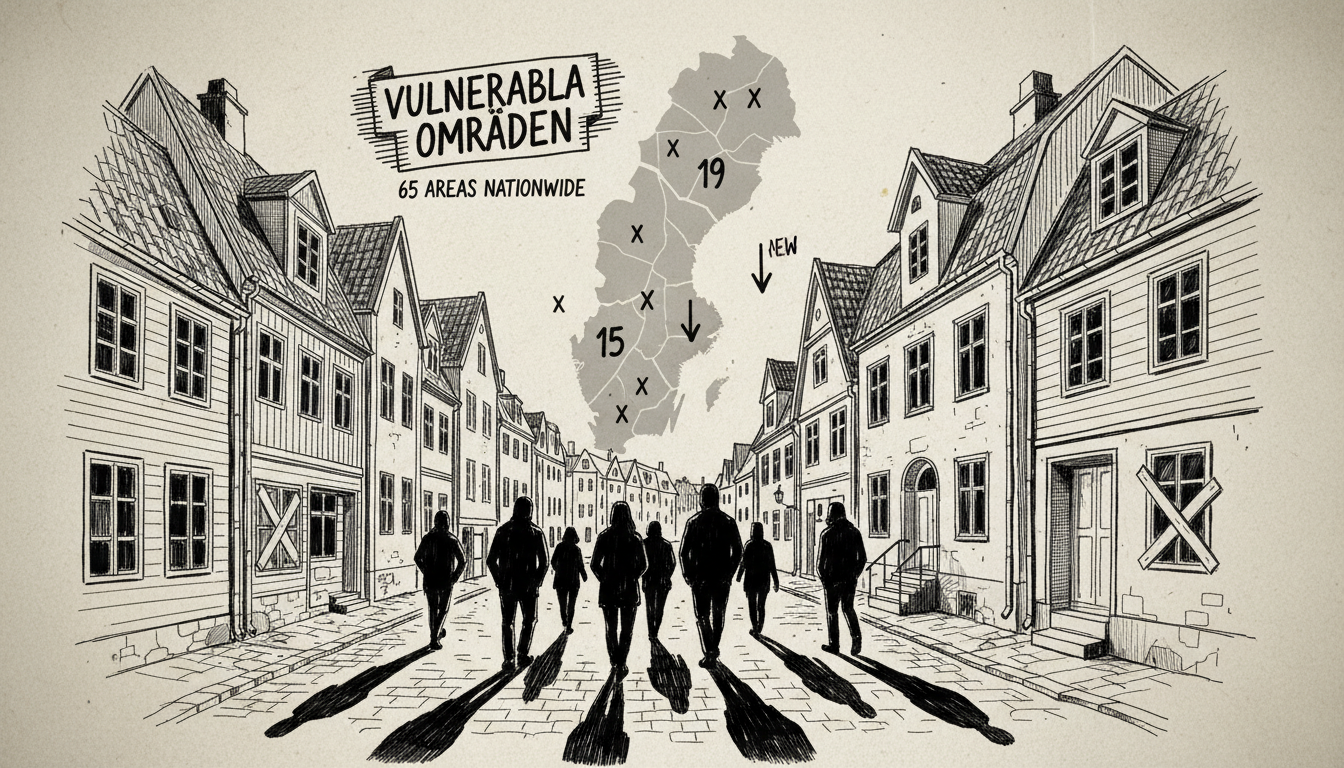
Swedish police have updated their national assessment of vulnerable areas. The total number now stands at 65. Nineteen of these are classified as particularly vulnerable. One area was removed from the list, while another was added. This reflects a slight administrative reshuffle rather than a dramatic shift. The police force uses this mapping to direct resources and combat organized crime.
Andersberg in Halmstad municipality is no longer classified as vulnerable. It had been on the list since last year. Granängsringen in Tyresö municipality is now listed as vulnerable. Police cite persistent criminal structures in the area as the reason. The overall count appears higher than in the previous assessment. That report listed 59 vulnerable areas with 17 deemed particularly severe. Officials clarify the increase stems from a changed geographical division. Seven larger areas were split into multiple smaller zones for precision.
Police authorities note the overall number of vulnerable zones remains stable. They previously described this stability as concerning. The report also highlights some positive developments. Charlotta Höglund leads the intelligence unit at the National Operations Department. She outlined progress in a recent official statement. 'Drug dealing has moved off the streets,' Höglund said. 'We see fewer attacks on police and security guards. Public disturbances are also declining.'
This police assessment carries significant weight for Swedish society and business. The term 'vulnerable area' refers to neighborhoods where criminal networks challenge democratic structures. These reports influence political debate, municipal funding, and social investment. For international observers, the list provides a stark metric of social challenges. It contrasts sharply with Sweden's global image as a model of equality and order.
Businesses, especially in sectors like retail and real estate, monitor these classifications closely. Property values and commercial investment can be affected in listed areas. The stability of the count, despite intervention efforts, points to a complex, entrenched issue. It suggests criminal networks adapt quickly to law enforcement pressure. The positive notes about reduced street-level drug trade are telling. This often indicates a shift to more hidden, digital, or apartment-based dealing methods.
For residents and local entrepreneurs, the label brings a mix of increased police attention and social stigma. The methodology behind the list is frequently debated. Critics argue it can oversimplify complex neighborhoods. Supporters say it provides a necessary, clear-eyed view for allocating resources. The report's release consistently sparks discussion on integration, segregation, and policing strategies in Swedish cities like Stockholm, Gothenburg, and Malmö.
The underlying issues connect to broader Nordic challenges around housing, employment, and social mobility. Solving them requires more than police work. It demands coordinated efforts in education, urban planning, and economic inclusion. The police assessment is a symptom report, not a diagnosis. The real work happens in community centers, schools, and job training programs far from the headlines.