
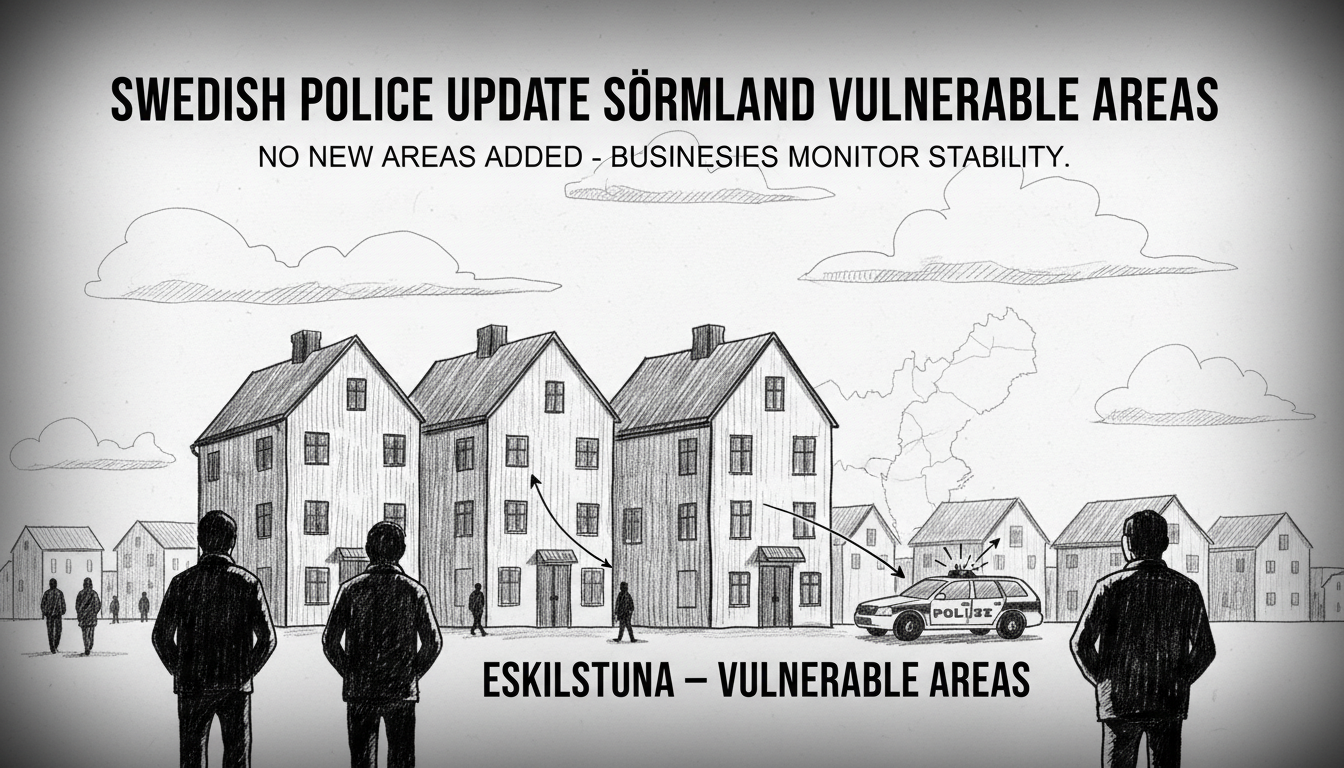
Swedish police have released their latest biannual assessment of vulnerable areas. The report identifies neighborhoods facing challenges with crime, insecurity, and low socioeconomic status. The classification system has three tiers. The most severe category is 'particularly vulnerable'.
In the Sörmland region, no new areas were added to the list this quarter. The three areas of Årby, Fröslunda, and Skiftinge in Eskilstuna remain classified as vulnerable. The area of Lagersberg was removed from the list in a previous assessment. None of the Sörmland areas are classified in the most serious category.
Police officials state the purpose is to provide a clear picture of societal challenges. The mapping helps direct resources and preventive work. Areas can be upgraded, downgraded, or removed based on development trends. This process has been ongoing since 2015.
The 'particularly vulnerable' category indicates areas with deeper systemic issues. Police note these zones have a higher risk of parallel societal structures. Extremism and witness intimidation are also more prevalent there. Maintaining public order is described as especially difficult in those locations.
For the broader Stockholm business ecosystem, these reports are closely monitored. Investors and founders consider public safety and social stability as key factors. A stable social environment is crucial for attracting talent and venture capital. The reports can influence perceptions of different city districts.
Areas like Östermalm and Södermalm are traditional hubs for Swedish startups and fintech firms. They typically score very low on these police vulnerability scales. This stability is a competitive advantage for Stockholm as a Nordic innovation hub. It supports the city's reputation for safety and high quality of life.
The direct business impact in Sörmland is likely minimal for now. The listed areas are residential suburbs, not major commercial centers. However, long-term regional development strategies often address these social factors. A cohesive society is viewed as foundational for sustainable economic growth.
The police methodology relies on both crime statistics and local officers' assessments. It considers factors like drug sales, violence, and trust in public institutions. The report is a tool for municipal and national agencies. It is not intended as a public ranking of neighborhoods.
This consistent, data-driven approach is typical of Swedish public policy. It provides transparency while aiming to depoliticize a sensitive topic. The focus remains on allocating resources where they are most needed. The next assessment is expected in two years.