
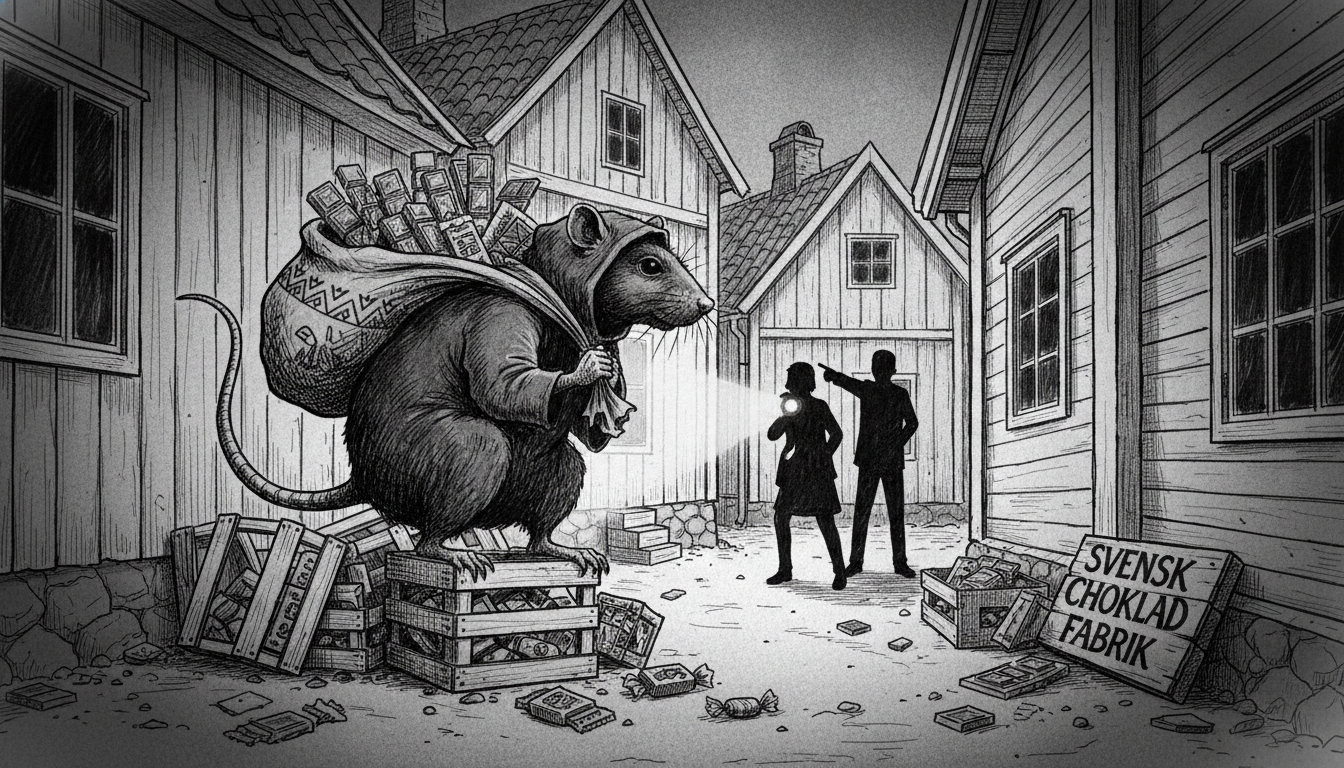
Swedish police responded to a suspected break-in where the only missing loot was chocolate, uncovering a tale of a likely rodent burglar in rural Gävleborg County. This bizarre incident, where a homeowner feared a human intruder only to find evidence pointing to a rat, provides an unusual glimpse into minor police work and the resourcefulness of local wildlife. The case, though never formally filed in the Riksdag's annual crime statistics, highlights the intersection of domestic life and nature in Sweden's quieter regions.
A Suspiciously Sweet Disappearance
The sequence of events began on a Saturday morning in Gävleborg County. A concerned homeowner contacted police, convinced their property had been breached on two consecutive nights. The evidence was peculiar and specific: during the first night, the top layer of chocolates vanished from a box. On the second night, the bottom layer was cleaned out. This systematic plunder suggested a methodical thief to the resident, who grew anxious that someone had obtained a key to their home. Police officers were dispatched to the address to document a report and examine the scene, a standard procedure for any suspected unlawful entry under Swedish law.
The response followed established protocol for minor property concerns, though the nature of the stolen goods was atypical. Police resources in the county, which spans from the Baltic coast to dense inland forests, are allocated for a range of incidents. This call represented the kind of community engagement that forms a significant part of local policing outside major urban centers. The homeowner's worry was genuine, reflecting a universal desire for domestic security.
The Nest Beside the Treasure
During their investigation at the residence, the attending officers made a critical discovery. Positioned near the location of the chocolate box was a rat's nest. This finding immediately shifted the hypothesis from a two-legged burglar to a four-legged suspect. The nest's proximity to the scene of the culinary crime presented a compelling, albeit circumstantial, alternative explanation. Animal behavior experts note that rats are highly opportunistic omnivores with a keen sense of smell. Chocolate, rich in fats and sugars, represents a high-energy prize for rodents, which are known to seek out and hoard such food sources.
While the evidence was not definitive—no rat was caught in the act, and no chocolate was found in the nest—it was sufficiently persuasive for the homeowner. Confronted with this new information, they elected not to proceed with a formal police report. This decision closed the unofficial case, sparing the Swedish legal system from recording one of its more unusual suspected thefts. The incident never became a statistic in the National Council for Crime Prevention's data, but it concluded with a plausible, nature-oriented explanation.
Rodents, Resources, and Rural Life
This episode speaks to broader themes of human-wildlife coexistence in Sweden. Gävleborg County, with its mix of coastal areas, farmland, and forests, provides ample habitat for rodents like the brown rat. Experts point out that as autumn progresses and natural food sources become scarcer, these animals often venture closer to human dwellings. A poorly sealed home or easily accessible food stash can become a prime target. The incident serves as an informal public reminder, beyond any government policy announcement from Rosenbad, to secure foodstuffs and seal home entry points against small invaders.
From a policing perspective, the call was handled appropriately. Officers investigated the complaint seriously before the animal-related clue emerged. A police spokesperson might reflect that while resources are always a consideration, responding to citizen concerns maintains public trust. This aligns with broader Swedish government policy on community safety and preventive work. The outcome—a resolved concern without further bureaucratic steps—can be seen as an efficient use of frontline resources, allowing officers to return to other duties.
The Unwritten Report and Societal Reflections
The homeowner's choice to forgo a formal report is a common endpoint for many minor incidents. It underscores the discretionary space within the Swedish legal system where common sense often prevails. Had they insisted, a report would have been filed, but it would likely have been classified as 'unsolved' or 'explained by other circumstances,' contributing minimally to the understanding of crime in the region. Instead, the story remains a local anecdote, a humorous footnote about the assumptions we make when things go missing.
What does this say about modern life, even in rural Sweden? We are quick to assume human malice before considering simpler, natural explanations. The initial fear was of a human intruder, a violation of personal space and safety. The reality was potentially a small animal acting on instinct. This contrast between perceived threat and probable reality is a microcosm of a wider human tendency. It also reflects Sweden's generally low levels of property crime, where a missing chocolate bar can reasonably be suspected as a break-in, unlike in regions with higher crime rates where more serious signs would be expected.
Beyond the Chocolate Box
While the Stockholm political sphere debates major Riksdag decisions on energy, defense, and immigration, life in Sweden's counties continues with its own rhythm. Incidents like the Gävleborg chocolate mystery rarely reach the corridors of power, but they form the fabric of daily experience. They remind us that not all mysteries involve complex conspiracies or require high-level government policy interventions; some are solved by noticing a nest in the corner.
Furthermore, the story touches on Sweden's relationship with its environment. The country prides itself on its nature and wildlife, but that coexistence has practical, sometimes messy, dimensions. This includes securing garbage in bear country, protecting gardens from elk, and, as in this case, keeping sweets away from nimble rodents. It's a continuous negotiation between domestic order and the untamed natural world just outside the door.
In the end, the case of the pilfered chocolate leaves us with a question: How often do we misinterpret the actions of the natural world as human threats? And in an era of complex global challenges, is there not a slight comfort in a mystery that resolves into something so ordinary? The incident, insignificant to the machinery of state, offers a moment of levity and a lesson in checking the corners for a nest before fearing the worst in human nature. The true culprit may never be known for certain, but the shift in suspicion from a criminal to a creature provides a perfectly plausible, and decidedly Swedish, conclusion to the tale.